The dress had a sewn-in tag that said 2XL, and I was a size 8. I stood in the bridal suite holding it by the shoulders while my sister Mara fixed one earring in the mirror. Outside, seven lavender dresses hung on a rack. Mine looked like it belonged to somebody else’s event.
“It was the only one left,” Mara said, smiling at me in the mirror.
I asked if we could find something else. My mother said the ceremony started in two hours, and I needed to stop making things about myself.
My father, Frank, was sitting by the window with his phone. He didn’t look up. I could’ve left. I should’ve left. Instead, I pulled the dress on and told myself I was being practical.
That’s how I got through a lot with my family. I called it practical when I swallowed something I knew was wrong.
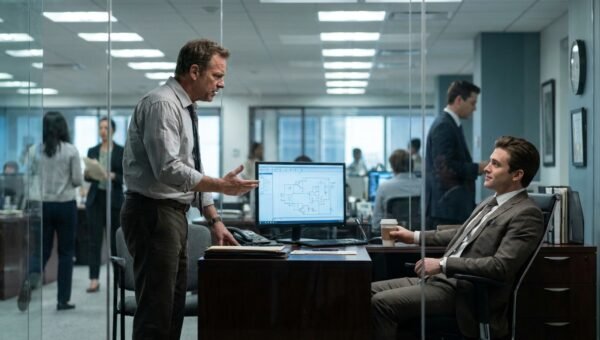
I’m a structural engineer. I run a small firm in Albany, and three months before the wedding, I finished the main design for a commercial complex outside the city. Grant’s family business had commissioned it. The project was worth millions, and the design used a new load system I’d been working on for years. I was proud of it, but I didn’t talk about it much at home. My parents heard “engineering” and changed the subject to Mara’s latest plan.
Mara had always been the one they worried over. I was the one they assumed would manage.
Grant, her fiancé, was supposed to be bringing me into a meeting with his family after the wedding. That was what Mara had told me. I figured it was a chance to talk through the next phase of the project. I didn’t know she and Grant had already decided I wouldn’t be part of that conversation.
At the ceremony, I stood at the end of the line in the orange dress. The sleeves kept sliding down, and the hem dragged enough that I stepped on it twice. People looked at me, then at the lavender gowns, then looked away. I kept my face still and held my bouquet too tightly.
Mara didn’t seem embarrassed. She barely glanced at me. When I tried to stand beside the other bridesmaids for a photo, she moved me to the far end because “the colors looked better that way.” I went where she pointed.
Honestly, I was still telling myself the dress was just a stupid mistake.
The reception started at 4:00. Grant’s relatives and a few people from his family company were there, including Eleanor, his grandmother. She’d founded the company’s architecture division decades earlier, then retired. I knew who she was, but we’d never met.
At 4:18, she walked straight across the room toward me. She took my hand, looked me in the eyes, and said, “You are the engineer, aren’t you?”
For a second I couldn’t answer. I had my blue tablet tucked under my arm, the way I carried it everywhere, and she’d noticed the project files open on the screen.
“Yes,” I said. “I am.”
My mother grabbed my elbow before Eleanor could say more. She pulled me behind a marble column near the service hall. Her fingers dug in hard enough to leave marks.
“Don’t talk to her about the project,” she said.
“What project?”
Mom looked back toward the room. Her voice went low. “Mara and Grant used your plans.”
I asked what that meant. She pressed her lips together, then started talking too fast. Grant had submitted my design under his own name to his family’s review group. Mara had helped him get copies of my files. They planned to present the work as Grant’s and use it to secure a major investment and a partnership with the family company.
My mother knew. She’d known for weeks.
“They said they’d make it right later,” she said. “I thought it would be better if you didn’t make a scene.”
I pulled my arm free. “You thought I should wear this and keep quiet?”
Her eyes flicked to the orange dress. “Mara wanted you away from the investors. She said you’d embarrass Grant if you started talking about the design.”
The dress suddenly made a kind of sense I didn’t want. It wasn’t just ugly. It was big, loud, and impossible to ignore, so everybody would notice the wrong thing before they noticed me.
I told Mom to stay there. She said, “Please, don’t ruin her wedding.”
I walked back into the reception anyway. I wasn’t going to let her call this a family disagreement and tuck it away with everything else.
Eleanor was waiting near the side hall. She asked me to come with her to a small archive room the company kept in the venue’s conference wing. Her assistant had brought over project records earlier that day for a private review. Eleanor said she’d recognized the way I marked the structural calculations on my tablet.
“I’ve seen that pattern before,” she said. “I wanted to be sure.”
The room had a long table and a stack of blueprints. Eleanor opened the top folder and turned it toward me. There were my calculations, including the odd little marks I used to track stress changes across the support grid. I’d made that shorthand years ago because the software kept rounding off values I needed to see.
Then she put Grant’s presentation beside it.
The designs matched. So did the calculation errors I’d corrected in my final file. Grant’s version still had the old numbers.
“He can’t explain the system,” Eleanor said. “I asked him about it last month.”
I looked at the pages and felt my jaw tighten. I knew every line. I knew where the original draft had been rough, where I’d stayed up fixing it, and which notes I’d added on the last night before delivery. This wasn’t inspiration. It was my actual work.
Eleanor said she’d saved the files Grant submitted and the date stamps from the company server. She’d been suspicious when his proposal showed up, because the math was too close to work she’d reviewed earlier. She hadn’t known who had made it until she saw my tablet.
I asked why she hadn’t called me sooner.
“I didn’t know who to trust with it,” she said. “I wanted proof before I accused my grandson.”
Grant wasn’t her grandson by blood, but she’d helped raise him after his mother died. She said it plainly, and I believed her. That didn’t make what he’d done smaller.
We went back to the reception with the files. Eleanor said there were several family executives and project partners in the room. They were there for the wedding, but Grant had also planned to talk with them about the project. So I asked her to let him make his pitch.
I know how that sounds. I could have kept it private and handed everything to lawyers the next day. But I’d already spent too many years watching my family decide what I was allowed to say. I wanted Grant to say it in front of people who could hear the lie.
He was standing beside Mara near the head table when we came up. I put my tablet down and opened the final design file. Eleanor placed the original documents beside it.
Grant’s smile slipped. “What’s this?”
“My work,” I said. “The design you submitted under your name.”
Mara looked at me, then at Mom, who’d come back into the room. “This is not the time.”
“It became the time when you stole my plans.”
One of the company executives leaned closer to the printed pages. Grant started explaining that they’d collaborated on the design. I asked him to explain the load calculations.
He didn’t answer.
“Tell them how the north support transfers the load,” I said.
Grant looked down at the page. “I’d have to check the full model.”
“You submitted it as your work.”
“I handled the business side.”
Mara stepped between us. “We were going to tell you.”
“When?”
She didn’t answer. The room had gone quiet, but I could hear a fork scrape against a plate behind me.
Eleanor told the group the files had been checked against the company records and the dates confirmed. Grant tried to say I’d shared early drafts with Mara, which was true. I had. I’d sent her a few pages because she said she wanted to understand what I was building.
That part was on me. I’d trusted her with work I should’ve kept private.
“But the final files are mine,” I said. “And he can’t explain them because he didn’t make them.”
Grant started to speak, stopped, then looked at Mara. That was enough. He could have denied it cleanly if he’d had a clean story.
My mother stepped forward. Her voice shook. “I knew they were using her work.”
Mara turned on her. “Mom, stop.”
“I knew,” Mom said again. “I thought it would be settled before anyone found out.”
It wasn’t the kind of apology I wanted. It was a fact. A fact that made it harder for any of them to pretend this was a mix-up.
Mara’s face changed when she saw the executives talking quietly with Eleanor. She pulled off her bouquet and dropped it on the table.
“You’ve ruined my wedding,” she said.
I looked at the orange dress, then back at her. “You tried to ruin my career before it started.”
She walked out through the side doors. Grant followed her after a few seconds, leaving the presentation folder on the table. The wedding reception stopped. People drifted into smaller groups, and my parents didn’t come near me.
The formal part took longer. Three weeks later, my attorney filed the ownership records and the original project dates. Eleanor’s company confirmed the designs came from my firm, and Grant’s family withdrew his proposal. The company reassigned the project rights to me under a signed agreement, with new legal protections around my work.
I accepted Eleanor’s offer to partner with her firm on the development. I kept my own company, too. Her contacts helped me bring in two new clients, and I didn’t have to pretend I was grateful to my family for letting me work.
Mara sent one email. It said she hoped I’d “come to my senses.” I didn’t answer. My parents called twice, then stopped after I told them I wouldn’t discuss anything without my lawyer present. Maybe that sounds cold. I was tired of being asked to make their choices easier.
At the venue, before I left, I went back to the bridal suite to get my coat. The orange dress was on the floor where I’d taken it off, twisted inside out. I tucked my blue tablet under my arm and walked out into the evening sun.