For fifteen years, I called Mom’s extra holiday chair stubbornness. I said it often enough that I stopped hearing how mean it sounded.
Owen and I were in the community center office, trying to settle where to hold Mom’s memorial. He wanted the church. I said Mom hadn’t been there in years, and she’d spent every Friday night at the center instead. We were both tired, and I’d already decided I could live with either place.
Then Marcy, the center director, set a brown paper bag on the desk between us.
“She left this with me,” she said. “Told me to give it to you two.”
Owen looked at the bag like there might be another argument inside it. I opened it.
There were two decks of cards, worn soft at the corners, and a folded sheet of paper with Mom’s handwriting on it. The list of names was for the memorial. I knew most of them from the Friday card games.
Then I saw Elise.
Owen’s first wife. The woman we hadn’t seen in fifteen years.
He leaned over my shoulder. “Cross her off.”
I didn’t answer right away. I should say I was always the calm one in our family. I wasn’t. I could be just as stubborn as Owen, and I liked being right more than I liked keeping things peaceful.
“Why?” I asked.
“Because she doesn’t belong there.”
He pointed to the bottom of the page. His finger stopped just above the last item. He didn’t say what was written there.
That was the first time I noticed how carefully Mom had put the list together. It wasn’t a grocery list she’d scribbled out in a hurry. Every name had a small mark beside it, like she’d checked and rechecked who should be there.
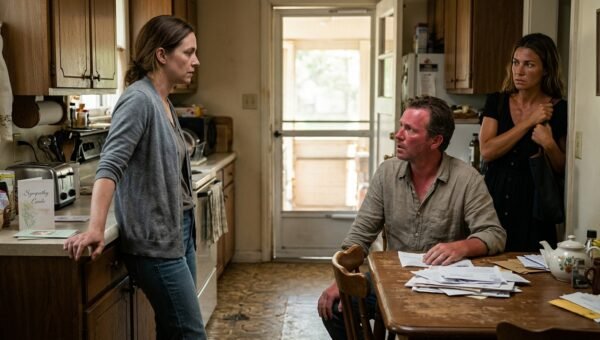
Mom had been gone six days. I had a work schedule in my purse and a stack of condolence cards at home, and I still found myself thinking about the little things she’d left behind. Her reading glasses on the kitchen counter. The jar of peppermints she kept for the Friday players. The chairs.
At Thanksgiving, she always left one chair empty near the end of the table. If I asked, she’d say, “That’s Elise’s place.”
“Elise isn’t coming,” Owen would say.
“Maybe not,” Mom would answer.
That was the whole conversation, usually. I thought Mom was refusing to accept that the marriage was over.
I thought she liked making Owen feel bad. There were years when I found that irritating, and I told her so.
Now we were in the office with the guest list, and Owen wanted Elise’s name gone.
I put the list down. “Read the last line.”
“I saw it.”
“Then read it out loud.”
“Joyce.”
I used the hospital voice I use when somebody is trying to leave before a doctor comes back. “Read it, Owen.”
I worked the front desk at a small hospital near home. I knew how to keep my voice even when a room was getting tense. It doesn’t mean I always use that skill for good. Sometimes I use it to push until people give in.
Owen picked up the page.
The first line at the bottom said, “Elise Voss. Invite her.”
Under that, Mom had written a date: “9/18/09.”
Then a short note: “She took the blame for the forged signature on the family loan. Ray did it. Letter in the seven of hearts.”
Owen read it once. Then again, slower.
“Mom wrote this?”
“Yes.”
“She knew?”
“I don’t know. Not yet.”
He put the page down hard enough to slide it across the desk. “That’s ridiculous.”
The last line had brought us to a stop, but it hadn’t told us how Mom could know. Owen turned toward the door.
“Wait,” I said.
“There’s nothing to wait for.”
“The seven of hearts.”
“We’re not digging through her cards.”
I reached into the bag and pulled out the first deck. My fingers found the cracked edge of the cardboard box. The cards had a faint smell of hand lotion and the lemon cleaner the center used on the tables. I remember that because Mom hated the cleaner and complained every Friday.
Owen stood with his coat still on, staring at the floor.
“Let me look,” I said.
He let out a breath. “Fine. Look.”
I took the cards from the box one at a time. In a hospital, I handle things that people don’t want to look at. Paperwork, belongings, the small plastic bag with someone’s keys in it. There isn’t always a right thing to say. Sometimes there’s just the next thing that needs doing.
The seven of hearts was near the middle. Something thin was tucked behind it.
It was a folded note on lined paper. The fold had worn through at one corner. Mom had written on the outside: “Ray’s letter. Keep with the list.”
Owen reached for it, then stopped. I handed it to him.
“Do you want me to read it?” I asked.
“No.”
He opened it.
The letter was dated February 2024, three months before Mom died. It was signed by Ray Kessler, the accountant who had worked with Owen on his small accounting firm years ago. Ray had died the year before Mom found the letter, after years of being estranged from the family.
Owen’s lips moved over the first few lines. He held the paper close, then farther away. He’d always needed reading glasses and hated admitting it.
“Read it,” I said.
He shook his head.
I wanted to grab the letter. I wanted to get the answer and be done with it. I didn’t. The thing is, I knew what it was like to be handed news before you had room for it.
Owen sat down.
“Ray says he forged Mom’s signature,” he said.
I waited.
“He says Elise knew I didn’t do it. She told them she forged it herself.”
The loan had been $46,281. Mom had agreed to lend money to Owen’s firm, but Ray had changed the paperwork and put Mom’s signature on a second document she hadn’t signed. The forged paper made it look as if Mom had guaranteed more than she agreed to.
Ray’s letter said Owen’s initials were on the file, and there was a risk investigators would think he knew about the extra amount. He was a CPA. A criminal charge could have cost him his license and ended the business he’d built.
Ray wrote that Elise had taken the blame because she believed Owen hadn’t known what Ray was doing. She’d told the family she forged the signature. She never corrected the story, even after Owen called her a liar and ended the marriage.
Owen lowered the letter.
“She told me she did it,” he said.
“She told everybody.”
“I thought she took money from Mom.”
“I know.”
He rubbed his thumb across the edge of the page. “I told her not to call me again.”
I remembered the divorce. Not every detail, just little pieces. Owen standing at Mom’s sink with his tie still on, saying Elise had embarrassed him. Mom asking him to slow down. Me saying, “She made her choice.”
That sentence had come out of my mouth at the time, and I’d never taken it back.
“What did Mom find?” I asked.
Owen read the next part. Ray said he’d hidden copies of the loan papers in a locked drawer after the investigation ended. He’d found the confession letter years later, while clearing out the drawer, and had written to Mom because he couldn’t keep lying about it. Mom had kept the letter and the original papers.
“She knew for months,” Owen said.
“Looks like it.”
“She let me think Elise did it.”
I couldn’t defend Mom. She’d kept the truth from him. Maybe she thought telling him would only reopen the damage. Maybe she worried he’d refuse to believe it. Maybe she wanted to protect Elise’s confidence. I could guess all day, but Mom wasn’t there to answer.
Owen read the letter again. His face had changed, though he was still trying to hold himself together. I could see the effort in his jaw.
“Why didn’t she tell me?” he asked.
“I don’t know.”
“She could’ve told me.”
“Yes.”
I said it plainly. Mom had made a choice, too, and it had cost Owen fifteen years of knowing the truth. I loved her. That didn’t make every decision she made right.
The funeral argument came back to me then. Owen had wanted the church because that was where Dad’s service had been. I had said Mom hadn’t attended in years. What I hadn’t said was that I thought the center was the place she belonged. I’d spent years treating her Friday games as a habit, something she did because the church and the family had both changed.
At the center, she had people who knew how she shuffled cards and how she tapped the table twice when she was deciding whether to stay in a hand. It was a small thing. It was also where she’d built a life after she stopped going to church.
“I don’t know if Elise will come,” I said.
Owen folded the letter carefully along the old crease. “I don’t know if I can call her.”
“You don’t have to ask her to forgive you.”
“I know.”
“You can tell her what you know.”
He stared at the note. I had pushed him to read it, and part of me wished I hadn’t. I also knew it was too late to pretend it didn’t exist.
“I was wrong about her,” he said.
I didn’t fill the silence. It was a sentence he needed to say without help.
After a minute, he took out his phone and walked into the hallway. I stayed in the office with the list and the cards. Through the open door, I heard him try the number he still had saved.
“Elise, it’s Owen.”
A pause.
“It’s been a long time.”
Another pause.
“Mom died. We’re having the gathering at the center.”
He stopped talking. I could hear the faint hum of the copier down the hall.
“She left your name on the list,” he said. “And I found out why.”
He listened for a while.
“I know I have a lot to answer for.”
I could hear the nerves in his voice. It was the same voice he used when Mom was alive and he wanted her to forgive him but couldn’t bring himself to ask.
“I’d like you to come,” he said.
When he came back, he had red eyes and the phone in his hand. He didn’t tell me everything Elise had said. I didn’t ask.
“She’s coming,” he said.
I nodded. That was enough for the moment.
We left her name on the list.
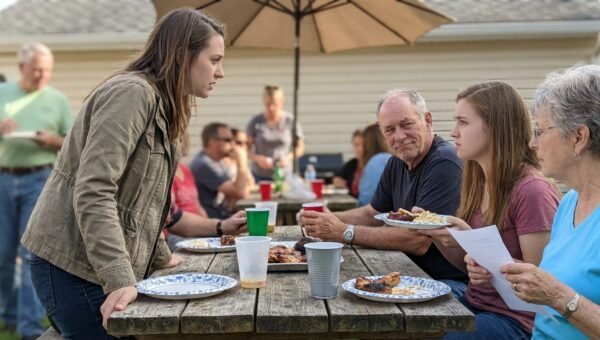
The memorial was the next Friday afternoon. We set out the tables where Mom and her friends played cards. People brought sandwiches, a pan of brownies, and one tin of the hard little mints Mom kept in her purse. Marcy put out paper cups and asked if we wanted the card tables arranged in a square.
“Like she liked them,” I said.
Owen set Mom’s two old decks on the table. He’d brought the note and letter in a plain folder. He didn’t show it to everyone. He didn’t need to. He told the people who asked why Elise was invited that Mom had wanted her there.
Elise arrived a few minutes before we started. I recognized her from old pictures, though her hair was shorter and she’d gotten older, like all of us. Owen went to meet her.
They stood a few feet apart.
“I’m sorry,” he said.
“I know,” she answered.
Then she put her hand on his arm. It wasn’t a big reunion. No speech. They both looked tired.
Mom’s chair had been empty at every holiday for fifteen years. That afternoon, we pulled it up to the card table and Elise sat in it. Owen sat beside her, and the worn deck rested between them.
I kept waiting for the old hurt to disappear. It didn’t. The letter couldn’t give those years back, and Mom’s note couldn’t make her silence harmless.
But when I looked across the table, Elise was holding the seven of hearts, and Owen was listening to her talk about Mom’s Friday games.
The chair wasn’t empty anymore.