I was twisting the lid onto Dad’s old coffee tin when David came in and told me he’d quit his job. The funeral flowers were still on the dining room table. Three days. That was how long it had been since Dad died.
David looked pleased with himself, like he’d handled some annoying chore. He said, “Why keep working? Your inheritance should be plenty for both of us.”
I set the tin down. I didn’t say what I wanted to say, which was that I’d been awake most of the night hearing Dad cough in my memory. Instead, I asked when David had given notice.
“Yesterday,” he said. “They’ll figure it out.”
He’d already figured out what to do with money he didn’t have. I heard him call his mother, Evelyn, from the kitchen. He told her he’d buy her a house. Then he called his sister Chloe and promised her $200,000. I was still wearing the black shoes I’d worn to Dad’s funeral. I could feel the seam rubbing my heel.
I didn’t fight. I didn’t warn them. I smiled a little and let them dream.
There was something David didn’t know. I knew how this ended, though I didn’t yet know all the reasons my father had gone to such trouble to make it end that way.
That afternoon, Arthur Vance, Dad’s estate lawyer, called. His voice sounded careful. He asked if I was alone, then said, “Before we release anything, I need to ask you one question.”
I sat at Dad’s kitchen table. The chair still had a nick on the back from when I was a kid and dropped a casserole dish against it.
“What question?” I said.
“Did David know about the second will?”
I looked toward the living room. David was laughing at something on his phone.
“No,” I said. “He thinks there’s only one.”
Arthur went quiet for a second. Then he asked me to come to his office first thing in the morning. He said not to discuss the call with David yet.
That was easy enough. David was busy making plans.
Before the call, I’d believed the worst part was watching my husband turn my father’s death into a payday. I was wrong. The worst part was recognizing how long I’d been finding excuses for him.
Eight months earlier, David had come out of Dad’s study with a sheet of paper and acted as if he’d found an old family recipe.
He said it was a draft of Dad’s will. It mentioned spousal rights and joint property, and David decided it meant he’d be in charge of the estate.
I asked Dad about it later. He brushed it off and said Arthur was updating some things. I didn’t push. I didn’t want to be the daughter who suspected her husband over paperwork.
David kept asking about Dad’s property after that. How much the house might be worth. Whether Dad had money in other accounts. Once, while Dad was still alive, David asked if I knew what the land would sell for.
I told myself he was just being practical. That’s what I did. I made his behavior sound smaller so I wouldn’t have to deal with it.
The next morning, I went to Arthur’s office alone. The waiting room smelled like lemon cleaner, the kind that leaves a sharp taste in the back of your throat.
Arthur had a thick folder on his desk and a small envelope with my name on it.
He started with the date. Six months before Dad died, Dad had come to see him privately. David had been snooping around the study and asking questions about the estate. Arthur said Dad wasn’t confused or pressured. He was very clear about what he wanted.
Arthur handed me the certified copy of the second will.
It revoked the old draft. The entire estate, including Dad’s home, went into an irrevocable trust for me alone. The trust had strict spendthrift terms. David couldn’t claim the money as a spouse, and neither could his creditors. The trust protected the principal and income as my separate property.
I read the same paragraph twice. Then a third time.
“David gets nothing?” I asked.
“Nothing,” Arthur said. “Your father named him only to make that clear.”
I wanted to feel relief. Mostly, I felt embarrassed that Dad had seen something I kept refusing to see.
Arthur opened another folder. It held Dad’s notes about David’s questions and copies of bank records showing attempts to move funds around. David had tried to get details about Dad’s accounts without asking me. He’d also made a few calls to the bank, presenting himself as someone who needed information for family planning.
Nothing had been transferred. Nothing had gone missing. Dad had caught it early.
Arthur said the trust had a further safeguard. If David tried to claim a spouse’s share or gave up his job expecting the inheritance, the trustee could release evidence of those earlier attempts. Dad had written that the protection was meant to keep me from being pressured after he was gone.
That was why Arthur had asked whether David knew. He needed to know if David had already made a claim or pushed me to sign anything.
I said he’d quit his job the day before.
Arthur took off his glasses. “Your father anticipated that possibility.”
I opened the little envelope. Dad’s handwriting was shaky in one place, neat in another. He wrote that he loved me and hated having to put this in writing. He said he’d watched David treat my patience like permission. He didn’t want money to become one more thing I had to defend in my own home.
The letter ended with, “You don’t owe anyone a share of what I left you.”
I read that line with my thumb pressed to the paper. I could feel the fold in it.
Arthur explained the acceptance forms and the next steps. I signed the trust documents. My hand didn’t shake, though my coffee had gone cold by then. I asked for a copy of everything.
I didn’t ask Arthur to soften the terms. I didn’t ask if there was some way to give David a little money and avoid a fight. That thought came up, because I was still used to being the person who made things easier for him.
I let it go.
That evening, David spread house listings across the kitchen table. Evelyn and Chloe were there. They’d brought takeout, and Chloe was scrolling through houses on her phone while David pointed out places with a yard.
Evelyn wanted a one-story house. Chloe had already worked out how she’d use the $200,000. I sat down with them because walking away would have started questions I wasn’t ready to answer.
David tapped the table. “We’ll have this settled soon.”
“Did Arthur call?” I asked.
“He’s calling tomorrow,” David said. “We’ll go in and get the paperwork started.”
I looked at him. “You already gave notice.”
He shrugged. “It’s done.”
Evelyn said she’d found a place she liked. Chloe laughed and asked if she could start looking at cars too. I ate half a piece of cold chicken and kept my mouth shut.
I wasn’t proud of that. I was watching them spend Dad’s money, and part of me wanted to see how far David would take it before he remembered Dad was a person, not a bank account. That wasn’t kind. It was just honest.
The next morning, David showed up at Arthur’s office with Evelyn and Chloe. He hadn’t told me they were coming. He said they wanted to be there when the disbursement was discussed.
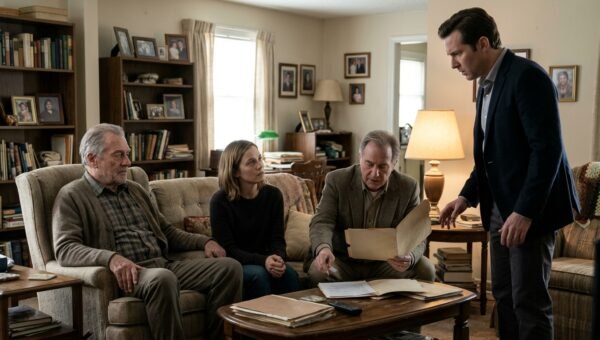
Arthur didn’t argue with them. He let everyone sit down, then placed the second will on the table. David leaned forward, already reaching for the folder.
Arthur read the revocation first. He said the old draft had been legally canceled six months earlier. David said he’d seen the paper in Dad’s study and thought it was the final version.
“It wasn’t,” Arthur said.
David’s hand stayed on the table. “That’s not what it said.”
Arthur slid the signed revocation toward him. The old draft was there too, marked as revoked. David stared at the signature and the date. He’d believed that old paper made him co-executor or gave him a share through spousal rights. It did neither. It had never become the final will.
Then Arthur read the trust terms aloud. Everything went to me, held in an irrevocable trust with protections against claims by a spouse or creditors. David was named only in the section stating he received no bequest.
Evelyn asked if there was some mistake. Chloe asked where the money was supposed to come from, then turned to David.
“You said it was handled,” she said.
David’s face changed. He pointed at the old draft and said Arthur was making this too complicated. He said I could fix it. I could write checks to his family. He said we were married, so the money was ours.
I’d heard him say that before. I’d believed it before, too, because arguing with him over small things took more energy than I had. This wasn’t small.
“No,” I said. “I’m honoring my father’s wishes.”
David looked at me like I’d handed him an insult. “You’re really going to do this?”
“I already did.”
His mother started asking about the house he’d promised. Chloe wanted to know how he could have told her the money was certain. They turned on him, each asking the same thing in a different voice. The house. The $200,000. The job he’d quit.
He had no answer that helped him.
Arthur remained calm. He explained that the estate stayed under the trust and that David had no legal claim to it. The records about David’s past inquiries were there if he tried to challenge the will or pressure me to give up the protections.
David didn’t challenge it. He couldn’t.
I walked out of the office before the arguing was over. I could hear Chloe say, “You promised me.” Then Evelyn said something I couldn’t make out. I didn’t turn around.
I hired Arthur to start the divorce. I also served David with a formal notice to leave Dad’s house. He still had time to arrange a place, but I wasn’t going to pretend we were working things out while he stayed there.
He packed his clothes and a few boxes over the next several days. He had to move into Evelyn’s cramped apartment. His old employer wouldn’t take back his resignation. That part wasn’t something I could fix for him, even if I’d wanted to.
I didn’t want to.
The marriage hadn’t ended at Arthur’s office. It had ended when David heard my father had died and started handing out the money before the flowers were cleared away. The office was only where I stopped pretending I could make that mean something else.
I still miss Dad in ordinary ways. I reach for my phone when something breaks, then remember. I keep his old coffee tin on the counter, though I don’t store coffee in it anymore. Some mornings, I take his favorite ceramic mug out to the back porch and sit there while the sun comes up over the house he left me.
The trust is still in place. David can’t touch it. Neither can his family.
I drink my coffee slowly from Dad’s mug, and the house stays quiet.