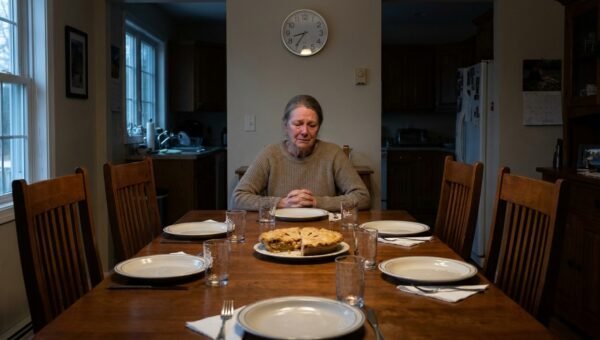
“Same as always. Don’t worry your head.”
Odis said it over supper, and I passed him the potatoes. I smiled, too. The property tax notice was folded beside my plate, the kind of certified letter you can feel through the envelope before you open it. It said our escrow was short. The land was in my name, so the county had sent it to me.
I didn’t ask Odis what he knew. Not then.
The day before, I’d called the bank from our kitchen and asked about the balance.
I’d expected the woman on the phone to say there was a mistake. Instead, she told me our retirement account held $9,000. I asked her to say it again. She did.
It had held $214,000.
I put both hands flat on the linoleum and stayed there until the room stopped tilting. I don’t know why I remember the little crumb stuck to my thumb. Maybe because I kept rubbing it while the woman explained she couldn’t discuss every transaction over the phone. She said I could come in and speak with the branch manager.
So I called Odis into the kitchen. He was washing his hands for supper. He looked at the notice, then at me, and made that remark like he was telling me the weather.
We’d been married forty-one years. I knew how he could make a hard thing sound small. Usually, I let him. That night, I passed the potatoes and let him think I’d accepted the answer.
I barely slept. At 7:30 the next morning, I left while he was still in bed.
The road to the bank runs past old mine land and two houses that have been empty longer than I can remember. I’ve driven it thousands of times. That morning, every mile brought back some small thing I’d let go without asking about. A check Odis said he’d handled. A call from his brother Vance that ended when I walked into the room. A few months of Odis saying we should “leave the money alone” until things settled down.
I’d called it peace. It was easier than admitting I didn’t know what was happening with our own money.
Evelyn Cruz was the branch manager. She took me into her office and shut the door. I sat down with my purse in my lap, though I didn’t need to hold it. She asked if I wanted water. I said no, then changed my mind.
“I’m going to show you what I can,” she said. “Some of this may take a minute.”
The account screen looked ordinary. That was almost worse. There were numbers and dates, no warning in red. Evelyn pulled the transaction ledger and printed the records. Five pages came out, one after another, with the printer making a little clicking sound each time.
Four cashier’s wires had gone out beginning in late May. The recipient on each was Catawba Ridge Holdings LLC.
I read the name twice. I’d never heard it.
Evelyn explained that Odis had made the withdrawals. The paperwork showed where the money went, but it didn’t explain why. There were four wires, with amounts that added up to $205,000. What remained in the account was the $9,000 I’d heard about over the phone.
I pressed my finger on the first date. “Could there be another account?”
“Not under this profile,” she said. “I can help you look at the records we have.”
I wanted to ask how she could say that so calmly. But she was being careful with me, not cold. I thanked her. I actually thanked her, which embarrassed me later.
I asked her to print every record she could. Then I went to the library by the county clerk’s office. The public computer took a while to load the state business registry, and I had to ask a young man where the search button was. I’m not good at pretending I know things I don’t.
Catawba Ridge Holdings was registered to Vance alone. The address was his. Odis was listed as an unsecured guarantor.
That word stayed with me. Unsecured. Odis had put our money into his brother’s company and signed himself up as a guarantor, but there was nothing listed that protected us if the business failed.
I printed the page and put it with Evelyn’s records. The printer paper was warm when it came out. I remember that because my hands were cold, though the library was not.
Before I went home, I went back to Evelyn. I opened a new account in my name only and had my pension redirected there. We moved the remaining $9,000 into it, except for $3,840 that went toward the escrow shortfall. I also asked Evelyn to flag our joint line of credit and remove Odis’s automatic transfer permissions.
She didn’t tell me it would be easy. She explained what needed signatures and what could be changed right away. I signed where she marked the forms. My hand shook once, and I went back over the last letter in my name because it looked like a different person had written it.
I knew Odis would notice when his card didn’t work the same way. I knew it would start a fight. But by then I understood that doing nothing was also a choice. I’d been making that choice for years.
When I got home, his truck was in the drive. He was out back, so I walked to the cab and opened it. I don’t know if I’d seen the locked metal toolbox before. I must have. Odis kept gloves and work papers in there, and I’d never had a reason to look.
The key was on his ring, hanging by the back door. I told myself I was looking for the truck registration. That was not true.
Inside the toolbox were folders with Vance’s name on them. I found handwritten promises to repay Odis, dated receipts for the wires, and three property tax warnings addressed to me. Odis had kept them folded together beneath the folders.
I sat in the truck and read every page.
The notes said Vance was going to repay the money after a property closing. Odis had written that the subdivision deal would turn around. One note said the closing should happen before year-end. Another said Vance needed more time.
The tax warnings were older than the notice I’d received. One had a crease down the middle, as if Odis had carried it in his pocket. He hadn’t only kept the money secret. He’d hidden the signs that the land was in danger.
I put the papers back in the folders, then changed my mind and took them inside. That was the first time I felt truly angry. Not because he’d tried to help Vance. I knew Odis loved his brother. It was because he had decided I was not allowed to know what was happening to my own home.
At supper the night before, I’d passed him the potatoes. I’d smiled so he wouldn’t guess I was going to the bank.
The next evening, I set the papers on the same kitchen table. I laid out Evelyn’s records, the county registry page, the tax warning, and the new bank forms. The supper table runner was still there. I had to move the salt shaker to make room.
Odis came in from the garage and stopped when he saw the papers.
“What’s all this?”
I pushed the wire receipts toward him. “Tell me why our money went to Vance’s company.”
He sat down slowly. He looked at the papers, not at me.
“It was a loan,” he said.
“It was our retirement.”
“He’s going to pay it back.”
“When?”
He rubbed his forehead. “The property closing was supposed to happen before year-end.”
“Supposed to.”
He looked up then. “You don’t understand how these things work.”
I put the tax warning in front of him. “I understand this bill came to me. I understand you hid three notices.”
His mouth opened, then shut. He reached for the warning, but I held one hand on it.
“I was trying to keep you from worrying,” he said.
“No. You were trying to decide for me.”
He looked tired. Not like a man caught in some grand scheme. Like a man who’d made one bad choice for his brother, then another to cover it, and had kept going because turning around meant admitting what he’d done.
“Vance was in trouble,” he said. “I thought I could help him, then get it back.”
“You sent $205,000.”
“He needed the money to keep the deal alive.”
“And what did you think would happen if it didn’t work?”
He didn’t answer right away. Then he said, “I thought it would.”
That was the truth, I think. He’d believed in Vance, in the land, in the promise that this would all be made right. He’d also believed that I would accept whatever he told me because I had for forty-one years.
I slid the bank forms across the table. “I’ve moved my pension. The $9,000 is in my account. The line of credit is flagged.”
His eyes went to the papers. “You did what?”
“I did what I had to do.”
“You can’t just take over everything.”
“I can take my money out of your hands.”
He stood up, then sat again. I wasn’t proud of how much I wanted him to feel cornered. But I did. I wanted one hour of what it had felt like for me to find out our savings were gone.
“You’re making this worse,” he said.
“It’s already worse.”
I told him we were going to meet with an attorney. Vance would sign a formal deed of trust and second mortgage against his land and excavation equipment. The lien would be recorded, with a repayment schedule to my trust. Not another note in Odis’s handwriting. Not another promise over the phone.
“Vance has to sign by five,” I said. “If he doesn’t, I’m taking these records to the sheriff’s office and filing a fraud complaint.”
Odis stared at me. “You’d do that to your own family?”
“I’m doing it to protect my home.”
He said I was taking this too far. I said he’d already taken it too far when he put our retirement into a failing deal without asking me.
At the attorney’s office, Odis barely spoke. Vance arrived late, smelling of diesel, and sat across from me. He looked at the papers longer than he looked at my face.
“I can’t pay it all today,” he said.
“I know,” I said. “That’s why we’re here.”
The attorney explained the terms and what the lien covered. Vance asked if this was really necessary. I said yes. Odis did not tell me to calm down. He did not say I was worrying my head.
Vance signed before five. The attorney arranged to record the lien against the property and equipment, and the repayment schedule would run over several years. The money wasn’t suddenly back. I knew that. But now there was something enforceable behind the debt, instead of Odis’s hope that his brother would do right by us.
We used part of the remaining savings to make the escrow whole. The homestead stayed out of foreclosure. I kept my account separate, and Odis no longer had authority over my pension, the bank mail, or the household titles.
The marriage didn’t end that week. It changed. Odis still slept in our bed. We still ate at the same table. But he stopped reaching for the checkbook, and he stopped answering financial questions for both of us.
I bought a blue ledger book that afternoon. I started writing down every amount, even small ones, because I wanted the record to be mine. I keep it locked in my desk when I’m not using it. Odis gets a weekly allowance envelope now. I don’t say that to punish him. I say it because it’s true.
The first page is neat. My writing gets less neat after that. The blue ledger sits on the kitchen table beside the salt shaker, open to page one, and Odis sits across from me waiting for his envelope.