The last ordinary thing Toby said before the school called was that he wanted the apple slices in a separate bag. He was seven, and he liked to keep the apple from touching his sandwich. By the time I learned why, my boy had been handing away every lunch I packed for five months.
I made turkey sandwiches, apple slices, and a juice box each morning. Forty-five dollars a week, give or take.
Toby would come home hungry, but he told me he’d eaten the crackers the school gave out. I didn’t press him. I thought he was going through a picky stage.
Then Mrs. Gable, the lunch lady, called me.
“Mrs. Anderson, your boy gives his entire lunch to the same girl every day. She never brings food.”
I was standing at the sink with a dish towel in my hand. “Who?”
“Lily. Same clothes every week. Same bruise on her wrist.”
I asked my manager to cover me and drove to the school. I remember the wet rubber smell in the hallway from all the kids’ shoes. Mrs. Gable brought me to a bench near the cafeteria. Toby and Lily were sitting there, their knees almost touching.
Lily was small for seven. Her sleeves went past her wrists, though the room was warm. Toby had his lunch bag folded flat in his lap.
I knelt beside them. “Toby, why didn’t you tell me?”
He looked at Lily first. She kept her eyes down.
“Mom, she told me her dad locks the fridge.”
That was all he said at first. I had to ask what he meant, and even then I could tell Toby was worried he’d broken a promise. Lily had asked him not to tell. Her father said the authorities would take her away to somewhere worse if anyone found out.
“I’m sorry,” Toby whispered.
I put my hand on his shoulder. “You don’t have to be sorry.”
The school office let Lily sit in a quiet room while I called child services from the parking lot. I didn’t wait for another meeting or a call back the next day. I told the person who answered that a child said her father locked food away, that she had a bruise, and that my son had given her his lunch every school day for five months.
The call took less than ten minutes. Waiting felt longer. Toby sat in the back seat with his coat zipped up to his chin. I kept looking at the school doors.
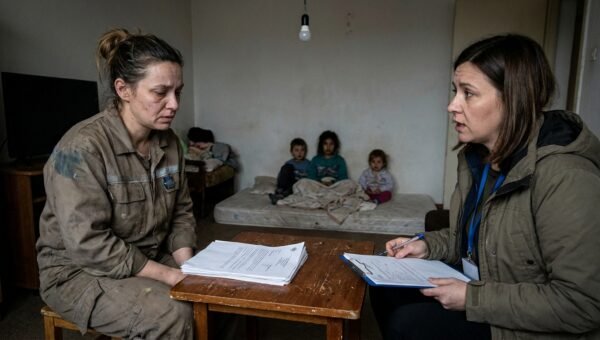
Caseworker Miller arrived about forty minutes later with Officer Reynolds. Miller spoke softly to Lily and asked questions without rushing her. Reynolds asked me what Toby had heard and when. I had very little. That bothered me. I wanted to hand over a neat list, but all I had was five months of empty lunch bags and a seven-year-old’s words.
“Can you come with us?” I asked.
“We’ll go to the home,” Miller said. “You can follow.”
I left Toby at school with Mrs. Gable, who promised she would stay beside him. I hated leaving him there, but bringing him into the house didn’t feel right either. Before I drove away, he leaned through the open office door.
“Is Lily coming back?”
“I’m going to do everything I can,” I said.
The Vance house sat on a quiet street with trimmed shrubs and a clean driveway.
Marcus Vance opened the door before Miller could knock a second time. He wore a button-down shirt and smiled like we’d arrived to discuss a fence.
“Is something wrong?” he asked.
Miller explained that she needed to check on Lily after a report about food and a bruise. Marcus nodded, still smiling.
“She’s fine. Kids make things up.”
I looked at Lily. She stood behind him in the hall with both sleeves pulled over her hands. She didn’t come toward me, but she didn’t turn away either.
Marcus said she’d eaten breakfast. He said she was dramatic since her mother died a year earlier. Then he said people had been putting ideas in her head. He said it calmly. That was the part that made my jaw hurt from holding it still.
Miller asked if we could speak with Lily alone. Marcus agreed, but stayed close enough to hear. So Miller asked him to step into the living room with Officer Reynolds.
“I don’t want a scene,” Marcus said.
“Then let us do the check,” Miller replied.
I stayed near the hall. I wasn’t a caseworker or a cop, and I knew I couldn’t make the rules. But I could see Lily’s hands shaking at the ends of her sleeves, and I wasn’t going to leave her alone with a man who had just told us she made things up.
Officer Reynolds noticed the bedroom door. There was a heavy brass deadbolt and a hasp on the outside. Not a lock meant to keep a child out of a hallway. A lock meant to keep a child in a room.
“Why is there a lock on the outside?” Reynolds asked.
Marcus’s smile slipped. “Privacy. She gets up at night.”
Miller asked for the key. Marcus said he didn’t know where it was. He checked a bowl by the front door, then his pockets, then a drawer in the kitchen. He had the key. He just didn’t want to use it.
Lily made a small sound behind me. It might have been a whimper. I turned and put myself between her and Marcus.
“Open it,” Reynolds said.
Marcus looked at me. “This is my house.”
“And that’s a child behind that door,” I said.
Reynolds told him they would force entry if he didn’t open it. Marcus’s face changed. The pleasant neighbor was gone. He dug in his pocket and pulled out a key.
I still hear the small metal scrape as he worked the lock.
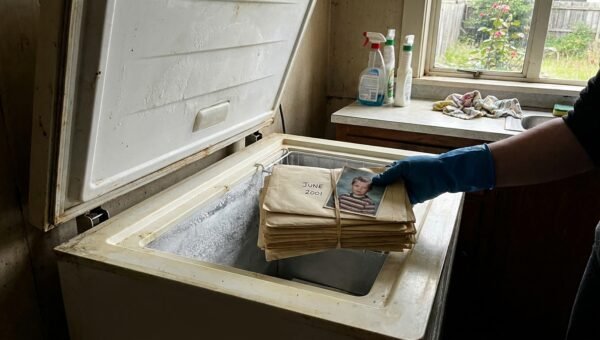
The room beyond was almost empty. A cot sat against the wall without sheets. A camera pointed at the bed from above the doorway. In one corner was a little fridge, chained shut and padlocked. There was spoiled milk inside, along with rotten produce. No toys. No warm clothes. No books.
Miller stepped into the room and looked at the fridge. Reynolds stayed close to Marcus.
“What is this?” I asked.
Marcus started talking fast. He said Lily had been difficult, that food went missing, that he had to keep order after his wife died. He said he couldn’t afford to replace things she wasted.
I thought of the $45 a week. I thought of Toby dividing his own lunch into Lily’s hands while I asked him if he was still hungry at dinner.
Miller asked if Lily had tried to get food from the kitchen. Lily nodded once.
“He pulled me,” she said.
Marcus snapped, “Don’t.”
That was enough for Reynolds. He moved Marcus away from the hallway and told him to turn around. Marcus said he was being treated like a criminal. Reynolds put cuffs on him anyway.
I had written down dates for the school lunches because Mrs. Gable asked when the pattern started. I had the note in my purse. I handed it to Miller, along with the school’s statement. I didn’t have proof of the locked fridge, but there it was, chained in plain sight.
Marcus looked over his shoulder at me. “You don’t know anything about my family.”
“No,” I said. “But I know what my son saw.”
They took Lily for a medical check. I went with her. At the hospital, a nurse cut the sleeve of her shirt back just far enough to examine her wrist. The marks were old and new. The doctor asked if someone had grabbed her there.
“Dad grabs me when I try the pantry,” Lily said.
The room went quiet. Not in a movie way. The nurse stopped writing for a second, then started again.
They checked Lily for malnutrition and dehydration. I sat beside her and kept my hand where she could reach it. She held two of my fingers. I didn’t ask her to tell me the whole story. She’d already said enough for one night.
Toby came with my sister after the exam. He had been wearing his coat at school because he’d given Lily his spare one when she said she was cold. I found that out only after Mrs. Gable told me. Toby didn’t bring it up himself.
He stood at the hospital door, looking at Lily. “I’m sorry I didn’t tell sooner.”
Lily shook her head. “You fed me.”
Toby’s mouth tightened. He was trying not to cry, and I wished I could take that whole day off his shoulders. I couldn’t. I could only sit with both kids until the caseworker came back.
Marcus was arrested for felony child endangerment and unlawful restraint. The police got a search warrant. In a closet, investigators found pantry padlocks, winter clothes Lily had never worn, and benefit checks meant for Lily’s care. They also found medical records that showed untreated weight and wrist injuries. The records said she’d been pulled away from the kitchen hard enough to sprain her wrist.
He’d kept the checks. He’d kept the clothes. He’d kept her from the food.
I was angry at him, obviously. I was also angry at myself for how easily a clean lawn and a pleasant smile had passed for proof that things were fine. I’d seen Marcus at school events. I’d thought he was a quiet man having a hard year. I can say now that I should have noticed more, but I didn’t know Lily well enough to see what was missing. Toby did.
The first few days were paperwork and phone calls. Lily was placed in protective care while Miller looked for family. I told Miller I could take Lily temporarily if that helped, but I wasn’t going to pretend a kind offer was the same as a plan. Lily needed someone who could keep her safe for good.
I started with the little I knew about her mother’s family. Marcus had told people they were gone, but that didn’t sit right with me. With Miller’s help, I found Clara Jenkins, Lily’s maternal aunt. Clara had been cut off after Lily’s mother died. Marcus had told her Lily didn’t want contact and that he needed space.
Clara called me back that night.
“I thought she didn’t want me,” she said.
“I’m sorry,” I told her. “She didn’t get to decide.”
Clara came to meet Lily with a folder of family pictures and a soft blue sweater. She didn’t make a big speech. She sat beside Lily and showed her a photo of Lily’s mother holding a birthday cake. Lily touched the picture with one finger.
“I remember this,” she said.
Clara cried quietly. I was glad Lily didn’t have to comfort her. The caseworker checked Clara’s home and talked through the emergency plan. Two weeks later, Clara was granted legal guardianship while the case moved ahead. Marcus’s parental rights were suspended, and a criminal protective order kept him away.
Toby didn’t get praised in some big school assembly. I was relieved. He didn’t need to be made into a mascot. I told him he did a kind thing, and that grown-ups still had to be the ones to keep a child safe.
“I just didn’t want her to be hungry,” he said.
“I know,” I told him.
Three weeks after the call from Mrs. Gable, Clara brought Lily over before school. Lily had been to the doctor again and was eating small meals as advised. She was still quiet. She still pulled her sleeves down when someone new came near. But she came in the front door without asking if it was okay to sit.
I put two lunch bags on the kitchen island. Same kind of brown paper bags. Turkey sandwiches. Apple slices. Two juice boxes each, because Toby said one was for lunch and one was “just in case.”
I used to think packing lunch was the most ordinary thing I did all day. Now I check the bags twice, and I don’t mind the extra work. Toby and Lily walked down the sunlit driveway together toward the bus stop, carrying one bag each.