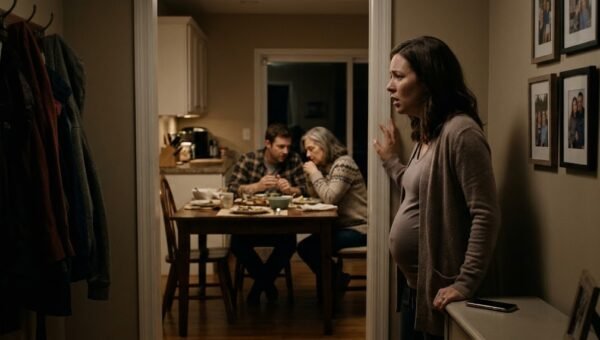
The green folder was in the wrong place.
I noticed it on the kitchen counter while Greg sat on the sofa asking me to make him breakfast. I’d kept that folder in the drawer by the phone, where I put receipts I might need later. The corner was sticking out under a grocery circular. I almost moved it back. Then Claire came in and told me I had a choice.
“Serve my husband or leave my house.”
She said it without yelling. That was almost worse. Greg didn’t look up from the television. I could see his socked feet on the coffee table, and my daughter stood between us with her arms crossed, waiting for me to make this easy for her.
I smiled. Not because I was happy. I had spent a long time learning that my temper didn’t make people hear me better.
“Fine,” I said.
Claire blinked. Greg finally looked over. I went to the small room I’d been using, took my worn suitcase from under the bed, and started folding my clothes. I didn’t slam a drawer. I didn’t remind them about the grocery bags I’d carried in the day before, or the mortgage payment I’d made that morning. I didn’t say a word about the bills in that green folder.
I left without raising my voice.
For a long time, I believed quiet was the same as being kind. I’m not sure I believe that now.
My wife, Diane, died eighteen months before I moved in with Claire and Greg. We’d been married forty-one years. After she was gone, the house felt too big, and the little things got hard. I’d put on the coffee and still reach for her cup. I sold the house because I couldn’t keep up with it on my pension alone.
Claire said I could stay with her while I figured things out.
“Dad, it’s family,” she told me.
I heard that and took it to mean I still had a place in her life. Maybe I wanted to hear it that way. I moved in with two suitcases and Diane’s old recipe box. I thought I’d be there a few months. It turned into a year and a half.
I paid half the mortgage. I paid the electric and water accounts that were in my name, and I bought groceries most weeks.
The utility balance ran about $400 a month, depending on the season. I didn’t make a speech about any of it. I figured it was easier to pay than watch Claire worry.
I also did the ordinary work. I took the trash out, fixed the loose cabinet hinge, and kept the kitchen clean because I was home more than either of them. I used to tell myself a house ran like an old truck: somebody had to keep putting oil in it, whether or not anyone noticed.
Greg noticed when I didn’t do what he wanted.
He’d been out of work for months, though he never called it that. He said he was between jobs, looking at options, waiting for the right thing. I didn’t ask too many questions. I knew he had debts, but I thought Claire knew the whole picture. I thought that was between them.
A few weeks before I left, he started asking me to bring things to him.
A drink from the kitchen. His phone charger. His lunch, even when he was sitting ten feet away. I did it once or twice because I didn’t want another argument in the house.
Then it became expected.
“Dad, could you get Greg his coffee?” Claire asked one morning.
“He can get it himself,” I said.
Greg laughed like I’d made a joke. “I thought you were here to help.”
That stayed with me. Not because I needed thanks for every little thing. I didn’t. But it sounded like he thought my staying there meant I owed them obedience.
On the day Claire gave me the ultimatum, Greg had asked me to make him eggs and find his keys. I was already putting the grocery bags away. I told him I wasn’t his servant.
Claire came into the kitchen after that. I remember the refrigerator making a low hum. I remember the little green folder under the circular. Most of all, I remember her eyes going to Greg before she spoke, like she was checking that she had his agreement.
“Serve my husband or leave my house,” she said.
I could have told her I’d paid more toward that house than Greg had in months. I could have put the bills on the counter, one by one. But I’d been paying quietly partly because I didn’t want Claire to feel ashamed. And partly because I liked being needed.
That wasn’t all generosity. I can admit that now.
I left before I said something I couldn’t take back. The suitcase handle had a crack in it, and it caught on the front step. I had to lift it over the edge. Claire didn’t come after me. Greg stayed on the sofa.
I checked into an extended-stay place that afternoon. The room smelled faintly of lemon cleaner, and the air conditioner clicked on and off all night. I sat on the bed with my phone and opened the banking app. There were the household bills, set to come out automatically. I had linked them to my pension because it was simple, and because I’d never expected to need to prove anything.
I stopped the automatic payments.
Then I called Frank, an old friend who managed a few rental places. He knew I needed something small and affordable, not a favor that came with strings. He found me a one-bedroom flat two days later.
“You sure you want to do this?” Frank asked.
“I’m sure I can’t go back to that kitchen,” I said.
I moved in with my suitcase, Diane’s recipe box, and one lamp. I bought bread, eggs, coffee, and a jar of peanut butter. I stood at the checkout longer than I should have, adding up the total in my head out of habit. It was the first time in months I’d bought groceries without thinking about three other people.
The quiet felt good. Then it felt lonely. Then good again.
I didn’t know what was happening at Claire’s house. I didn’t call to check. I told myself that was the boundary I needed, though part of me wanted to hear her say she’d made a mistake. That’s not a flattering thing to admit, but it’s true.
On the seventh morning, I woke up to twenty-two missed calls from Claire.
There was one voicemail. I listened to it sitting on the edge of my bed, my coffee untouched.
“Dad, please call me,” she said. Her voice was rough from crying. “The power company sent a shutoff notice. I didn’t know you were paying the balance. It’s about four hundred a month.”
She paused. I heard a door close in the background.
“Greg left,” she said. “He packed his car and left this morning. He says he can’t do this anymore.”
Then she said she’d found the green folder. She’d been looking for the latest utility bill and pulled the grocery circular off the counter. The folder was full of receipts, payment records, and copies of bills with my name on them. She’d never seen the whole stack before.
“I thought Greg was paying the mortgage,” she said. “I thought you were just helping around the house. I’m sorry. I didn’t understand.”
I replayed that part once. Just once.
She said the mortgage was behind. The electric bill was due. Greg had told her he was covering more than he was, and she’d believed him because it was easier than asking. When the money stopped coming in, he blamed her for letting things get that bad. Then he left.
I didn’t call her back right away. I washed my coffee cup and set it upside down in the rack. It was a small thing, but I remember doing it slowly.
I called her that afternoon and asked if she’d meet me at a diner near Frank’s place. I didn’t want to talk at her house. I didn’t want to be pulled back into the same roles before either of us had said a word.
Claire was already there when I arrived. She had a stack of bills beside her, squared up at the edges. Her eyes were swollen. She slid them toward me before I’d taken off my coat.
“Please come home,” she said. “I can’t do this alone.”
I sat down and looked at the papers. The electric company’s notice was on top. The mortgage statement was underneath. She’d brought the bills I’d been paying, too, as if putting them in front of me might make the last seven days disappear.
“I’m sorry, Dad,” she said. “I was wrong.”
I wanted to reach across the table. She was my daughter. I could still see the little girl who used to sit on the basement steps while Diane baked bread upstairs. But I also saw the woman who’d told me to serve her husband or get out.
“Why didn’t you tell me?” she asked.
“I did, in the ways I knew how,” I said. “I paid the bills. I kept the house running.”
She wiped her nose with a paper napkin. “I thought Greg was handling the mortgage.”
“He told you that?”
She nodded. “He said your money was for your own expenses. He said you weren’t contributing much.”
There it was. Not a mystery, exactly. Greg had made himself look like the one holding things together, and I’d helped him by staying quiet. Claire had let herself believe it because she didn’t want another hard talk with her husband.
I didn’t tell her that to punish her. I said it because she asked.
“I should’ve asked you,” she said. “I should’ve checked.”
“Yes,” I said. “You should have.”
She looked down at the bills. “Can you help me catch up? Just this once?”
I had expected the question. I’d even thought through what I might say on the drive over. Still, hearing it from her hurt.
I picked up the stack and looked at the total. The mortgage was past due. The electric bill was marked for shutoff if the balance wasn’t handled. There were other notices beneath it. I didn’t add them up. I didn’t need to.
Then I slid the bills back across the table.
“I love you,” I said. “But I’m not paying this.”
She started to cry again. “So you’re just going to leave me here?”
“I’m not leaving you. I’m refusing to move back in and pay your debts.”
“Dad, I don’t know what to do.”
“I can help you find someone who does. Frank gave me the name of a debt counselor. I’ll write it down.”
I took a pen from the counter and wrote the name and number on the back of a diner receipt. I left the bills where they were.
Claire stared at the paper. “You won’t come home?”
“No.”
That was the hardest part. Not because I doubted it, but because I wanted to make it easier for her by taking it back. I’d spent too many years smoothing things over before anyone had to face what they’d done.
She asked if I’d forgiven her. I told her I was working on it. I wouldn’t pretend one apology made everything fine. I also wouldn’t pretend I stopped loving her.
The next few months were hard for Claire. She took a second job and started talking with the debt counselor. She couldn’t keep the house on her own income, so she put it up for sale and found a smaller place she could manage. I didn’t cover her payments. I didn’t move back in. We spoke on Sundays, then sometimes on Wednesday evenings too. We were careful with each other.
Greg didn’t come back. Claire told me he had been behind on his own debts and had no plan for the house. I didn’t ask her for every detail. I didn’t want to build my life around what Greg had done.
My pension stayed in my account. I paid my rent, my groceries, and my own bills. That was enough. More than enough, some days.
I still have the green folder. I moved the receipts into a drawer in my new flat, though I haven’t needed to look at them. I keep the folder because it reminds me how long I waited for someone to notice what I was doing. It also reminds me that I could have spoken up sooner.
Some mornings I sit by the window with a cup of black coffee I brewed myself. The room is quiet, and nobody is waiting for me to fetch anything. I don’t have to earn my place there.
I love Claire. I can love her without handing her my home, my pension, or my peace.
The bills stayed on her side of the table.