The grocery store was where I learned my marriage had ended for a reason Arthur never gave me.
I was checking the price on a jar of pasta sauce when someone tapped my shoulder. I turned, and a woman I’d never seen before asked, “Are you Mrs. Rhodes?”
I said yes. She glanced toward the end of the aisle, then back at me. “I’m Clara Vance. I’m the reason Arthur left. But what he told you isn’t what he told me.”
For a few seconds, I just held the jar. I remember the little paper price tag stuck to my thumb. I could’ve walked away. Instead, I put the sauce in my cart and said, “Tell me.”
Six months earlier, Arthur had stood in our kitchen and asked for a divorce. We’d been married ten years. We weren’t perfect, but we paid the bills, remembered each other’s coffee orders, and called home if we’d be late. I thought that counted for something.
“I want a divorce,” he said.
I asked why. He said, “I’ve been unhappy.”
“Since when?”
“I don’t want to talk about it.”
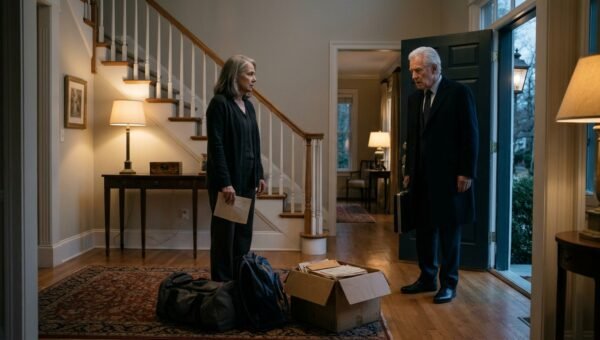
That was all. No fight came before it. No long talk about being distant. He moved out the next week, taking his clothes and the blue toolbox he kept under the stairs. I didn’t ask where he was going.
I was scared the answer would make it all feel even more final.
The first month, I kept thinking there’d been a missed conversation somewhere. Maybe I’d been too busy. Maybe I hadn’t heard him properly when he tried to tell me something. I went over ordinary days like they were church services I’d slept through, trying to find the part where I should’ve stood up and paid attention.
Arthur didn’t call to explain. He emailed about the insurance and the house bills, always short and polite. I told myself that was better than angry. I’d also tell myself I was being gracious, which was partly true and partly a way of not admitting I was ashamed. I didn’t want friends asking what happened when I couldn’t give them anything but, “He said he was unhappy.” It sounded like I’d failed a test without knowing there was one.
At the store, Clara asked if we could sit somewhere and talk.
She looked about my age, maybe a little younger, and held her purse with both hands. I expected anger. She seemed more tired than angry.
“I’m not asking you to forgive me,” she said. “I didn’t know the truth.”
She told me Arthur had met her through a small marine repair business he’d been trying to build on the side. Clara had invested some money in it. She believed he was leaving what he called a loveless marriage and planned to start over with her once the divorce was done.
“He said you’d been living separate lives for years,” she told me. “He said you wanted out too.”
I let out a laugh that didn’t sound like mine. “He never said that to me.”
“I know that now.”
She showed me messages on her phone. Arthur had told her he was afraid to come home. He said I was cold, that we barely spoke, that I’d already agreed the marriage was over.
There were bits of truth tucked in there, which made the lies harder to catch. We had quiet evenings. We didn’t spend every minute talking. We were grown people with errands and sore knees and a shared list on the fridge.
Clara had seen him after he moved out. She thought he was setting up a new life. But he kept asking her to wait before making anything public. He said there were “some details to settle.” She’d sent him money for the business, then started asking about receipts.
“He stopped answering the questions,” she said. “Then he stopped answering me.”
I wanted to dislike her. It would’ve been simpler. But she’d brought no grand story about how special they were together. She looked embarrassed, and I recognized that feeling. We were both trying to work out how much of our own judgment we could trust.
“Why tell me now?” I asked.
“Because I found out about the debt,” she said. “And because I think he left you so you wouldn’t find it first.”
I didn’t know what to say. I said I had to get home. Clara gave me her number and waited while I put it in my phone. My hands were clumsy. I typed one digit wrong, deleted it, and started again.
I drove home with the groceries in the passenger seat. The bread tipped onto the floor at the first stop sign. I picked it up and put it back on the seat. Then I sat in the driveway longer than I needed to.
That night, I opened the file cabinet Arthur had always handled. He’d never forbidden me from looking. He just made it seem as if the paperwork was too fussy for me, and I’d let him. I’m good at keeping track of the small household things. I’d let that become an excuse for not asking about the larger ones.
There were bank statements, tax forms, and envelopes I’d never opened because they had his business name on them. One was a notice from a lender. The letter said a commercial loan was in default. It named Arthur’s business and listed a balance of $184,672. It also said the lender had a claim against business assets and might pursue the people who had signed as guarantors.
I read that sentence three times.
My name wasn’t on the loan. That should have helped. It didn’t, not right away. We’d had a joint savings account. I found transfers from it to Arthur’s business, one after another, with notes like “parts” and “shop costs.” The balance had fallen by $31,408 over eight months. I had known it was lower. Arthur had said he was moving money around and would put it back after a contract came through.
I’d believed him. I’d even defended him when my sister asked if the business was doing well. I told her Arthur knew what he was doing. I wish I’d asked what that meant. I wish I’d asked where the money went. I wish I hadn’t been so pleased when he called me “the steady one,” as if not asking questions was a virtue. I’m saying that because I know I made it easy for him to keep the books to himself. That still doesn’t make his choice mine.
The next morning, I called the number on the notice. They wouldn’t discuss the loan with me, which confirmed that I wasn’t named on it. Then I called a lawyer. I had to leave a message and wait until after lunch to hear back. In between, I made toast and didn’t eat it.
The lawyer, Janice, told me not to sign anything Arthur sent without having it checked. She also told me to pull every statement I could find and get a full review of our shared accounts.
“Your first job is protecting yourself,” she said.
That sounded plain enough. I could do plain.
I called Clara that evening. We compared dates. The first large transfer from our savings had gone out two months before Arthur announced the divorce. Around then, he’d told Clara that he was nearly free of the marriage and needed her investment to keep the business going. She’d sent him $18,750 in three payments.
We weren’t friends. We weren’t even sure we liked each other. But we both had dates, messages, and bank records, so we met once more and made copies of what each of us had. The story got uglier, but it also got clearer. Arthur hadn’t left because he’d fallen out of love. He’d seen his business failing, the debt building, and questions coming. He’d made himself the wronged man in two separate stories, hoping each of us would help him avoid the part where he had to answer for his own choices.
Three weeks later, I met Arthur in a conference room at Janice’s office. I brought the bank statements and the lender’s notice. Clara had given Janice a signed statement about what Arthur told her and the money she’d sent him. Janice sat beside me. Clara came too, though she stayed quiet.
Arthur arrived expecting, I think, to discuss the divorce paperwork and go home. He looked at the papers on the table and stopped.
“What is this?” he asked.
“The loan notice,” I said. “And the transfers from our savings.”
He sat down. “That business was going to work.”
“It didn’t.”
“I was going to pay it back.”
“When?”
He rubbed his forehead. “I didn’t want you dragged into it.”
“You used our savings.”
“I was trying to fix it before you knew.”
Clara placed her statement on the table. “You told me she knew the marriage was over.”
Arthur looked at her. “That’s not what I meant.”
“You said she wanted the divorce too.”
He didn’t answer.
I slid the audit toward him. Janice had gone through the accounts and confirmed what belonged to me, what came from our joint funds, and what could be kept separate from the business debt. She’d also helped me open an account in my name alone and put the house paperwork in order. The lender could pursue Arthur under his guarantee. It couldn’t make me responsible for a loan I hadn’t signed.
Arthur looked at the pages for a long time. Then he said, “I was unhappy.”
That old excuse. The same small sentence he’d left me with six months earlier.
“No,” I said. “You were in trouble.”
He leaned back. “I didn’t know how to tell you.”
“You could’ve started with the truth.”
“I thought I could handle it.”
“You thought you could handle all of us.”
Nobody spoke for a moment. I didn’t raise my voice. I had imagined saying all kinds of things on the drive over, but they fell away once I saw the papers in front of him. I didn’t need to call him names. The dates and amounts were right there.
He looked at me. “I never meant to hurt you.”
“I know you didn’t plan every part of this,” I said. “But you still did it.”
Janice laid out the divorce terms. Arthur had to keep the business debt and accept that the shared funds used for it would be accounted for in the settlement. My lawyer had checked the language carefully. I wasn’t signing on to his loans or taking responsibility for his business. Arthur could have his lawyer review it. He couldn’t ask me to cover the debt quietly.
He didn’t sign that day. He took the papers to his lawyer, and we waited another month while they worked through the numbers. The delay was annoying, but it didn’t undo what I’d learned. I stopped checking my email every ten minutes. I stopped trying to guess whether Arthur was angry or sorry. His feelings weren’t the part I needed to manage anymore.
The divorce was finalized without me taking on his business liabilities. I kept my share of the house proceeds and my own savings. Arthur kept the business and the debt attached to it. I didn’t get back the money he’d already moved out of our joint account, but the settlement counted it as money he’d taken. Clara pursued the money she’d lent him through her own lawyer. I didn’t follow every detail after that. I’d done what I could do.
Clara and I exchanged one more call. She thanked me for hearing her out. I told her I was glad she’d stopped me in the store.
“I’m sorry,” she said.
“I know,” I told her. “Take care of yourself.”
There wasn’t a big friendship after that. We didn’t need one. We’d been placed in the same lie, and we’d helped each other get out with the truth in hand.
I still sometimes replay that kitchen conversation. I still wish Arthur had said, “I’m scared,” instead of “I’ve been unhappy.” Maybe that wouldn’t have saved our marriage. I don’t know. It would at least have left me with the truth, and I wouldn’t have spent six months believing I’d missed some secret failure in myself.
My finalized decree is filed in the kitchen drawer. I bought a new mug after the old one chipped, plain and a little too big. Some mornings I sit at the table with coffee and the sun on the counter, and I don’t have to wonder what Arthur is hiding in the next envelope.
The mug is mine. The drawer closes cleanly.