The first thing I remember is the cold metal edge of my car key pressing into my palm while Daniel stood in the doorway and told Emma she wasn’t going anywhere.
My daughter had a folder hugged to her chest. I was between her and Daniel, trying not to look like I was. He was speaking in the calm, clipped voice he used when he wanted to sound reasonable.
“Put the folder down, Emma.”
She didn’t.
“Move,” I said.
That was Sunday afternoon. To explain how we got there, I have to go back to Friday night and a small card beside a bowl of fruit.
For years, I thought Emma had the sort of marriage people envied. She and Daniel had a tidy house in a Wichita cul-de-sac, and they always seemed to know what the other wanted. When I called, Emma usually sounded busy but cheerful. If I asked about Daniel, she’d say, “Mom, everything’s wonderful. Daniel takes such good care of me.”
I took her at her word. I’m not proud of that.
I used to work in a school office, where I got good at noticing when a kid’s “fine” meant something else. Somehow I didn’t use that skill on my own daughter. I heard the cheerful voice and let myself be relieved.
I arrived Friday evening with a grocery-store pie and an overnight bag. Emma hugged me at the door, and Daniel asked whether I’d had trouble finding the house. He was pleasant. He even carried my bag upstairs.
Twenty minutes later, I watched him correct the way Emma set his drink down.
“Handle toward me,” he said.
She moved the glass.
Then she told him about getting a promotion at work. Her face lit up when she said it.
Daniel took a sip and said, “It’s not like you’re running the place.”
Emma gave a small laugh. “No, I know.”
I wanted to say something then. I really did. But she was watching me, and her smile had gone stiff around the edges.
At dinner, she’d made chicken. It was a little dry, maybe, but perfectly edible. Daniel cut into it and said his mother never let chicken sit in the oven too long.
“My mother knows when it’s done,” he said.
Emma reached for the serving plate. “I’m sorry. I’ll make something else next time.”
The fork against my plate sounded louder than it should have.
I had a sharp reply ready. Then I saw Emma’s face. She wasn’t afraid of what I might say to Daniel. She was afraid of what he’d say after I left.
So I smiled and asked him about his work. I’ve replayed that choice more times than I can count.
I thought I was keeping the evening from getting worse. I may have been keeping it easier for him.
Daniel relaxed. He talked about a job he was trying to finish, and Emma kept passing the potatoes and asking me if I wanted more tea. It felt like watching someone manage a room one small task at a time.
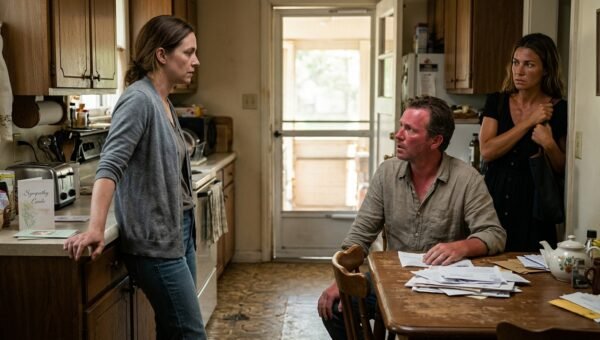
After dinner, I carried plates to the kitchen. Emma rinsed them while I dried. The fruit bowl sat by the sink, and beside it was a little white appointment card with her name printed across the top.
There was a time on it. No doctor’s name. Just a center and a phone number.
I looked at Emma. She didn’t look back. She was scrubbing a plate that was already clean.
I didn’t ask. Daniel was in the next room, and I had no idea what that card meant. But I knew Emma had put it where I would see it.
She knows I notice things. I used to tease her that I could find a permission slip under three weeks of school papers.
I went to bed with the card’s number in my head.
At 7:30 Saturday morning, Daniel was still asleep upstairs. I stepped outside and called from my cell phone. The air was cool enough to make me pull my sleeves over my hands. I remember the sound of a sprinkler ticking somewhere down the block.
A woman answered. “Community advocacy center. This is Dr. Aris.”
I gave my name and said I was Emma’s mother. My voice came out too loud, so I lowered it.
“I found an appointment card,” I said. “I’m not sure what I’m supposed to do.”
There was a pause. Then she asked if Emma had agreed to let the center speak with me. I said I didn’t know.
“I can’t share private details without her permission,” she said. “But I can help you think through how to support her safely.”
I told her about dinner. The drink. The promotion. The chicken. I also told her Emma had looked scared when I almost spoke up.
Dr. Aris didn’t tell me to go in and fight Daniel. She said that pressure, monitoring, and constant put-downs could be part of coercive control. She said a person might need help making a plan before leaving, especially if a partner tracked calls, schedules, or money.
I stood on the front step with the phone against my ear.
“Don’t confront him without Emma’s say-so,” she said. “Let her choose the pace.”
I wanted to ask how I could stand in that house and act normal. Instead, I said, “All right. Tell me what I can do.”
She gave me general guidance and said Emma could contact the center herself. I didn’t ask for details she couldn’t give me. I went back inside before Daniel came downstairs.
At breakfast he complained that the coffee was weak. Emma got up and made more. Her hand was steady. Mine wasn’t, so I kept both hands around my mug.
When Daniel went upstairs to shower, Emma glanced over.
“You sleep okay?” she asked.
“Fine,” I said.
It wasn’t much. But she held my eyes for a second, and I knew she understood that I’d seen the card.
I stayed calm all day. That sounds simple. It wasn’t. I had to swallow a dozen comments, including one when Daniel picked up Emma’s car keys from the counter and put them in his pocket.
“She doesn’t need the car today,” he told me.
Emma said nothing.
Later, when she asked whether she could go to the pharmacy, Daniel said he’d take care of it. He didn’t yell. That was part of what made it hard to name. He made decisions in a mild voice, then let the rest of us feel foolish for noticing.
He also checked his phone when a notification came through on Emma’s. She had to tell him where she was going before she could leave the house. Their accounts were shared, she said when I asked about a bill. Daniel handled the budget.
I kept hearing Dr. Aris’s warning in my head. Don’t turn this into a scene before Emma is ready.
That night, I asked Emma to help me find a spare blanket in the guest room. Once the door was shut, I said, “I called the number.”
She looked at the floor.
“I’m sorry,” I said. “I shouldn’t have done anything without asking.”
“No,” she said. “I wanted you to.”
Her voice broke on the last word. She sat down on the edge of the bed and pressed her fingers to her eyes.
I sat beside her but didn’t touch her until she leaned into my shoulder.
“I left it there for you,” she said.
That was the line I’ve kept hearing. Not because it was dramatic. It wasn’t. She said it like she was admitting she’d borrowed my sweater.
She told me she’d called the center three weeks earlier and started going to counseling. She’d been rebuilding her sense of what was real, one session at a time. Daniel checked phone records and shared apps. He knew where she was meant to be. She couldn’t ask me for help without worrying that he’d see the message.
The card was the only thing she could safely leave in plain sight.
“I thought if I told you, you’d go after him,” she said.
“I might have.”
“I know.”
I didn’t argue. I had spent the whole visit wanting to tell Daniel exactly what I thought of him. Emma needed me to listen, not make myself the center of the problem.
Dr. Aris had told me the center could help with a safe exit plan. Emma had already talked with them about where to go and what she’d need. We kept our voices low and made sure we didn’t use her phone to plan anything Daniel might see.
She said she needed her identification, work papers, and a few things that belonged to her. She had some documents already put aside. She’d been waiting for a chance to leave without making him feel cornered before she was ready.
I asked if she wanted me to take her home with me.
“Yes,” she said. “But I need to do it carefully.”
So I stayed through Sunday. I kept making small talk with Daniel. I laughed at a story I didn’t find funny. I even helped clear breakfast dishes while he watched a sports recap in the other room.
It was the hardest kind of quiet. I knew what was happening now, but I couldn’t rush her. I had to let Emma lead, even when my hands wanted to do something.
Sunday morning, Daniel said he had to check on a work job. He expected to be gone a while. Emma and I waited until his car had turned off the street, then went upstairs and gathered what she had planned to take.
We weren’t trying to carry out her whole life in one trip. Just the papers and personal things she needed first. Emma had already spoken with the center about getting legal and advocacy help to sort out the rest.
Then I heard a car door outside.
Emma stopped folding a sweater.
“He’s back,” she said.
I went downstairs first. Daniel came in through the front door while Emma was still holding the folder. He looked at the bag by the stairs, then at me.
“What is this?”
I kept my voice level. “Emma’s leaving with me.”
He laughed once, but there was no humor in it. “This is between my wife and me.”
Emma came down behind me.
“Don’t make this worse,” he said to her. “Put that stuff away.”
She tightened her grip on the folder.
I stepped between them. That’s how we got to the doorway, and the cold key in my hand.
Daniel’s voice got louder. He said Emma was being ridiculous. He said I was filling her head with ideas. He told me I had no right to interfere.
I didn’t answer those accusations. I’d learned by then that arguing about the wrong thing could pull Emma back into the same old circle.
He reached toward the folder. I blocked him.
“Move,” he said.
“No.”
Emma was quiet for a moment. Then she stepped around me enough to look at him.
“I’m leaving,” she said.
Daniel shook his head. “You’ll regret this.”
Emma’s voice shook, but she didn’t take it back.
“I don’t want to live like this anymore.”
He started talking over her. She looked down once, and then she looked back up. I didn’t fill the silence for her. That part mattered. Her words had to belong to her.
I opened the door. Daniel said something else, but I didn’t catch all of it. Emma walked past him. I followed.
We drove away in my car. The afternoon sun hit the windshield, and Emma rolled down her window even though the air was warm. She held her hand out for a few seconds, letting the wind move over it.
The door behind us stayed closed.
In the weeks that followed, Emma worked with the center and legal advocates to sort out her money and the things she’d left behind. She went back to work. When she told me about her promotion again, I made sure I was listening.
She didn’t need me to rescue her from every hard thing. She needed me to believe her when she said she was ready.
I still see that card beside the fruit bowl. Emma had put it where I would look, and I nearly missed what she was asking.
“I left it there for you,” she’d said.
This time, I heard her.