The metal cabinet was the only thing in Roy’s rental in Sapulpa that had a lock on it.
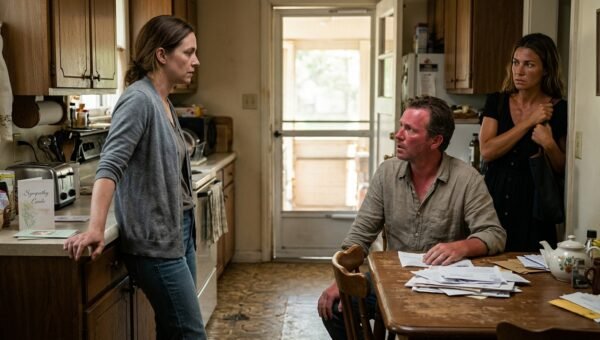
I noticed it after I’d loaded most of his things into my F-150. His VFW cap hung on a hook by the door. His kitchen drawer held unpaid medical bills. There wasn’t much else. Then I opened the bedroom closet and saw that gray cabinet pushed against the back wall, padlock shut.
I stood there with a cardboard box tucked against my hip, staring at it longer than made sense. I’d already decided I was going to get the place cleared by the first, like the landlord asked. So I went to the truck for the bolt cutters.
I didn’t know what I was about to find. I just knew that if I left the cabinet locked, I’d spend the rest of my life thinking about it.
Roy and I used to be close. Not the sort of close where we said a lot of sentimental things. We hunted deer every season and split a booth at Cracker Barrel after church on Sundays. He always slid the extra napkins toward me because I was the one who got syrup on my fingers. That was just how we were.
Then, about five years before he died, he started pulling away.
At first I told myself he was busy. I had a small business and kids at home, and I wasn’t exactly calling him every day either.
But Roy stopped calling first. He missed Thanksgiving one year, then the next. When I asked if he was coming, he said, “I’ll see how I feel.”
I figured I’d done something. I went through old conversations in my head, trying to find the bad thing I’d said. I couldn’t find one, but I figured that didn’t mean much. Sometimes you hurt somebody without knowing it.
Roy died last month at fifty-nine. Heart failure. He never married and never had kids, so I was the one who had to clear out his rental. The doctor’s words were simple enough. Heart trouble. But the drawer full of bills made it clear there’d been more to it than one bad day.
The place was so spare I could fit nearly everything in the bed of my truck. I don’t mean that as a figure of speech. His clothes, a few kitchen things, the VFW cap, and a small box of old pictures.
It looked like a man had stopped building a life a long time ago.
I wondered if he’d stopped because of me.
That question followed me around the apartment while I worked. It followed me to the truck, where I got the cutters, and back to the closet. The padlock was cheap. I squeezed the handles. It snapped with a sharp click, and I set it on the floor.
For a second, I didn’t open the cabinet. I don’t know why. Maybe I thought there might be something in there I’d rather not know. But the door was already unlocked, so I pulled it open.
There was no cash. No secret family. No angry note.
There were old hunting tags, a stack of photographs, folded papers, and Cracker Barrel menus held together with a rubber band. The top menu had a grease stain near the bottom, right where Roy used to drag his thumb while he read it.
I actually laughed once. Then I saw the envelope with my name written across it.
I sat down on the bare bedroom floor.
The first letter was dated five years earlier. I recognized the date because it was the month he stopped answering my calls. His writing was smaller than I remembered, the letters crowded together. I read the first line, then had to start over.
“I got bad news about my heart.”
That was all. One sentence, and there I was with my back against the wall, reading it in the room where he’d kept it hidden.
The next page said the doctor had told him his condition was serious and would get worse. Roy didn’t write down every medical word. He wrote what he understood: his heart was failing, he was going to need care, and he didn’t know how much time he had.
He also wrote that he didn’t want me to know yet.
I put the letter down. I picked it up again.
He knew I had a business to keep going and a family to take care of. He’d watched me stretch money and work late. He said he wasn’t going to make me choose between helping him and keeping my own life together.
I read that twice, because it made me mad.
Not at him exactly. At the idea that he could decide what I could handle without asking me. At the fact that he’d let me spend five years wondering what I’d done wrong.
There were more letters. Some were only a few lines. Roy wrote that he’d meant to call after the doctor’s appointment, but he couldn’t bring himself to do it. He didn’t want me hearing him cough. He didn’t want me seeing him get tired walking from the parking lot to the truck.
He had started getting bills he couldn’t pay. A few of the receipts were in the cabinet too. The dates lined up with what he’d written. The bills weren’t a surprise tucked away after his death. They’d been coming for years.
One letter said, “I don’t want my brother watching me go downhill.”
I set that one on my knee.
There was a photo underneath it. Roy and me standing beside a deer we’d taken when we were young enough to think we knew everything. I couldn’t remember the exact year. Roy had written on the back, “He was cold and complained the whole way back to the truck.”
That was true. I’d forgotten it. I’d forgotten how much he used to laugh at me for being cold, too.
I started sorting the papers by date, not because I needed to, but because I needed the dates to make sense. The first letter came five years earlier. The next was months after that. The handwriting got shakier toward the end, but he kept writing.
I felt ashamed reading them. I’d spent years telling myself I must have hurt him. Maybe I’d been selfish. Maybe I’d gotten so wrapped up in my own family and work that I hadn’t noticed him slipping away. I had used that story to explain his silence, even though I’d never checked if it was true.
I should have called harder. I should have driven over. I could have done more.
But I also knew I’d called. I’d left messages. I’d asked him to come for Thanksgiving. I’d said, “You can just show up, Roy. You don’t have to bring anything.”
He’d answered once, “I know.”
Then he didn’t show.
I found the journal at the bottom of the cabinet. It was a small spiral notebook, the kind I used to keep in my truck for parts and phone numbers. Most of the pages were about his appointments, pills, and bills. The last entry was dated a few weeks before he died.
“I miss the Sundays,” he wrote.
I stopped there.
Then I kept going.
He wrote about the hunting trips, the Cracker Barrel booth, and how I always let him order first even though I already knew what he wanted. He said he’d thought about calling me a hundred times. He said his pride had gotten in the way, and that he’d convinced himself being gone was better than letting me watch him get sick.
“I thought I was sparing him,” he wrote.
That line made me shut the notebook. I sat there holding it, angry and sad and tired in a way I can’t explain. I was mad that he’d made that choice for both of us. I was mad at myself for not getting through to him. And then I had to admit that I’d made a choice too. I’d let his silence become proof that I wasn’t wanted.
I sat on the bedroom floor for a long time.
The apartment was empty around me. I could hear the cardboard shifting when I leaned against it. There was no big moment where I felt fine again. I just stopped trying to invent a reason for him to have left me.
He hadn’t left because I failed him. He’d left because he was scared, sick, and too proud to ask for help. He’d loved me and still made a mess of it. Both things were true.
I said his name out loud. “Roy.”
Then, because it felt like something I should have said years ago, I added, “You could’ve told me.”
Nobody answered. Of course nobody answered. I’d spent five years hoping there was a sentence I could find that would make the whole thing less sad, and there wasn’t one.
I read every letter before I packed them. I didn’t skim. Some were hard to get through because he kept apologizing for things I would’ve helped him with without thinking. There were a couple of notes about bills and appointments, too. Those matched the receipts and the dates. He hadn’t made up the fear. He’d been living with it.
One page said he didn’t want to be “another problem” for me.
I kept thinking about that. Roy had sat in that apartment with his heart getting worse and his bills piling up, and somehow he thought the burden was letting me know. I would’ve driven him to appointments. I would’ve helped with what I could. I would’ve sat in that Cracker Barrel booth while he complained about the coffee.
I could have said all that. I didn’t get the chance.
So I read the rest, folded the letters carefully, and put them back in the envelope. I kept the old photos and hunting tags. I took the VFW cap off the hook and placed it on top of the box.
The landlord came by before I left. He asked if I’d gotten everything.
“Almost,” I said.
I packed the last bills into a bag to take care of, then checked the closet once more. The cabinet sat open and empty. It looked smaller without all the papers in it.
I drove home with the cap on the passenger seat and the letters beside it. I didn’t turn on the radio. At a stoplight, I glanced over and saw the corner of that old photo sticking out of the box. Roy had written “cold the whole way back” on the back, like I’d made the trip difficult for him.
I smiled a little. Then I cried, which is not something I usually do in traffic.
I don’t know if forgiveness is the right word. I forgive him for deciding I couldn’t handle the truth. I forgive myself, I guess, for taking his silence as proof that I didn’t matter. I still hate that we lost those years. Nothing in that cabinet gives them back.
But I brought home the things he kept. I put the cap on a shelf and the hunting tags in a drawer. The letters stayed on my kitchen table for a while because I wasn’t ready to tuck them away.
The last line in his notebook was about Sunday lunch.
“I still saved him the booth.”