6:17 on a Saturday morning, the intercom rang while Wade was yanking on his shorts. We keep our phones silent until ten on weekends, which is a little rule we made when we were both working too much. I was still trying to make sense of the noise when I asked, “Who is it?” Wade stopped for a second. Then he said, “The police.”
I followed him downstairs in my socks. I thought there had been a wreck, maybe somebody from the road near our place.
I didn’t know why he looked like he’d seen something coming for him. That part would make sense later.
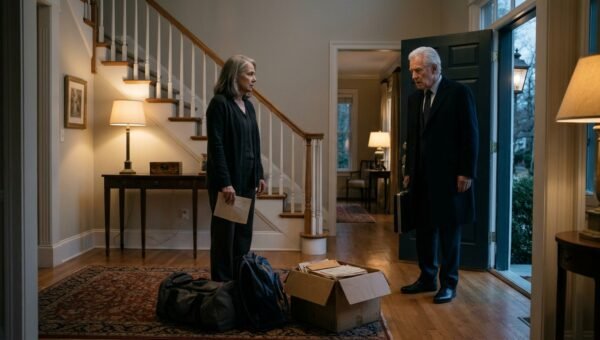
At the door were two officers, Jenkins and Vance, a woman from county social services, and a teenage boy with a canvas backpack. The boy’s face looked so much like Wade’s that I noticed it before I noticed the officers’ badges. Same deep-set eyes. Same little notch in one eyebrow. I remember thinking it was odd, and then I felt embarrassed for thinking about his face when he looked like he hadn’t slept in days.
The social worker introduced herself as Ms. Ruiz. She spoke gently, but she had a folder held tight against her chest and kept glancing at the boy. His name was Leo. He was fourteen. His mother had died overnight from an aneurysm, and the county had found legal papers naming Wade as his guardian.
Wade gripped the edge of the door. “There’s been some mistake,” he said.
Ms. Ruiz didn’t argue with him. “Your name and number are on the signed document,” she said. “We need to talk about where Leo can stay today.”
That was when I understood this wasn’t a welfare check or some mix-up.
Wade knew who Leo was. I could tell from the way his face had gone still, like he was trying to keep a lid on a pot that had already boiled over.
I moved around him and opened the door wider. The morning air came in, sharp enough that Leo rubbed both hands over his sleeves. “Come inside,” I said. Wade looked at me, but I didn’t wait for him to answer.
I brought them to the living room. Leo sat on the very edge of the sofa, still holding his backpack. He didn’t take his coat off. Officer Jenkins stayed near the front hall while Ms. Ruiz explained what she could. Leo’s mother had been sick for months, but the aneurysm came suddenly. She’d died the night before. The county had found the papers while sorting through her records.
“Did she tell him?” I asked.
Ms. Ruiz shook her head. “Not that we know of.”
Leo stared at the rug. He had one thumb pushed hard into the strap of his backpack.
I wanted to ask him if he’d eaten, if he wanted water, anything normal, but the room was full of facts that weren’t normal.
Wade sat down across from him. “Leo,” he said, and then stopped.
Leo looked up. “You know me?”
Wade rubbed his palms on his shorts. “I know who you are.”
That was not an answer. It was barely even a sentence.
Ms. Ruiz said Leo would need a safe place while the county reviewed the paperwork and made a plan. The document named Wade, but she couldn’t promise what would happen long term. She asked if we could keep him with us for now.
Wade glanced at me again. I could see the panic in his face, but I was too busy trying to keep my own voice level. “He can stay,” I said. “We’ll figure out today first.”
The officers and Ms. Ruiz stayed long enough to go over the next steps.
They left a card and a number to call if anything changed. At the door, Leo looked back at the house. He still hadn’t taken off his coat.
Wade shut the door. His hand stayed on the knob.
I said, “Kitchen. Now.”
The first thing I did was put a glass of water on the table. Wade didn’t touch it. I stood across from him and asked how long he’d known about Leo.
He looked down at the table. “Since before I met you.”
“Did you have a child before we got married?”
He rubbed the corner of his mouth. “Yes.”
I waited. He had given me one word, and apparently thought that counted as telling me.
“Why didn’t you tell me?”
“I thought it was finished.”
“Finished how?”
He said Leo’s mother, Marisol, had shut him out when Leo was little. He’d been young, scared, and not much use to her. There had been lawyers and arguments. He said he signed papers giving up his rights, and for years he believed that was the end of it.
“But you knew you had a son,” I said.
“Yes.”
“And you let me believe you didn’t.”
He shut his eyes. “I was afraid you’d leave.”
It was a plain answer. Not a good one. I could hear the refrigerator humming behind me, and I kept my eyes on his hands because I didn’t trust what my face was doing.
I asked about the money next. For at least two years, I’d noticed transfers from our joint account that didn’t line up with anything we paid for. They were usually around four hundred dollars. Wade called them old bills, then a tax thing, then something he was handling. I knew the amount changed, but it never changed by much.
I’d asked more than once. I’d accepted the answers because I liked my life with him and didn’t want to turn every odd thing into a fight. That was my part in it. I had made it easy for him to stay vague.
“Show me the statements,” I said.
“Can we do this later?”
“No.”
He stared at me. I could tell he wanted to argue, but he knew I wasn’t moving. We went to his office. I sat in his chair while he found the online statements, then printed them because I wanted to hold the pages. The payments went out every month. The earliest one I could find was from eight years ago. Most were $412. Some were more.
“Where did it go?” I asked.
“Marisol’s attorney had an account for Leo.”
“So you were supporting him.”
“I was trying to.”
“Quietly. From our money.”
Wade pressed both hands against the desk. “I thought if I kept paying, at least I wasn’t leaving him with nothing.”
I hated that his answer made sense to me. It did not make it right. He had been scared and selfish at the same time, and I could see both things without letting either one excuse him.
“Where are the papers you signed?”
He said he didn’t know. Then he remembered a box in the closet. He brought it out himself. It had old tax forms, a couple of family pictures, and a packet of legal papers held together with a rubber band that had gone brittle. He looked at the box like it had been waiting to accuse him.
The papers showed a proposed agreement about custody and support. Wade had signed it. Marisol had signed it too. But I couldn’t find a court order ending his parental rights. He’d taken the signed agreement as final because it was easier than checking. The newer document named him as Leo’s guardian if Marisol couldn’t care for him.
I read the name twice.
“You knew she could name you,” I said.
“I thought she’d changed it.”
“Did you ask?”
“No.”
That was the part that got me. Not some grand plan. Not a secret scheme. He had been making payments and hoping the whole thing would stay quiet. He’d let the money leave our account, let years pass, and let me believe there was nothing to ask about.
The birth record was clipped behind the old papers. Wade’s name was on it. So was Leo’s date of birth. There wasn’t any doubt left to hide behind.
I walked back to the living room. Leo was sitting in the same spot, staring at the backpack zipper. I asked if he wanted toast or cereal. He said he wasn’t hungry, but he let me bring him a glass of water. I put it on the coffee table, and he whispered, “Thanks.”
Wade came in and sat in the chair across from him. His knee bounced. He kept starting sentences and stopping. I didn’t know whether to feel sorry for him or angry at him, so I did neither. I sat beside Leo instead.
“I’m sorry about your mom,” I said.
He nodded. His eyes were red, but he didn’t cry. “She said I might have to meet him someday.”
Wade leaned forward. “I’m sorry I wasn’t there.”
Leo held the glass with both hands. “I don’t know you.”
Wade nodded. “I know.”
That was the first thing he’d said all morning that didn’t sound like he was trying to manage the situation.
The rest of Saturday went by in pieces. Ms. Ruiz called back. We went over the temporary placement forms and the next appointment. I found clean towels and made up the guest room. Wade called the school district to ask what we’d need for enrollment, then stopped when the office was closed. It was one practical thing after another, which was probably why I could keep moving.
Leo carried his backpack down the hall himself. I didn’t offer to take it. His room had a bed, a dresser, and a lamp that made a small clicking sound when I turned it on. He asked if he could shut the door. I said yes.
Wade came into the kitchen after that. I was standing by the sink, reading the bank statements again. The transfers had seemed small when they came one at a time. In a stack, they looked different.
“I didn’t want to lose you,” he said.
“You kept me by leaving out the part that mattered.”
He nodded, and his eyes filled. “I know.”
“No. You’re going to tell me everything. Every account. Every paper. Every call you made. I’m not going to find out one piece at a time.”
“I’ll show you.”
“Tonight.”
He started to say something, then stopped. “Okay.”
I told him the marriage wasn’t fine because he’d finally confessed after the police were already at our door. I also told him Leo had done nothing wrong. I wouldn’t let Wade’s choices turn into a reason to treat the boy like a problem we’d been handed.
“I’m not sending him away,” I said. “But I’m not pretending this is settled.”
Wade nodded.
“And you’re sleeping in the guest room tonight.”
“Okay.”
He didn’t ask me to change my mind. I was glad, though I also hated that I felt glad about such a small thing.
At 7:40 that evening, Wade brought me the old keepsake box again. He’d found a small photograph tucked inside a folded envelope. It showed him holding a baby on a porch. He was younger, his hair longer, his smile nervous. I hadn’t seen it before.
Leo walked into the hall while I was looking at it. He stopped when he saw the photo.
“That’s me,” he said.
Wade didn’t move closer. “Yes.”
Leo took the picture from my hand and looked at it for a long time. Then he set it on the table, face up. No one said anything for a few seconds. I could see the baby’s hand curled around Wade’s shirt.
That night, Wade slept in the guest room down the hall, not with Leo but on the other side of the door. We’d already agreed he would give the boy space. I sat at the kitchen table with a glass of cold water and listened to the refrigerator hum. The hallway light slipped under the guest room door.
Wade had spent years thinking a signature and a monthly payment could keep a whole part of his life put away. The boy was here now. The papers were on my table. And I had told Wade exactly where he would sleep.