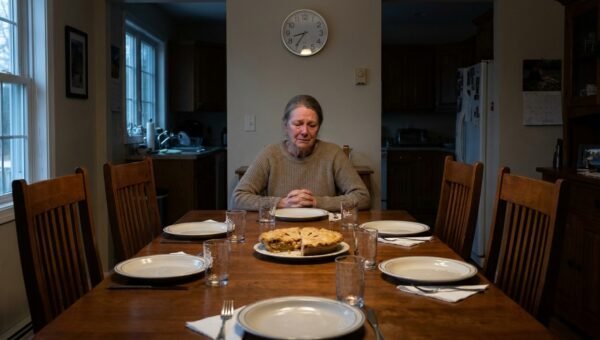
The guest chair beside my hospital bed was where Greg served me divorce papers.
I was wearing a hospital gown and one of those plastic bracelets that pinches if you bend your wrist. The papers landed on the tray beside my untouched gelatin. Greg laughed when he told me he’d filed and planned to take the house and the car. I remember the fork sliding off the tray. I remember more clearly that the bracelet had my birthday printed wrong.
The hospital had kept me overnight because the room seemed to tilt whenever I sat up. At first the doctors were checking for something neurological. I heard them talking just outside my curtain, low enough that I couldn’t make out the words, and I spent most of that morning trying not to read their faces.
Greg arrived after lunch. He didn’t ask what the doctors had said. He set the papers down and told me he was done.
“I’m taking the house and the car,” he said. “You can figure out somewhere else to go.”
Then he laughed, like the whole thing was obvious.
I didn’t argue. I didn’t ask how he planned to take either one. I looked at the pages and then at the hospital bracelet, and I let him talk until he ran out of things to say. I was dizzy, tired, and scared about my health.
I also knew that arguing with Greg had never made him hear me.
He took the car keys from my purse before he left. He said he needed the car for work, though he hadn’t had steady work in months. When the door shut, I could hear a cart rattling down the hall. That was the part I remember. Not some grand feeling. Just a cart with one bad wheel.
The doctors eventually told me I had severe labyrinthitis, an inner-ear infection. It could make the room spin and leave me unable to walk straight, but it wasn’t a brain tumor or a stroke. I went home the next day with medication and instructions to rest. My balance came back slowly. My thoughts were clear enough.
Greg had spent years treating my work like a hobby. I’m a corporate data analyst, and I’ve worked remotely for the same company for three years.
I make $130,000 a year. He knew I sat at a desk and had calls. He just never asked what I earned, or read the tax filings I left with the household paperwork.
I didn’t hide it from him. I stopped correcting him after a while because every time I tried, he found a way to make it sound small. “Freelance pennies,” he called it once, while I paid the property tax bill. I should have pushed harder. I didn’t. It was easier to let him think whatever he wanted than have another argument about money.
Our house had been mine before the marriage. I bought it with my own money, and the deed stayed in my name. It was worth around $750,000 by then, though I never talked about it like it made me special. I also had the car through a lease in my name and under my corporate account. Greg saw the car. He never looked at the paperwork.
The day after I got home, I called Evelyn Ross, the lawyer who’d handled my house purchase. I had her number because I’d kept the folder with the deed, even after Greg complained I saved too much paper.
Evelyn let me explain without interrupting. Then she asked me to bring the divorce papers, my tax records, and the car lease.
“Don’t sign anything,” she said. “And don’t assume his filing means he gets what he’s asking for.”
She checked the deed, the county records, and my bank statements. I sat at her office table and watched her line up the records in date order. I work with numbers for a living, so that part felt familiar. What didn’t feel familiar was seeing Greg’s name next to a claim he had no right to make.
Evelyn also told me the filing was rushed and relied on the idea that everything was shared property. It didn’t make the house his. It didn’t make the car his, either.
I changed the locks when I got home. I called the lease company and confirmed Greg couldn’t keep using the car under my account. Evelyn told me to freeze the joint credit lines while we sorted things out. I did that, then put the papers in a file drawer and took my medication.
For two days, Greg didn’t call. I assumed he was busy showing Courtney the life he thought he was about to get.
I already knew there was a woman named Courtney. Greg had been dressing better and staying out later, and once I saw her name flash on his phone when it was lying on the counter. He told me she was a friend from a business group. He said it in the same voice he used when he wanted a subject closed.
He’d been telling Courtney he owned our house outright and that the car was his. I learned that later. At the time, I only knew he’d served me papers from a hospital bed, taken my keys, and walked out as if I were a bill he’d finally paid.
The phone rang at 11:23 p.m. on the third night after I’d come home. Greg’s name filled the screen. I let it ring once more than I needed to, then answered.
He was breathing hard. I could hear a door slam somewhere near him.
“Please don’t hang up,” he said.
I sat up and waited. The room didn’t spin anymore, but I held the edge of the mattress anyway.
He told me Courtney’s lawyer had pulled the county records and checked the title and loan registries. The house was in my name alone. The car lease was in my name. The loan papers Greg had shown Courtney as proof of his plans included a second lien he’d tried to put on the house.
He’d forged my signature on the spousal consent.
I didn’t know about the lien application until that call. Evelyn hadn’t found it in the records she’d checked. Courtney’s legal team had found the application while looking into what Greg claimed he owned. They’d also found that he had $42,000 in personal debt he’d kept from her.
Greg said Courtney had locked him out. Her lawyer had told him the courthouse marriage he’d rushed into couldn’t stand as he’d represented it, especially with my divorce not finalized. Courtney was seeking an annulment. He’d gone through with the ceremony because he wanted to impress her and make his property claims sound real.
I heard him swallow. He asked me to sign a paper saying he was entitled to half the house. He said it would calm Courtney down and keep her from making trouble over the loan papers.
“You have to help me,” he said.
I had to stop myself from laughing. Not because any of it was funny. Because he’d sat beside my hospital bed, with a bracelet on my wrist, and told me I would be the one leaving with nothing.
“No,” I said.
He started talking faster. He said the forged signature was a mistake. He said he’d been under pressure. He said he never meant for the bank to actually approve anything. I listened until I heard him say my name like I was still supposed to fix it.
Then I told him to speak with Evelyn. I ended the call.
The next morning I sat with Evelyn in a conference room. Greg came in late, wearing a wrinkled shirt and carrying a folder with papers sticking out. He had a lawyer with him, a young man who barely spoke and kept checking the documents in front of him.
Greg looked at me first. He didn’t look at the deed.
He asked if I’d reconsidered. He said Courtney was threatening to report him. He said he had nowhere to go if she kicked him out, and that he needed me to be reasonable.
Evelyn put the county deed record on the table. Then she placed my tax records beside it and the car lease after that. Last came the loan application with the signature that wasn’t mine.
Greg stared at it.
I felt the old urge to smooth things over. I’d done that for years. I’d paid bills quietly, let him take credit for things I handled, and let him mistake my patience for not knowing what was happening. I was done making his version of things easier to live with.
Evelyn slid the counter-petition toward his lawyer. The terms were plain. The house stayed mine. Greg got no equity. He had to return the car and remove his belongings. His $42,000 in personal debt stayed his.
I told him I would not sign anything giving him a share of my house. I also told him the forged application was going to the district attorney’s office if he contacted me again outside of the legal process.
He said, “You’d really do that to me?”
I didn’t answer. Evelyn did.
“He needs to review the papers,” she said.
Greg’s lawyer leaned close to him. They spoke quietly. Greg looked down at the table, then signed. Not because he agreed with me, I think. Because there wasn’t anything left for him to argue.
By the end of the week, he’d returned the car. Courtney had filed to annul the rushed marriage, and Greg was staying in a small rental while his finances were reviewed. I didn’t call her. I didn’t need to. The records had done what I couldn’t get Greg to do for years: make him look at the truth.
I kept the house, my job, and the money I’d earned. The divorce went through with Greg receiving no share of the property. I’m not proud that part of me felt satisfied. I’m also not going to pretend I felt sorry for him.
A few days later, I sat at my kitchen island in the house he’d said he was taking. The morning sun came through the window onto the counter. I used a pair of shears to cut off the hospital bracelet, then dropped it into the trash beside Greg’s old house key.