“Mom would’ve complained about that coffee,” I said, looking at the paper cups Leon was setting out.
My brother David had just told me to cross Clara’s name off Mom’s memorial list. We hadn’t seen Clara in fifteen years. David said the name like it was a mistake Mom had made, and I was holding the list when he said it.
I keep thinking about that coffee. It was too weak, the way Mom liked it, and the smell of peppermint from her paper bag was stronger than the coffee was.
It took me a second to understand why Leon, the community center director, had brought the bag to us.
David and I had already spent two days disagreeing about where Mom’s memorial should be. He wanted a church service. Mom hadn’t gone to church in years. She played cards at the community center every Friday, so I kept telling him that was where people knew her. He finally gave in, but he carried his jaw tight the whole time we set a date.
Leon had kept the bag in his office because Mom asked him to. He handed it to me before the guests arrived. Inside were two decks of worn cards and a folded sheet of paper with a list of names in Mom’s shaky handwriting.
“She said to give it to you,” Leon told me. “She was very clear.”
The cards had soft, bent corners. One of the red cards had a tiny brown stain on it, maybe coffee, maybe something from years ago.
I turned it over with my thumb. Mom had held those cards every Friday for longer than I could remember.
Then I read the list.
Most names were people from the card group, and a few were family. Near the bottom, Mom had written Clara.
David leaned over my shoulder. “Take her off.”
He didn’t raise his voice. He didn’t need to. He had been saying Clara’s name as little as possible for fifteen years, and now he wanted me to make it disappear from a sheet of paper.
I looked at him. “Mom put her there.”
“Mom’s gone. Clara isn’t family.”
I knew better than to answer too fast. I was tired, and I wanted the day to go smoothly. For years, I had let David’s version of the divorce sit there untouched because bringing it up meant another argument. I wasn’t proud of that. I just didn’t want to lose my brother over something I couldn’t fix.
But Mom had kept a chair open for Clara at every holiday after the divorce. Not a chair with a name card or anything fancy. Just one place at the table that never got filled, even when the rest of us were squeezed together.
David had always called it one of Mom’s habits.
“She kept that chair for fifteen years,” I said.
His mouth tightened. “That was her choice.”
“Yes. It was.”
He reached for the list. I held on to it.
That’s when I saw the line at the bottom. It wasn’t another name. Mom had written an address and a note in small letters. I couldn’t make out the whole thing because David had stopped moving, and I was staring at his face instead.
“Read it,” I said.
“Not now.”
“David, read the last line.”
He looked at me as if I’d sided with Clara. Maybe I had, a little.
I felt bad about that, but I also knew Mom did not leave a paper bag at the community center for us to ignore.
The note said the director had the key to her file locker. It said to ask Leon for the blue tin. Then, under that, Mom had written one more sentence.
I didn’t read it aloud yet.
Leon waited while David paced to the end of the table and back. The paper cups rattled when his sleeve brushed them. Finally, he stopped and held out his hand.
“Give me the list.”
“No. First tell me why you want her name gone before you even know what’s in that tin.”
“Because I know what happened.”
That was the old answer. The one we had heard for years. Clara had walked out, and David had been left to deal with the mess. He said she had lied to him, and that she left him to take the blame when his firm was audited.
I remembered the divorce in pieces. A phone call from Mom. David’s voice sharp and tired. Clara’s name never said at family dinners. I remembered Mom asking if I thought Clara had anyone to help her move. I said I didn’t know, because I didn’t want to get between them.
I had let that become my part in it.
Leon went to his office and came back with a small key. The file locker was in a back room where the card club kept extra supplies. It wasn’t a dramatic place. Just a row of metal drawers, a paper towel roll, and a box of playing cards with half the corners crushed.
David stayed near the door.
“Mom really kept things here?” he said.
“She played here every Friday,” I said. “You know that.”
He looked down at the key in Leon’s hand. “I thought she kept the cards.”
“She kept both.”
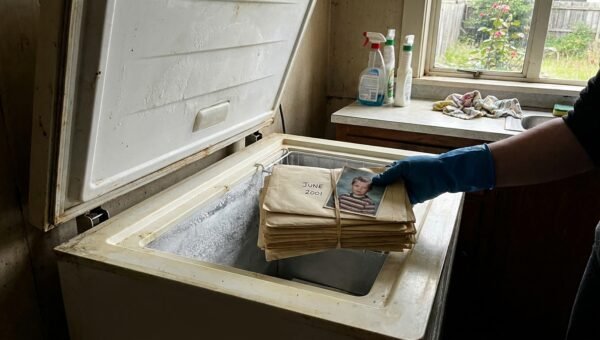
Leon opened the locker. Inside was the blue tin, tucked behind a stack of old score sheets. The lid had a small dent on one side. I knew it from Mom’s kitchen, where she’d kept buttons and loose needles in it for years. I don’t know why she moved it here. Maybe she wanted someone else to hold on to it.
David reached for it, then pulled his hand back.
I opened it.
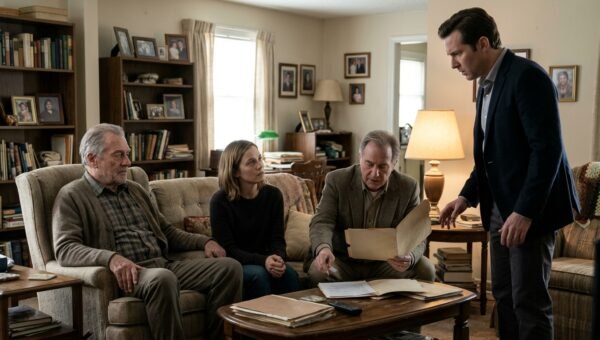
There were three envelopes, all yellowed at the edges, and a short note from Mom. The first envelope held a letter from Clara. The other two held copies of old firm papers, dates, and handwritten notes. I looked at the letter first because it had Clara’s name at the top.
David took it from me.
“Read it,” I said.
He stared at the first page. “I can’t.”
“You can.”
He sat down. I sat across from him, and Leon stepped away to give us room, though he stayed close enough to hear if we needed him.
David started reading silently. His finger moved down the page. Then he went back to the top and read a few lines again.
“What does it say?” I asked.
He shook his head.
“David.”
“It says she found the mistake.”
He stopped there. Then he read more, his lips moving without sound. Clara had worked with the firm’s books. During an audit, she found a serious error in the handling of client funds. The entry was tied to work David had approved. If the firm had treated it as intentional, he could have lost his license and his career.
Clara had signed a statement saying the error was hers. She left the marriage soon after, and let David believe she had hidden it from him and abandoned him with the blame. The old papers showed the dates. Clara had reported the problem before the audit reached the firm. The correction had been made before any client lost money. Her statement was what kept the investigation from turning into a charge against David.
There was a copy of her letter to the firm’s managing partner, dated before the divorce papers. She had written that David had not known about the error when she found it. The records matched the dates she gave. Mom’s note said she learned the truth shortly after the separation, when Clara came to her with the papers and asked her not to tell David unless he was ready to hear it.
David put the letter down.
“She could have told me.”
“Maybe she thought you wouldn’t listen.”
“Mom knew?”
“Yes.”
“All this time?”
I didn’t answer. I could see the answer on Mom’s handwriting, on the dates, on the envelopes she had kept all those years. Still, I let him ask it.
He picked up the second note, the one Mom had written for us. His hands were shaking enough that the paper made a soft sound against the table.
The last line on the list read: “She took the fall so you could keep your license, David. Read the letters in the blue tin.”
That was the sentence I hadn’t wanted to say out loud. Not because it was hard to understand, but because it was Mom’s voice reaching him after she was gone.
David put his hand over his mouth. He looked down at the cards beside the tin.
“She let me hate her,” he said.
I wanted to tell him he was wrong, that Clara had chosen what she thought would keep him safe. But I didn’t know what Clara had felt all those years. I only knew what she’d written and what Mom had kept. So I said, “I think she was trying to protect you.”
He folded the letter, then opened it again. He read the same lines twice. He cried quietly, with his head bent down. I didn’t touch him right away. We had both spent years pretending the subject didn’t hurt, and I didn’t know what would feel like comfort to him now.
After a while, he looked up. “Do you have her number?”
Mom’s papers had one on a small card. I called Clara myself because David’s fingers were shaking too much to press the buttons. She answered on the fourth ring.
“Hello?”
I gave my name. There was a pause.
“I know,” she said.
I told her Mom had died. I heard a small breath on the other end, then nothing for a few seconds.
“She kept calling me,” Clara said. “Every Friday, after cards.”
“I know.”
“I didn’t think she’d keep the chair.”
“She did.”
I looked at David. He had both hands wrapped around one of the worn decks. He nodded for me to pass him the phone.
“Clara,” he said. His voice cracked on her name. “I read the letters.”
She didn’t answer right away.
“I’m sorry,” he said. “I should’ve listened.”
“I didn’t know how to tell you,” she said.
“I know. I know now.”
He asked if she’d come to the memorial. She said she needed a little time, and David said he understood. He didn’t ask her to forgive him. That mattered to me. He only said, “I’d like you there, if you want to come.”
She said she would.
The call ended, but David stayed at the table. He put the letter back in the tin carefully, as if a rough hand might damage something Mom had guarded for years. I set the two decks beside it.
“You were right about the community center,” he said.
“I wasn’t right about everything.”
“I know.”
We had guests coming soon, and there were still cups to set out. So we did that. We didn’t talk much while we worked. It felt like the first honest quiet we’d had in years.
When Clara came in, David stood up. She held her purse in both hands. He walked toward her, then stopped a few feet away, giving her room to choose what happened next.
“I’m glad you came,” he said.
She nodded. “I came for your mother.”
“I know.”
They hugged, not for long. Clara’s hand pressed once between his shoulder blades, and then she stepped back. No one clapped. Nobody made a speech. The guests kept coming in, and the day carried on.
I pulled a chair up to the card table. David took the seat across from Clara. The old decks sat between them beside an extra cup of coffee, and for once, the chair Mom had saved was occupied.