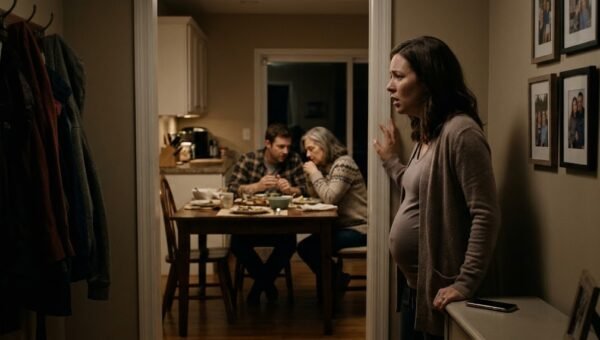
I had the blue pill pinched between my fingers when I saw the folded note beside my oatmeal. The hospital tray had arrived at 6:12 Tuesday morning. The note said, “Please don’t take the blue pill until we speak.” I’d been taking it for nine months because my son, Howard, said it helped my memory. I set it down.
I was 72, and I knew my own name. I knew I had a paid-off house worth $214,000 and a pension of $1,760 a month.
I also knew Howard had been telling me I was too confused to keep living alone. He wanted me to sell the house and move into care. So when the night nurse came back, I asked her what the pill was.
Her name was Evelyn Ramos. She checked my hospital chart, then looked at the bottle in my purse. She turned it to read the small print and checked the pill in my hand. I watched her face change, though she kept her voice even.
“Who fills your medicine box?”
“My son, Howard.”
She glanced toward the hallway. “Mrs. Greene, this medication was never prescribed for you.”
She told me it was an old, heavy sedative, one that could make a person sleepy, dizzy, and confused. The pharmacy record showed no current prescription. The pill’s imprint matched a medicine that had been taken off my list three years earlier and never renewed. My fingers tightened around the paper napkin.
I asked Evelyn if I could see the pill again. She put it in a clean cup and told me not to take anything from the organizer Howard had brought. I wrapped the blue pill in a tissue and kept it beside my water glass. Then I asked her to tell the doctor I wanted a full toxicology screen.
Evelyn didn’t make a fuss. She said, “I’ll get him.” That was all. I liked that about her. She didn’t pat my arm or tell me not to worry. She brought me the cup of oatmeal I’d stopped eating, and she made sure I understood that nobody was going to give me another pill without asking me first.
I kept thinking about the first few months. Howard had offered to fill my weekly pill caddy after I mixed up two morning doses. He said it would be easier for both of us. I was embarrassed, and I let him.
He also brought a little bottle of pills he called an advanced memory formula. I can’t tell you why I didn’t ask the pharmacist. I trusted my son. That’s the plain truth.
The fog came on slowly enough that I blamed myself. I missed a dental appointment. I lost my place in the checkbook. Once I stood outside the grocery store with my keys in my hand and couldn’t remember whether I’d driven there or ridden with a neighbor. Howard was always ready with an answer.
“You’re getting mixed up, Mom.”
“I’m just tired,” I told him.
“You need help before something happens.”
He said it as if he were worried. He probably was worried, at first. But there was always the house in the middle of it. He kept bringing up the $214,000 appraisal, and he kept saying the pension wouldn’t cover care for long. He had already picked out a low-cost facility. He called it a place where I’d be safe.
My house had been mine for forty years. I knew which porch board clicked under my left foot. I knew the cabinet door that had to be lifted slightly before it would close. None of that proved I could still live there, Howard said. On the days I felt slow and wobbly, I couldn’t find a good answer.
Seven months ago, he told me I needed to sign a power of attorney so he could handle things. I signed. He said it was only in case I got worse. Later, he started talking about a quick sale to a man named Marcus Vogel, who was supposedly ready to buy the house. I asked why I needed to decide so fast. Howard said I wasn’t being practical.
I didn’t know then that my confusion had a source. The hospital doctor, Robert Miller, came in just after seven. He explained that I’d fainted the day before because I was dehydrated and my blood pressure dropped when I stood up. He was running the tests Evelyn requested.
“I want to know what’s in that pill,” I said.
“We’ll check,” he told me. “I can’t promise the result right away.”
He also said they were keeping me for observation. I told him I understood. My voice sounded steadier than I felt. I had to remind myself that I was allowed to ask questions. I’d spent so many months watching Howard answer them for me.
He’d brought my purse and a folder to the hospital the night before, then left to “finalize paperwork.” I’d thought the folder was for the care facility. Once the doctor went out, I opened it. The first page was a sale agreement. The next pages were closing papers. I found Howard’s name on the line for power of attorney.
Then I saw the escrow instructions.
The $214,000 proceeds were meant to go into Howard’s personal account. Not mine. His.
There was a note from Marcus Vogel clipped to the contract. It said he could move quickly if the paperwork was signed that morning. I read the words twice. I had to stop and put the pages flat because my hands were shaking. Howard wasn’t just trying to find a buyer for my house. He’d arranged to take the money.
I called the nurse. I asked her to contact the hospital social worker, and I asked for the forms to revoke Howard’s power of attorney and health care proxy. I understood what that meant. He was my only child. Signing those forms would close a door I’d kept open even when I should have asked what he was doing on the other side.
The social worker, Denise, came in with the forms and read them with me. I asked her to go over each line. She did. I signed at 8:41. Then I called my bank and had my pension deposit account locked against Howard’s access. It was not a clever move. It was just the next thing I could do.
Dr. Miller came back before nine with the first lab report. He said the blood test showed an abnormal level of a sedative that had not been prescribed to me. The amount fit with what I’d been taking. He explained that this kind of medicine could affect balance, short-term memory, and alertness, especially in an older person.
“Could it make me seem like I had dementia?” I asked.
“It could make you look confused and unsteady,” he said. “That doesn’t mean you have dementia.”
He couldn’t tell me how quickly I’d feel like myself again. He could say the test didn’t show the kind of decline Howard had described. My mind had not quietly failed in nine months. I had been drugged in a way that made it look as if it had.
I sat with that for a while. I thought of all the times Howard had reminded me I forgot things. He’d watched me struggle, then used the struggle as proof. I was angry. I was also ashamed that I’d believed him. Both things were true, and I had to leave them that way.
At 9:30, Howard came into room 314 carrying coffee. He looked at the papers on my tray and stopped. The smell was burnt and bitter. I knew that coffee. He used to bring it to my house on Sundays when his business was doing well, and we’d sit at the kitchen table and talk about nothing in particular.
“How are you feeling, Mom?”
“Clear enough.”
He put the coffee down. “They’re keeping you here over nothing. We need to get you home and finish the sale.”
I slid the lab report toward him. Then I set the blue pill beside it. Last, I placed the escrow papers on top. I didn’t make a speech. I didn’t have one in me.
He read the account line. His hand went still on the edge of the tray.
“What is this?” I asked.
“It’s temporary. The money was going to cover some things, then I’d sort it out.”
“Your things?”
“I was trying to keep the business open.”
He said the business was behind on payments. He said he’d planned to repay me. He said I’d been confused and he’d handled things the best way he knew how. Every answer seemed to change before he finished it.
I pushed the pill toward him. “You gave me this for nine months.”
“I was trying to help you.”
“No. You were trying to make me look sick.”
He looked at the open doorway. The social worker stood there with a hospital security officer. Evelyn was farther back, holding the chart. Howard’s voice dropped.
“You can’t do this to me.”
“I can.”
“You’re my mother.”
“I know exactly who you are.”
His eyes went to the revoked power of attorney form. I handed it to him. He didn’t take it.
“Your authority is over,” I said. “The sale is canceled. My bank has been notified. The hospital has called Adult Protective Services and the authorities.”
“Mom, don’t.”
“I want my house keys.”
He took them out of his pocket and set them on the tray. His hand shook once. I picked them up and closed my fingers around them.
“I’m not signing anything,” I said. “And I don’t want you handling my medicine again.”
He tried to say something, but nothing came out that I could accept. The security officer told him he had to leave the room. Howard looked at me once. I looked down at the key ring in my hand.
I didn’t go after him.
The hospital reported the drugging to Adult Protective Services and local authorities. The social worker helped cancel the sale and make sure Howard could no longer get into my accounts or make medical decisions for me. The final lab report confirmed the sedative. Howard later admitted he had used old supplies he had access to and kept filling my pillbox because he thought the money would save his failing logistics business.
The house was not sold. The pension stayed in my account. Howard was barred from my room and from speaking for me. I didn’t call him after that. I still miss the son I thought I had, which is different from wanting him back in my house.
By Thursday morning, I was home. I took a taxi because I didn’t trust myself to drive yet. I walked in through my own front door and set my purse on the kitchen chair. The house was quiet. My hands still felt a little slow, but the fog was lifting, and I knew where I was.
I sat at my kitchen table with black tea. The sunlight came in without anyone asking me to move or hurry. My ring of house keys rested solid and heavy on the polished wood beside a clean, empty glass.