“Mabel, is there any more?” Thomas asked, holding my empty bowl in both hands.
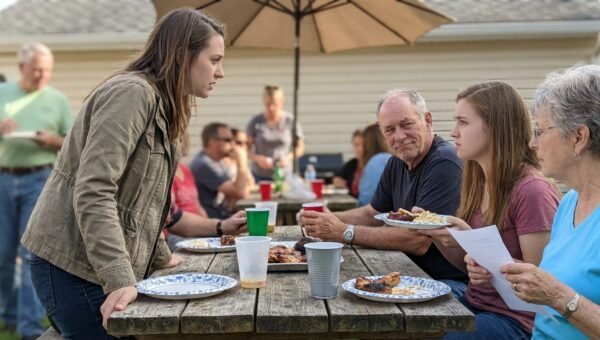
He was standing at the end of the church picnic table. Chloe’s potato salad was right behind him, still sitting there in its neat little dish. I could see the serving spoon laid across the top. I knew what he was about to do, but I couldn’t tell if he did.
A few people had stopped talking. I kept my hands on my lap and waited.
I’m sixty-eight. I’ve buried two husbands. I know a person can make a mess by speaking too soon.
So I’ll back up a little, because none of that bowl business makes sense unless you know what I found on page forty-one.
The church cookbook came home with me after the women’s retreat. It was new, still a bit stiff at the spine, with a blue cover and a picture of the church garden on the front. My daughter had brought it over, along with a container she wanted me to take home.
“Look what they printed,” she said.
Page forty-one said “Sunshine Potato Salad.” Under that, in smaller type, it said “Chloe Thomas.”
I read it twice. Maybe three times. Then I looked at the recipe. It left out the part where I pour vinegar over the potatoes while they’re hot and let them sit before anything else goes in.
It also had no pickle brine, though the salad tasted mostly of pickle brine when I made it right.
The recipe wasn’t mine anymore, according to that page. But it wasn’t even right.
I won a blue ribbon for it at the county fair in 1987 or 1988. I forget which year. My daughter keeps the ribbons in a frame in her pantry, and she knows the year because she wrote it on the back. She says I’m allowed to forget a thing or two. That’s generous of her.
I named it Sunshine Potato Salad because the color looked cheerful in a white bowl. That was before church cookbooks and committee meetings. Back then, I made it for family dinners, then for potlucks, then for anybody who asked.
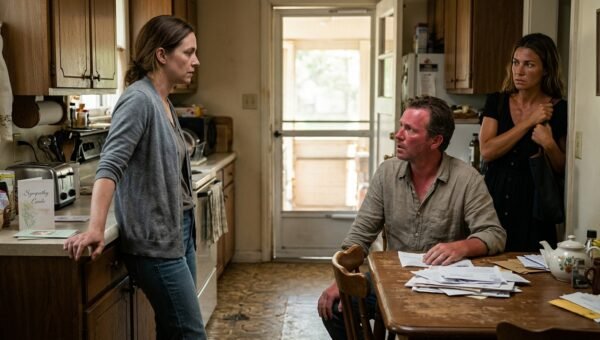
I did not call Chloe. I didn’t corner her after church. I set the cookbook on my counter and left it there for a few days.
I’ll admit, I wanted to call her. I also wanted to be the sort of older woman who didn’t get worked up over a potato salad, which is an easy thing to say until somebody puts her own name on yours.
Chloe was thirty-four, newly married to Thomas, and trying hard to fit in. Thomas had only recently become our pastor. He was a decent man, and he was always hungry. I don’t mean that as a criticism. I mean he could come through the kitchen after a service and ask if there was anything left, even if the only thing left was half a biscuit.
Chloe wanted to be useful. She had told me that herself. She wanted the women to see she had ideas, not just a pastor’s-wife title. I understood that part. I didn’t like what she’d done, but I could understand the hunger behind it.
The first time I noticed her watching me was at the women’s retreat, a few weeks before the cookbook came out.
We had been asked to bring food for lunch, and I’d brought a big pot of potatoes and my usual things. Chloe came into the kitchen while I was working and stood on the other side of the counter.
“Can I watch how you make it?” she asked.
“Sure,” I said.
She watched close. I remember thinking she had a sharp eye. She wrote things down in a little notebook while I cut the potatoes. I told her what went in, and about how much. I didn’t mind. Recipes are meant to be shared, as far as I’m concerned.
But I didn’t hand her a formula for the part I never measured.
You have to dress the potatoes while they’re hot, but not when they’re too hot. There’s a point where they’ll take in the vinegar instead of turning to mush. I can’t tell you the number of minutes. I can tell by the way the steam comes off and by how the edge of a cut potato looks when I tip it with the spoon. Then there’s the pickle brine. I pour it in a little at a time, tasting as I go. Too much and it takes over. Too little and the salad just sits there being potato.
I know how that sounds. Like I’m guarding a state secret. I’m not. I have tried to explain it. My daughter has stood beside me more times than she can count, and still she says, “Mom, how much is a little?” I tell her, “You’ll know when you taste it.” Which is not helpful, I know.
Chloe wrote the amounts down. She asked whether the potatoes should cool first. I said no, not all the way. Then someone called me to help set out plates, and I went. I thought she had what she needed.
When I found her name under mine, I got mad, then embarrassed about being mad, then mad all over again. It’s a potato salad, I kept telling myself. It’s also the thing I’ve brought to that church for years. Both things were true. My daughter saw the cookbook on the counter and gave me a look, but I told her I wasn’t going to make a fuss.
I didn’t want to shame Chloe in public. I also didn’t want to give up something I’d earned just because I was old enough to be expected to smile and let the young ones have their turn.
So when the church picnic came around, I made my salad.
I made it the way I always do. I used the potatoes from the farmers market, though I’d had to go back because the first bag had a soft one tucked at the bottom. I boiled them until a fork went in without a fight, drained them, and left them just long enough that the worst of the steam passed. The vinegar went on while they were warm. I watched it soak in. I added the brine at the end, a little, then a bit more.
I wasn’t going to make it badly just to prove something. That would’ve been foolish, and I’m not above foolishness, but I could at least try not to be.
The morning of the picnic, I got there early with my bowl covered in a dish towel. Chloe was already there. She’d set her salad on the table with a little card in front of it that said “Sunshine Potato Salad.” She’d added yellow paper flowers around the card. I had to give her credit for the flowers. They were cheerful.
Her salad looked pretty, too. Smooth on top, bright yellow, with chopped herbs scattered over it. Mine was in my old white ceramic bowl, the one with a little blue line around the rim. It had a tiny chip on the underside. I don’t even remember where I got it. It’s just been my bowl for years.
Chloe smiled when she saw me.
“Yours looks lovely,” she said.
“So does yours,” I said.
And I meant it, mostly. We put the bowls a few feet apart. I didn’t want to watch her watch me, so I went to help with the lemonade and the paper plates. There was plenty to do. There always is at a church picnic, even when people say they’re just stopping by.
I noticed the first few people taking her salad. Nobody made a face. Nobody said anything. It was a nice-looking dish and people were polite. They took a small spoonful, then moved on to the baked beans or the chicken. One woman circled back to the table, glanced at Chloe’s bowl, and kept going.
Mine had a steady line. People who knew me took some, then came back. A couple of younger women asked what I’d put in it. I told them the ingredients, then said the rest was in the timing. They laughed like I was joking.
By noon, Chloe’s bowl had maybe four spoons taken out. Mine had a smudge around the sides and no salad left. One of the older men had scraped it clean. He looked a little sorry when he set the spoon down, but I told him not to be. That was what the bowl was for.
This is where my mind got busy, and I’m sorry if I sound as if I’m counting every bite. I was. I could see the two dishes from where I stood. I could see the little card with Chloe’s name on it. I could see the empty place in my bowl where the salad had been, and I kept thinking I ought to say something before Thomas did. Then I thought, no, let him eat his lunch. Then I thought, if I say nothing, the cookbook still says her name. Then I felt mean for thinking that while Chloe was standing there with people passing her dish by. She wasn’t a monster. She was a young woman who’d tried to make herself look like she belonged, and she’d gone about it the wrong way. I know what it feels like to want people to like you. I also know what it feels like to be taken for granted because you’ve been around long enough that folks assume you won’t mind.
Thomas had been eating at the far end of the table. I saw him get up with his plate. He walked around the end, looked at Chloe’s dish, then at the one I’d brought. He lifted my empty bowl in both hands.
That brings us back to where I started.
He didn’t walk toward the kitchen. He carried my bowl over to Chloe’s end of the table and set it right in front of her, just beside her untouched salad.
Then he looked at her dish and back at the empty bowl.
“Could I have some more of Mabel’s?” he asked. “This one’s still here.”
He said it kindly. He wasn’t trying to humiliate her. Thomas had simply eaten enough of both to know the difference, and there wasn’t a tricky way to say it.
Nobody laughed. That mattered.
Chloe looked down at the bowl. Her fingers tightened around the serving spoon, then loosened. She had put so much care into how the dish looked. I could see her trying to decide whether to be hurt or mad. I know that face. I’ve made it myself.
Thomas added, “I thought it was the same recipe.”
It was quiet for a second. Not a big dramatic quiet. Just the kind that comes when somebody has said the thing everybody was trying not to say.
Chloe looked at me. “I did watch you make it,” she said. “I wrote down what you told me.”
She didn’t say she’d meant no harm. She didn’t say I was wrong. I appreciated that.
“I should’ve asked before I put your name on it,” she said. “I mean, before I put mine on it.”
That was the first time she had said it plainly. My daughter was standing nearby with a stack of paper plates. I could tell she wanted to step in, but I shook my head a little. I didn’t need her to do that for me.
“It’s not about the bowl,” I said. “It’s that the page says it came from you.”
“I know,” Chloe said. “I’m sorry.”
I could’ve made her apologize again. I could’ve explained the county fair, the ribbons, the years I’d carried that bowl into the church basement. The truth is, I wanted to. I wanted everyone to hear the whole story and understand that I hadn’t just wandered into the kitchen yesterday. But standing there with the empty bowl in front of us, I could see she already understood enough.
So I told her what I should have told her at the retreat.
“The potatoes need the vinegar while they’re warm,” I said. “Not hot enough to fall apart. And the brine has to be tasted as you go. You can’t get it from a card.”
She nodded. “Will you show me?”
I almost said, I already did. I didn’t. It would’ve been true, but it wouldn’t have helped.
“Yes,” I said. “Next time we make it together.”
Thomas went back for more chicken. A few people came by and asked if there was any salad left. There wasn’t. Chloe’s dish stayed mostly full, but it didn’t sit untouched the whole afternoon. She took some herself after the tables cleared, and I saw her try it without making a face. She was allowed that much.
The cookbook didn’t get pulled from shelves or anything. It was already printed. But the kitchen committee started asking people whose recipes they were before the next one went in. The women joked about it at the following potluck. “Who do we credit for this one?” became a regular question. Chloe laughed too, though she had a way of looking at me first.
She and I never became best friends. That’s not what happened. We got along better after that. She helped me with a church supper one winter, and I let her do the chopping while I watched the potatoes. She asked how warm they should be. I said, “Warm enough to know.” She smiled at that, and I showed her what I meant.
My daughter still keeps the blue ribbons in her pantry. They hang steady on the wall, just above the shelf where she keeps the flour. I went home that afternoon with my old bowl, clean except for a little vinegar smell around the rim. I washed it at my sink and set it upside down to dry.
The page in the cookbook still had Chloe’s name on it.
The ribbons were still my daughter’s to keep.