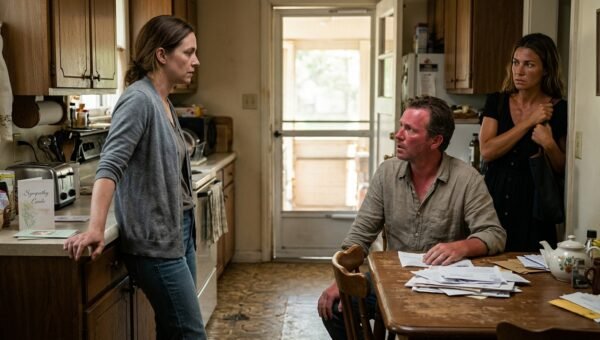
My hand was inside Grandma’s flour drawer when Julian reached across the counter and said, “Close it. We’re not doing this today.”
I had only opened it to find a pencil. The drawer stuck like it always had, and I had to tug twice before it gave. Then I saw the bundle of old order slips tucked behind the flour scoop, tied with baker’s twine.
Our bakery was supposed to be sold that Thursday. The rain kept ticking against the front windows while Julian stood beside the contract, ready to sign.
I had flour on my sleeve and a dead man’s name in my hand.
Arthur Vance. The same name was stamped on slip after slip, dated month after month, right up to that week.
I didn’t close the drawer.
Julian and I inherited the bakery six months earlier, after Grandma and Grandpa died. We owned it equally, which meant neither of us could make a clean decision without the other. Julian wanted out. I wanted the ovens running for Martha and the others who’d spent most of their working lives in that kitchen.
That sounds simple when I say it now. At the time, I was worried about the roof, the electric bill, and whether I could make enough to buy Julian out. I also knew the bakery couldn’t keep going on memories alone.
Julian worked in corporate finance. He was used to looking at numbers without seeing the people standing behind them.
I’m not saying that to make him a villain. He’d been helping with the bills after Grandma got sick, and he thought selling was the safest thing for us. He just didn’t work the flour bins as a teenager. I did.
Grandma taught me to count change beside the brass register. She made me start over if I was off by a penny, even if there were customers waiting. Saturdays, before the rush, she’d let me choose one pastry. I usually picked a brioche knot, still warm enough to leave butter on the paper.
I didn’t understand then that she was teaching me what the place was for. Mostly I thought she was teaching me not to short the till.
The person waiting by the counter that Thursday was Charles Henderson, the buyer Julian had brought in. The contract said the building would be sold clear of outstanding service obligations.
I’d read that line three times and still couldn’t tell what it meant for the bakery’s old accounts.
When I saw Arthur’s name, I stopped trying to guess.
“What are these?” I asked.
Julian took a step toward me. “Put them back.”
That was when Henderson leaned closer. He’d been watching the slips, not the contract.
“Don’t,” he said. “I talked to someone using that account yesterday.”
I looked at him. “Someone?”
“A woman. She was carrying four crates of seeded sourdough to St. Jude’s pantry.”
The bread slips bent in my fingers. The rain kept tapping the window, and behind me the oven fan made its usual low rattle. I knew St. Jude’s. Martha had sent bread there for years, though I’d never been told much about why.
Henderson said the woman had introduced herself as Clara Vance. Arthur’s daughter.
Julian’s face changed, not by much. He looked down at the contract and rubbed his thumb along one corner. Then he said, “That’s not relevant to the sale.”
It was the first time I heard him say something that didn’t fit what I was looking at.
Henderson explained that he wasn’t a demolition developer. He was buying old commercial buildings with a local grocery group and keeping the businesses that could keep working. He’d come by the bakery the day before without Julian, to see what the neighborhood was like.
“I was told there weren’t any regular customers left,” he said.
There were plenty of days when the bakery felt half empty. We’d lost some customers to a grocery chain, and the shop needed repairs. But we still had a morning line on Saturdays, and Martha knew more people in town by their bread orders than I knew by name.
“Clara was there,” Henderson said. “She was picking up bread for the pantry.”
Julian gave a short laugh. It didn’t sound like he found anything funny. “One person picking up bread doesn’t make this a business.”
I wanted to answer him, but I couldn’t get past the word one. One customer, one account, one name on a pile of slips that covered twelve years.
So I opened the drawer wider.
There were more papers underneath, folded and flattened from being kept there. I pulled out the bundle. Julian moved fast enough that the contract slid sideways.
“Stop,” I said.
He put both hands on the counter. “You don’t know what you’re looking at.”
That was true. I didn’t. But I knew he did.
Martha came through the kitchen doors carrying a brown leather ledger. She’d worked the ovens since Grandma’s early days, and she had a flour mark on one cheek. She didn’t look surprised to see the slips.
“I wondered when you’d find those,” she said.
Julian stared at her. “You were supposed to leave that in the office.”
“I did,” Martha said. “You’re the one who moved it.”
The ledger had Grandma’s handwriting inside. I knew it from the recipe cards and the notes she used to leave by the register. Martha set it beside the slips and opened it to a page marked with a bit of folded paper.
The account was listed as Arthur Vance’s community bread fund. It showed monthly deposits and weekly orders. There was a balance, too, though I had to read the figures twice. The money hadn’t been a gift to the bakery. It had been held for bread and soup orders meant for families who needed help but didn’t want to stand in line and explain themselves.
Arthur had been a neighbor and a retired teacher. He died twelve years earlier. Before he died, he and Grandma had set up the arrangement quietly. Afterward, his daughter Clara kept paying into the account every thirty days, always under his name.
“Why keep it secret?” I asked.
Martha turned one of the slips toward me. “Arthur didn’t want anybody thanking him for bread.”
That was the line I kept hearing after. Not because it was clever. Because it sounded exactly like the way Grandma would’ve handled it. Keep the books straight. Feed people. Don’t make a show of it.
Clara had kept her father’s name on the orders so nobody would make a fuss over her, either. Martha and Grandma had packed the weekly loaves. Sometimes soup, when the kitchen had enough. St. Jude’s pantry was one of the places that got them.
I looked at the dates. The last slip had been written in Grandma’s hand, but the new payment mark was Clara’s. She’d kept it going after Grandma died, while we were busy arguing about the building.
Julian looked at the ledger. “Those are obligations.”
“Yes,” I said. “They are.”
He finally admitted he’d found the slips two weeks earlier while going through the accounts for the sale. He’d moved them into the flour drawer because he didn’t want them mixed into the paperwork. When I asked why he hadn’t said anything, he rubbed his forehead.
“The contract has an indemnity clause,” he said. “If we signed with those accounts open and couldn’t fulfill them, we’d be on the hook.”
“So you hid them?”
“I was trying to keep the sale clean.”
It wasn’t a good answer. It was a human one, which somehow made it harder to stay mad in a simple way. He wanted a fast closing. He wanted his share of the money. He was tired of the bakery’s bills and didn’t want to inherit another problem.
But he’d let Henderson believe we had no regular customers. He’d told Martha to stop baking the community batches. And he’d left me ready to sign a contract without telling me what was in the drawer.
“You told me the accounts were settled,” I said.
“I said the business accounts were settled.”
“That isn’t the same thing.”
He looked down. “I know.”
Martha closed the ledger with one hand. Her fingers had little burns from the ovens. I remembered watching her pull pans out when I was fifteen and thinking she never seemed tired. She did. She just came back in the morning.
Henderson picked up the sale contract and read the clause Julian had been pointing to. “I’m not signing this version,” he said.
Julian’s shoulders tightened. “Then we’re done.”
“No,” Henderson said. “The demolition part is done. I buy operating businesses. I was told this one had no regular trade, but this says otherwise.”
He didn’t promise to save us out of kindness. He talked about roof repairs, a new walk-in cooler, and a plan for turning the front room into a small bakery café with local goods. He wanted to invest, but not take over the kitchen. He wanted the bakery to stay open and the staff contracts protected.
That was more than I’d expected. It was also not enough to keep Julian from leaving with nothing.
The estate had a right-of-first-refusal clause. Grandma and Grandpa had put it in the papers years ago, in case either of us ever wanted to buy the other out. I’d forgotten it was there until Martha told me where to look.
I did the math on the back of one of the order slips. My inheritance, the money I’d saved, and a small loan I could manage would cover Julian’s share if Henderson provided the building funds. It would leave me with very little cushion. I knew that.
I also knew I couldn’t ask Julian to stay in a business he hated.
“I’ll buy your half,” I said.
He looked at me like I’d said I was buying the moon. “You can’t afford that.”
“I can afford enough of it.”
“You’ll have no savings left.”
“I know.”
He shook his head. “You’re doing this because Grandma gave you a pastry every Saturday.”
That stung because it wasn’t completely wrong. I was doing it because of the pastry, and the register, and the staff, and the people whose names I didn’t know but whose bread orders were right there in my hands. I was doing it because selling had started to feel like pretending none of that counted.
“You don’t have to understand it,” I said. “Just tell me what you need for your share.”
The lawyer came back the next morning. We didn’t sign the old contract. Henderson’s group agreed to a minority stake for the building improvements, with me keeping kitchen control and the staff’s jobs written into the new agreement. Julian got his payout. I took on debt and the daily mess of keeping a bakery open.
The sale-and-demolition deal ended there. It took weeks to get the new papers right. Clara met with us and agreed to make the bread program official, so the account wouldn’t depend on anybody’s memory or a hidden stack of slips. We named it the Arthur and Grandma Vance Bread Trust.
Julian left the business for good. We still see each other at family things, but we mostly talk about weather and whose turn it is to bring a side dish. I don’t pretend I’ve forgiven every part of it. He did what he thought would protect his money. He just didn’t tell me what he was protecting it from.
The roof repairs started in the fall. Henderson’s people helped fix the cooler and update the front room. Martha stayed on, and so did the others. The first week we reopened, she put the community loaves on a separate rack near the back door, just like before. No signs. No announcements.
At dawn the first Saturday after the last repair crew left, I wiped down the brass register with a clean cloth. I’d come in at 4:00 to get the ovens going. A fresh batch of pastries sat on a tray for the morning rush, and the flour dust hung in the early light.
I set one brioche knot aside before the bell rang.