I was wrong about which account my brother emptied that night. I thought the blue debit card in his hand meant my forty-two thousand dollars was gone. It didn’t. I know how the story ends now, but for a while I believed I had lost my home and the money I’d worked years to save in the same ten minutes.
I’d just finished a fourteen-hour NICU shift. My scrub top smelled like hand soap and the cheese crackers I’d eaten at the nurses’ station around 4:00.
I remember that because I was still tasting them when I turned onto my parents’ street at 10:15 p.m., already thinking about a shower and my bed.
Instead, I saw my suitcase beside the front door.
There were three black trash bags beside it. I recognized the green sweater sticking out of one. My mother, Ruth, had folded it for me the Christmas before. I stood with my keys in my hand for a few seconds, trying to make the bags mean something else.
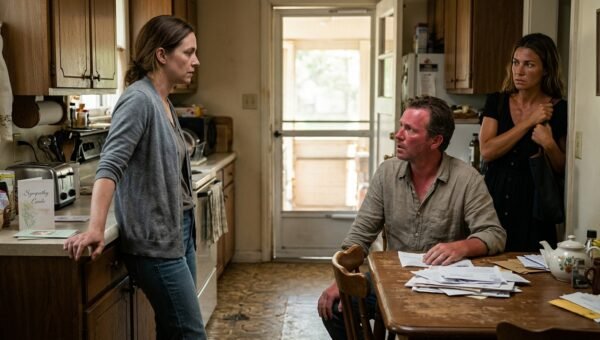
Then I saw my brother, Wade, at the kitchen table. My parents were there too. Brittany, his new girlfriend, was sitting in my old bedroom doorway, holding a mug that belonged to me.
Wade slid my blue debit card across the table. He said my job in that house was done. He said it like he’d practiced it.
“Your job here is done.”
My father, Paul, kept looking at the table. Mom watched Brittany. I looked at the card and asked where my money was.
Wade said he’d taken care of it. He said the account was empty, and there wasn’t anything I could do about it.
I don’t know why I looked at Mom first. I suppose I still thought she might say this had gone too far. She didn’t. She said, “Don’t make a scene in front of Brittany.”
I didn’t yell. Not because I was calm. I had just worked with tiny babies and scared parents all day, and I didn’t have much left to spend on a fight. Also, I was ashamed. I’d been living at home, and I’d let my family talk about my paychecks like they were part of the household budget.
That wasn’t the whole truth, but it was enough of one to make me feel stupid.
I’d paid a share of the bills for years. I bought groceries when Dad’s hours were cut and covered a repair on Mom’s car.
Nobody forced me to do those things. I wanted to help. I also wanted to believe that helping meant I was safe there.
When I got the NICU job, I set up a regular account for household expenses. The blue card was tied to that account. I kept a few hundred dollars in it for groceries and bills, not my savings. Wade knew I used that card around the house. He’d seen it in my wallet. He had no reason to think there was another account.
My savings had a different purpose. I’d been putting money away for a nurse practitioner fellowship. It took me years. I skipped trips and kept driving an old car that made a noise when I turned left. I had forty-two thousand dollars set aside, and I had told my parents the amount because I thought they were proud of me.
Earlier that week, the money had moved into a hospital credit union trust for the fellowship.
It needed my biometric approval and institutional clearance to come out. Wade didn’t know that. My parents didn’t know either.
At the time, all I knew was that my brother was smirking at the card and my mother was asking me to protect Brittany’s evening. I picked up the card. Then my phone rang.
10:34 p.m.
I stepped outside before I answered. My hands were shaking enough that I had to try the screen twice. The call was from Mara, the hospital compliance director. She told me the credit union had flagged an attempt to access my secured account.
I thought she meant the household account. I told her Wade had the blue card. She asked me to stay on the line, then explained that the card had only reached the expense account. The forty-two thousand dollars was still in the fellowship trust.
I sat down on the porch step.
Mara said someone had tried to enter a PIN and submit a withdrawal request using my information. The credit union had blocked it because the account required my biometric approval and a second institutional sign-off. They’d also flagged a signature that didn’t match mine.
“Did anyone else have access to your information?” she asked.
My family was inside. I could hear a cabinet shut. I said yes.
Mara didn’t ask me to explain the whole family history. She told me not to go back inside to argue, and asked if I could get somewhere safe for the night. She also told me hospital legal services could help secure my records and put a hold on linked identifiers.
I said yes to the hold. I said yes to the report. I was surprised how easy it was to answer once the questions were plain.
Then I sat there longer than I needed to. I could hear them talking through the door. I kept thinking about my clothes in those bags, the sweater, my name on the account. I wanted to go back in and ask Mom one more time why she’d picked Brittany’s comfort over mine. I knew how that would go. Still, I wanted to ask.
I called Nia, a nurse I worked with, and told her I needed a place to sleep. She was quiet for a beat, then said, “Come here. We’ll figure out the rest tomorrow.”
I loaded the suitcase and the bags into my car. I left some books behind because the trunk was full. I took the blue card with me. Wade watched from the kitchen but didn’t come outside. Dad opened the door once, then closed it again when I looked up.
The next morning, I met with the credit union security officer and a lawyer from the hospital. I brought my pay records, my account papers, and the messages I’d saved from Wade asking me for login details a month earlier. I hadn’t given him the password. I had sent a photo of the front of the blue card when he said he was trying to pay the electric bill. At the time, it seemed harmless.
The officer showed me the transaction log. There had been a failed PIN attempt and a withdrawal request tied to a forged signature. It hadn’t been a mistake with the bills. Someone had tried to move my fellowship money.
The actual balance in the expense account was $386. That was the money Wade had been pointing to when he said he’d emptied me. He hadn’t gotten the forty-two thousand. He had only managed to leave a record of trying.
I went over the same facts more than once. Maybe I was hoping one of them would change. The blue card had been used to make the whole thing look ordinary. My parents had helped pack my things. Wade had taken my information, tried to access the trust, and then stood there acting like he’d won. I kept thinking about Mom saying not to make a scene. Not once had she asked if I had somewhere to go. Not once had she asked if I was okay. I know I wasn’t perfect in that house. I could be sharp when I was tired, and I’d used money to avoid hard conversations. But I had not earned that. I had not earned that.
The hospital lawyer helped me file a formal report. I also froze the accounts tied to my personal information and set up new passwords, new account numbers, and a mailing address that wasn’t my parents’ house. I didn’t call them to explain. I didn’t want to give them another chance to talk me out of what I’d already done.
Nia let me stay in her spare room for twelve days. I slept on a narrow bed with a squeaky frame, and I kept waking up before my alarm because I was used to checking the clock before a shift. I went to work. I ate what Nia put in front of me. I filled out apartment forms between shifts.
The police and credit union investigators went to my parents’ house a few days later with a warrant. I wasn’t there. I was at work when Mara called to tell me they’d found the paperwork Wade used to try to get into the trust. The account records and signature check backed up the report.
My parents called that night. Mom said the investigators had embarrassed the family. Dad said Wade had made a bad choice and needed help, not charges. I asked if they’d known he was trying to take my money. Neither answered right away.
Mom said Wade thought he was entitled to some of it because he’d helped around the house.
He had not. He’d helped Dad carry groceries once or twice. That was what she meant.
I told her the money was for my fellowship and that I wasn’t dropping the report. She said I was tearing the family apart over money that was still there.
That was the last time I spoke to either of my parents for more than a few seconds. Wade was charged with felony fraud and identity theft. My parents didn’t face the same charges, but the investigation showed they had helped him get my account details and pack my things. They spent money trying to pay for his defense. I heard about that through a cousin. I didn’t call to check whether it was true.
I didn’t go back for the rest of my books. I didn’t ask for my old room. Brittany could have it. Wade could keep the card if he wanted. The hospital helped me finish the paperwork for the fellowship, and the trust covered the costs it was meant to cover.
The strangest part was that I still felt guilty for a while. I’d see Mom’s name on my phone and think I should answer just to make sure she was all right. Then I’d remember the bags at the door. I’d remember how she looked at Brittany before she looked at me.
I signed a lease on a small apartment with two windows and a kitchen counter big enough for a coffee maker. It wasn’t fancy. It was mine. On my first morning there, sunlight landed across the counter while I set down a new set of keys.
The blue card was gone. The clean keys were mine.