Cal asked me to cross Denise off Mom’s memorial list before we’d even unfolded the card tables. I had the list in my hand, and he was pointing at her name like it was a mistake I could fix with a pen.
I didn’t cross it out. I asked him why Mom had kept an empty chair for Denise at every holiday for fifteen years.
He pointed to the last line on the page.
I’m getting ahead of myself. The argument started earlier, with the funeral.
Cal wanted a church service. Mom hadn’t gone to church in years. She played cards every Friday at the community center, knew who took cream in their coffee, and called the center her second home. I wanted to have the gathering there. Cal said it didn’t feel right.
“People expect a church,” he told me.
“Mom stopped expecting one,” I said.
He looked at me like I’d said something mean. Maybe I had. I was tired, and I’d spent the week making calls while Cal kept saying we should “do it properly.” We weren’t fighting about God, not really. We were fighting about who got to say what Mom’s life had looked like.
We settled on the community center. Cal agreed because there wouldn’t be a church service, but he said we could still make the gathering respectful. I said Mom would have considered a card game respectful. We both knew neither of us had won.
The director, Mr. Bell, met me before the guests arrived. He was holding a brown paper bag folded over at the top. He said he’d found it in the office after Mom died, and he’d been waiting for me to come by.
“She asked me to keep it safe,” he said.
Inside were two decks of cards, both worn soft at the corners, and a folded sheet of paper. I recognized Mom’s handwriting before I opened it. She wrote her grocery lists in block letters, always pressing hard enough to leave marks on the paper underneath.
The page was a list of people to invite. Mr. Bell’s name was there, along with the regular Friday players. Then I saw Denise.
Cal came up beside me as I was reading. His face changed. Not dramatically. He just stopped moving for a second, then reached over and tapped her name.
“Take her off.”
That’s when I asked him about the empty chair.
For years, Mom had set a place for Denise at Thanksgiving and Christmas.
At first I thought she was doing it out of habit. Then Cal told her to stop. She didn’t. Once, when I asked, Mom said, “I don’t like pretending people disappear.”
I didn’t press her. I should have. I was happy to let the whole thing stay vague because vague meant I didn’t have to disagree with Cal.
Now he was standing in the community-center hall, asking me to erase Denise from a list Mom had made herself.
“She hasn’t been around for fifteen years,” he said.
“That’s not the same as being gone.”
His jaw tightened. He looked toward the card room, where Mr. Bell was setting out cups. Cal had wanted the church service, and he’d lost that argument. Maybe he thought if he could keep Denise away, the day would still feel like his version of Mom.
“Don’t make this harder,” he said.
I’m not proud of what I said next. I told him he’d been making things hard for Mom for years by asking her to pretend Denise never mattered.
He flinched, and I wanted him to. That was the ugly part. Grief didn’t make me kinder. It gave me an excuse to say things I’d been saving up.
Cal pointed again at the paper.
I looked down. Under the names, there was a date. Fifteen years earlier, written by itself. Then the final line, tucked close to the bottom edge.
Before I could read it, Cal said, “I know what it says.”
I figured he was bluffing. He had spent most of the morning acting as if the list itself was the problem. But he looked at that date like he’d seen it before.
We sat at one of the card tables. The vinyl covering had a little split near the edge, and my sleeve kept catching on it. Cal put the paper down between us. The two decks sat beside it.
Mom had played with those decks every Friday. She took one deck home when a card went missing, but somehow both of those old ones had made it back into the bag. One had a bent queen. I remember her saying it was a useful card because it looked “too tired to cause trouble.”
I didn’t know then that those Friday games had turned into a place where Mom heard things our family didn’t say out loud.
Cal picked up the paper and ran his thumb along the fold. “She kept asking me about Denise,” he said.
“What did you tell her?”
“That Denise left.”
He rubbed his thumb over the fold again. I could hear a cart squeak in the hall. Mr. Bell was moving chairs, trying not to make it seem like he was listening.
I asked Cal if that was what happened.
He stared down at the list. “I told everybody she left me.”
It was not the same answer.
Cal said they’d been fighting for months. He said he’d been angry all the time, and Denise had stopped trying to talk him down. He’d moved out after one fight, then told the family she’d walked away from the marriage. He said he let us believe she’d been cruel because admitting he’d left first felt worse.
“That’s all?” I asked.
“No,” he said.
He told me he’d said things to her he couldn’t take back. He’d told her she was the reason he was miserable. He’d made the fight sound like she had forced him out, even though he had packed his own things. He also told our family she’d been seeing someone. She hadn’t.
I sat there, looking at the bent queen. I remembered how quickly we’d believed him. Cal was loud when he was hurt, and Denise had always been quieter. We called that proof.
“You made us hate her,” I said.
“I know.”
He didn’t say it to defend himself. That made me more uncomfortable, not less.
Mom had learned the truth from Denise, at least part of it. I found that out from Mr. Bell later. One of the regular card players, Arlene, had been there when Denise called Mom years ago. Arlene said Mom never repeated their conversation, but she stopped letting the family talk about Denise as if she had been the only one who did damage.
“She told me your mother said, ‘I’m not going to make you beg to be remembered,’” Arlene said.
I was annoyed that Mom had shared anything with Arlene and not with me. Then I was annoyed at myself for thinking I deserved the whole story just because I was her daughter.
Mom kept setting that chair. She wasn’t trying to punish Cal in front of us. I think she was giving him a place to come back to, though I hated how long it took him to see it.
I picked up the page. The last line was in Mom’s handwriting, firm and a little slanted:
“You cannot build a peaceful future on a foundation of unaddressed blame; invite her so you can finally apologize for what you broke.”
Cal read it once. Then he read it again, quieter.
He covered his mouth with his hand. His shoulders moved, but he didn’t make a sound. I slid the paper toward him instead of taking it away.
“She knew,” he said.
“Yeah.”
“She knew I lied.”
“Yeah.”
He said it again. “She knew.”
There it was. Not a grand speech. Just the fact of it sitting between us, along with Mom’s old cards and the list I still hadn’t crossed out.
I told him I was going to call Denise. He said he should do it himself. I said he could, but the name stayed on the list either way.
For a minute he looked ready to argue. Then he nodded. I took my phone into the hall because I wanted a little space, though there wasn’t much of it. I called the number I’d found in an old address book Mom kept in her desk.
Denise answered on the fourth ring.
I told her Mom had died and was having a gathering at the community center. I said Mom had put her name on the list. I didn’t tell her everything about Cal’s confession because I didn’t want to make promises on his behalf.
Denise was quiet for a moment.
“Did Cal ask you to call?”
“No,” I said. “I did.”
She let out a breath. “I can come for your mom.”
I thanked her. Then I said I hoped the rest of us could do better than we had before. She said she’d see how she felt when she got there.
That was fair.
The Friday players began arriving while Cal and I were still setting out the cups. Arlene brought a tin of cookies. Mr. Bell put the two decks beside the guest book. People came in with the careful voices people use when they aren’t sure whether the family wants a hug or space.
Cal didn’t leave. He kept helping, though I could tell he was looking at the door every time it opened.
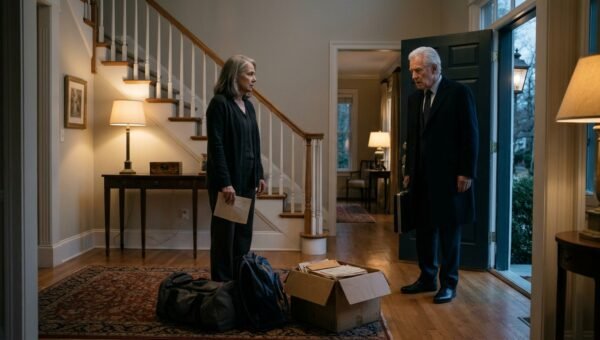
Denise came in alone. She had a dark coat folded over one arm and a small purse held close to her side. She stopped just inside the room. Cal stopped too.
I put my hand on the back of an empty chair and pulled it out.
Denise looked at me, then at Cal. He walked toward her. Not quickly. Just enough that he couldn’t pretend he hadn’t seen her.
“I’m sorry,” he said.
His voice caught on the last word. He didn’t try to explain what he’d told us or why he’d done it. He told her he’d been wrong to make the family think she had abandoned him. He told her he’d lied about her seeing someone. Then he said the one thing he had spent fifteen years avoiding.
“I broke it, and I let you carry the blame.”
Denise’s hand tightened on her purse strap. She didn’t hug him. She didn’t tell him everything was fine. She said she’d heard him, and that was what she could give him that day.
Cal nodded. He didn’t ask for more.
I wanted to say something about Mom, about the chair, about how this should have happened years ago. I didn’t. This wasn’t mine to tidy up for them. I’d spent enough time helping Cal make his story sound clean.
We started the gathering without a service. People told small stories about Mom. She dealt herself the queen of hearts whenever she thought nobody was watching. She hated when anyone read the rules out loud. She liked having one more chair than people, just in case.
At some point, Arlene began shuffling cards. Cal asked Denise if she wanted to play a hand. Denise said, “Just one.”
They sat across from each other at the center table. I set the bent queen aside and passed them the other deck. The room filled in around them, with people carrying cups and taking their places.
Cal dealt. Denise picked up her cards.
The extra chair was filled. The worn deck rested between them as they started a quiet game of gin rummy.