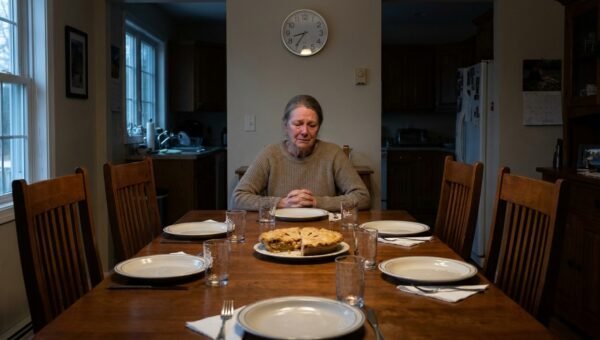
My brother took credit for caring for Mom at her funeral, and I let him finish.
I was six feet away with the hospital bracelet from the night she died still in my purse. I’d spent four years buying groceries, sorting pills, paying bills, and answering the phone when she woke up scared at 2 a.m. Dennis lived twelve minutes away. He visited three times in those four years.
He was forty minutes late to the service.
I know because I checked the clock twice. The first time, I thought maybe he’d come in before the prayer.
The second time, I was sitting there with my hands locked around the purse strap, hearing him tell everyone he’d been beside Mom through years of illness.
He had a clean suit and a sad voice. He said he’d done everything he could. A few relatives nodded. One of Mom’s church friends reached over and squeezed his hand.
I started to stand up.
Arthur Bennett, Mom’s attorney, touched my arm and whispered, “Wait.”
That was all. I sat back down. I don’t think I trusted myself not to say something ugly in front of the whole church, and I was tired of being the person who made things uncomfortable by telling the truth.
Arthur had a reason for asking me to wait. I didn’t know what it was yet.
The years before the funeral weren’t all awful. Mom was still Mom for a long time. She used to write the grocery list on the back of envelopes, even after I bought her a small pad just for that.
She’d say the envelopes were already there, so why waste paper. I’d bring groceries in and she’d tell me I’d bought the wrong kind of bread, then eat two slices anyway.
After her health began to slip, I took over more. At first it was driving her to appointments and filling her pill box. Then it was making sure she had food, handling the bank calls, and keeping the medicine schedule straight when she got mixed up.
I had a job and a life of my own. I cut back my hours, then gave them up. I told myself it was temporary. I still feel embarrassed saying that, because I know how easy it is to make a choice sound noble afterward. Some days I was patient. Some days I was short with her and went home mad at myself.
Dennis always had a reason he couldn’t come. He had work. His back hurt.
He had a meeting early. He’d say he would stop by Saturday, then call Sunday night and tell me something came up.
When I asked him to come sit with Mom for an afternoon, he said he’d try. I’d wait around for him anyway. Then I’d get the call saying he couldn’t make it.
“Could you bring her groceries this week?” I asked him once.
“I’m slammed,” he said. “Can’t you do it?”
I already was doing it. I didn’t say that. I just hung up and added milk to the list.
The calls came at all hours. Mom would wake up confused, or she’d be short of breath and frightened, or she’d think she’d heard somebody in the house. I got so used to the sound of my phone that I’d reach for it before I was fully awake.
I don’t want to make myself sound like a saint. I sometimes let it ring once before I answered.
I’d stare at the number and feel angry that the whole job had landed on me. Then I’d pick up anyway.
Dennis knew where the house was. He knew the drive. He lived twelve minutes away. I kept those facts in my head like they might eventually make him act differently.
Six months before Mom died, he called her about the house. He asked if she would sign over deed rights, supposedly to protect the property from Medicaid. I wasn’t there for that call, but Mom told me about it the next day. She was quiet, not confused.
“He wants me to sign something,” she said.
“What do you want to do?”
“I want to ask Arthur first.”
That was when she started keeping track. Arthur didn’t announce it to me, and Mom didn’t tell me every detail. I only knew they’d been talking. Sometimes I’d see his car outside her house after a visit, and Mom would say they’d gone over her papers.
I assumed it was ordinary planning. I didn’t ask to read anything. I was busy enough trying to keep her safe until morning.
Three months before she died, Mom fell beside her bed. It was around 2 a.m. I heard the phone ring in my hand before I understood what she’d said. She was on the floor and couldn’t get up. I called Dennis because I needed another person to help lift her.
He texted back that he had an early meeting and I should call an ambulance.
I did call one. I also helped Mom stay as still as I could until they got there. The floor was cold through my pajama pants. Her nightgown had ridden up at the knees, and she kept apologizing to me, as if she’d made some kind of mess.
“I’m sorry, honey.”
“Don’t be. Just stay still.”
I didn’t tell her what Dennis had written. She heard the message come in anyway. She asked if he was coming.
I said no.
The ambulance crew took her in. Dennis never showed up at the hospital. I stayed until the nurse told me Mom was settled, then drove home with my hands shaking on the steering wheel. I was mad at him. I was mad at myself for still expecting something from him.
A few days later, Mom asked me to bring her phone and the envelope list she kept by the kitchen table. She was clear that day. She asked me to sit down, then said she and Arthur were handling her papers.
“I don’t want a fight after I’m gone,” she said.
I told her Dennis would make one if he wanted to.
“He can try,” she said. “But he won’t get to tell my story for me.”
I thought she meant the house. I didn’t know she was saving his voice messages and writing down what happened. I didn’t know a recording was coming.
At the funeral, Dennis gave his speech before I could decide whether to stop him. He thanked the family for supporting him through years of caring for Mom. He spoke slowly and looked at people while he said it. That part was practiced. He’d always known how to sound reasonable.
After the service, some of the family stayed in the funeral home. Arthur closed the side doors and asked close relatives and a few of Mom’s friends to wait by the guest book. Dennis looked annoyed, but he stayed. He probably thought Arthur wanted to discuss the estate.
Arthur set Mom’s phone on the table.
“There’s a recording your mother asked us to play before anyone discusses her estate,” he said.
Dennis looked at me. I couldn’t read his face, exactly. Maybe he thought I’d planned it. Maybe he thought there was money to talk about. I was still holding the purse with the bracelet inside.
Arthur offered me the phone.
I could’ve let him press play. I could’ve asked him to handle the whole thing. Instead, I took the phone and pressed the button myself.
Mom’s voice came through the small speaker, calm and familiar. Not the weak voice she’d had at the very end. Her clear voice.
She said she was recording with her doctor and Arthur present, and that she understood what she was saying. Then she named what I’d done over the past four years. The groceries. The prescriptions. The bills. The nights I’d stayed with her when she was scared or sick. The hospital visits.
She didn’t make it sound pretty. She just listed it, one thing after another.
Then she said Dennis had visited three times in four years, despite living twelve minutes away.
Nobody moved. I could hear the little click the phone made when the recording went on to the next part.
Mom named his excuses. She played short saved voice messages, including one where he said he had an early meeting and couldn’t come after her fall. The words sounded worse in that room than they had on my phone at 2 a.m. They were his words. His voice. He couldn’t blame me for repeating them.
Dennis stepped toward the table.
“This is ridiculous,” he said. “She didn’t know what she was doing.”
Arthur didn’t raise his voice. He said Mom’s doctor had certified that she was of sound mind when she recorded the message and signed her papers. He took out the medical certification, then the estate packet.
The documents were signed and properly witnessed. The transfer-on-death deed gave me the house. The will left me the rest of Mom’s estate. Arthur explained that the deed and accounts were set up so Dennis had no legal claim to make.
Mom had made her choice while she was clear-headed. She’d done it before the funeral. She’d done it knowing he might be angry.
Her recording had one more part. She said she loved Dennis, but she would not let him use her illness to claim care he hadn’t given. She said the money she had lent him was itemized in the papers, but she was forgiving it. He would inherit nothing. Not the house, not the accounts, not some back-room deal because he was her son.
The room went still. People who had just comforted him looked away. One of Mom’s neighbors put her hands together and stared down at the floor.
Dennis said Mom had been confused. He said I’d put ideas in her head. I kept looking at the papers in Arthur’s hands so I wouldn’t say the first thing that came to me.
Arthur showed him the doctor’s certification. Dennis read it, or pretended to. He didn’t find anything useful to say.
The recording ended.
I didn’t feel like I’d won. I felt wrung out. There was still a funeral to finish, and Mom was still dead. But the story Dennis had told in front of our family was no longer the only story they’d heard.
Outside the alcove, Dennis caught up with me in the vestibule. He lowered his voice and said we should talk privately. He told me I was making a bad situation worse. Then he said I could give him part of the money and we could avoid a fight.
I asked him why he hadn’t come when Mom fell.
He said he had an early meeting.
“You still had time to send the text,” I said.
He rubbed his forehead and told me I didn’t understand how hard things had been for him. I wanted to tell him everything I’d done. I didn’t. Mom had already said it, and I was done arguing over facts.
Arthur had given me a copy of the itemized loan ledger. Dennis owed Mom money from more than one time he’d asked for help. It listed dates and amounts. Mom had chosen to forgive the debt, but I handed him the copy anyway.
“This is what she left you,” I said. “She forgave it. I won’t give you anything else.”
He looked at the ledger, then at me.
“You’re really going to cut me off over this?”
“No,” I said. “You did that yourself.”
I walked away. It wasn’t brave or graceful. I just couldn’t stand there one more minute while he tried to turn my mother’s last decision into something I’d done to him.
The house and accounts passed to me as Mom had arranged. Arthur handled the paperwork. Dennis didn’t have grounds to challenge the transfer, and he didn’t try after that day. He stopped calling. I stopped checking whether he might.
For a while, every quiet night felt strange. My phone would sit beside me, and I’d notice when it didn’t ring. I missed Mom. I didn’t miss being on call.
A few weeks after the funeral, I went back to her house alone. I sat on the front porch in the afternoon, with the hospital bracelet in my purse. The plastic edge had started to curl. I unclipped it and laid it across my hands.
My phone stayed quiet.
For the first time in four years, I didn’t have to listen for it.