The photograph was face down on the dusty table. My husband, Russ, had one hand wrapped around my arm while I turned it over with the other.
The man in the picture was Hal Barlow, the realtor who’d sold us our Vermont house. He was standing in the concrete room behind us, smiling at whoever took the photo.
I knew that smile. Hal had used it when he handed us the keys.
I should explain how we got to that table, though I still have trouble explaining what came after.
Russ and I bought the place for $275,000. It was a foreclosure, and the price was low enough that we knew we’d be fixing things. We didn’t know the previous owner, Silas Webb, had vanished. Hal said Silas was a recluse and that no one had heard from him in years. He made it sound like an old local story people had already given up on.
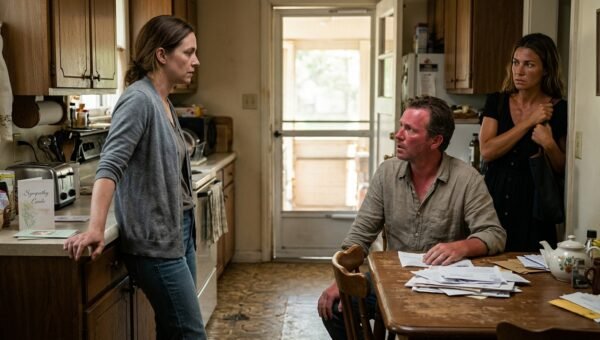
We were in our early fifties and tired of renting. I do payroll for a small plumbing supply company, so I’m used to checking numbers twice. Russ does maintenance at a school. He can look at a bad wall and tell you which tool to grab before I’ve found the flashlight. We thought we were buying a hard project, not a mystery.
The first few weeks were almost fun. We ate dinner off paper plates and argued about paint colors.
I liked the little mudroom best, though Russ said it smelled like wet boots no matter what we did. That’s marriage, I guess. You start calling a room charming because you paid for it.
Then Russ found the blank section of drywall.
It was in a downstairs room where the wall didn’t line up with the outside of the house. He tapped along it, and the sound changed in one spot. I thought it was a gap in the insulation. Russ took a utility knife to the drywall, and the first thing we saw was metal.
There was a door behind it. Heavy, locked, and with no handle on our side.
I called Hal. He said he’d never seen it before and offered to send a locksmith. I believed him, or wanted to. The locksmith came two days later and charged us $180. He got the lock open, stepped back, and said, “I’m not going in there.”
He didn’t explain. He just packed his tools and left.
The room was eight by ten feet, with concrete walls and a chair bolted to the floor. A small table sat against one wall. There were tally marks carved into the concrete, counted in groups, except the last few were uneven. I counted them twice because the number seemed too strange to be right.
Eight hundred forty-seven.
Russ said, “We should call somebody.”
“Who?” I asked.
He didn’t have an answer. I didn’t either. We stood in the doorway with our work shoes on, not wanting to step inside.
Then I saw the cassette player.
I used to have a cassette player in my car, back when they were normal. This one was dusty, but the buttons still moved. Russ told me not to touch it. I pressed play anyway.
A woman whispered, “Day 847. If anyone finds this, play the second tape.”
That was all. The tape clicked off.
Russ grabbed my arm. I remember the rough seam on his work shirt rubbing my wrist. I remember that better than what I said.
“Turn it off,” he said.
“It is off.”
“Then don’t touch anything else.”
But under the dust on the table was a second cassette. Beside it was the photograph, turned face down. I flipped it over.
Hal was in the room, smiling.
We left the house and called the state police from the truck. I didn’t want to use the local number. I can’t give you a clever reason. I just thought about the locksmith walking away, and about Hal telling us he’d never seen the door. It felt wrong to call the same town where he’d sold houses for years.
A state investigator named Mara Keene called us back that evening. She told us not to play the second tape until she could get there. We agreed. Then we sat in a motel room for six hours with the first tape in a plastic bag between us.
Russ kept saying, “We can sell it.”
I said, “We haven’t even finished the kitchen.”
That was me trying to make it about drywall. I didn’t want to say I couldn’t sleep in a room above that door.
Mara came the next morning with another investigator. They photographed everything and took the tapes. She didn’t tell us much, but she did say the house had been on the state’s radar because Silas Webb’s name came up in an older missing-person file.
That gave me a thin little bit of hope. I thought maybe the right people had finally found the right evidence. We went back to the house and kept working upstairs, but we didn’t go near the door.
Three days later, Mara called and said the first tape was mostly a date and a request to play the second. They were setting up equipment to copy it. She told us not to talk to Hal or anyone else about what we’d found.
So of course Hal called that afternoon.
He said there was a small issue with the closing papers and asked if he could stop by. His voice was warm and easy. I could hear the little click in his car’s turn signal through the phone.
Russ watched my face. I put the call on speaker.
“Nothing urgent,” Hal said. “Just a signature we missed.”
“We signed everything,” I said.
“Probably a clerical thing.”
He sounded so normal that for a few seconds I wondered if I was making it into something it wasn’t. Then he said, “And I heard you opened up a wall.”
I hadn’t told him that.
I said, “Who told you?”
There was a pause. A small one.
“People talk,” he said. “I’ll explain when I see you.”
I told Mara about the call. She said not to meet him without her. That night, I told Russ I wanted to look for paperwork that might explain the house’s history. He didn’t like it, but he came with me.
In the basement, behind a stack of old trim, we found a metal file box. It held property records, utility bills, and a few folded papers with Silas Webb’s name on them. One permit was for “foundation reinforcement,” but there was no record of an inspection. The bill for the work came from a company that didn’t exist anymore.
There was also an old service invoice with Hal’s name on it.
Not as the realtor. As the property manager.
Russ read it over my shoulder. “He told us he’d never seen the place.”
I kept staring at the word manager. That felt like a shift ending and the next one starting without time to sit down.
We called Mara. She came back with the second tape copied onto a digital file. She asked if we wanted to hear it. I said yes, then asked Russ if he did. He said, “I’m not letting you listen alone.”
The woman gave her name as Mae Larkin. She said she’d worked in the county assessor’s office and found deeds being moved between shell companies to hide who owned certain houses. She said she kept copies. When she refused to hand them over, two men brought her to our house.
She’d been held in the room for 847 days.
On the tape, Mae said a man named Silas brought food at first. Later, another man took over. She described a ring of keys and a habit of tapping the door twice before entering.
Then she named Hal.
“He said he handled the houses,” Mae whispered. “He said he’d make sure no one came looking.”
I pressed both hands against my knees. Russ kept his hand on the back of my neck.
The recording went on. Mae said she’d heard them talking about moving her, then arguing about money. On the last day, someone left the outer door unlocked. She didn’t say who. She said she crawled out, got as far as a road, and asked a truck driver to take her to a bus station.
She survived. She’d left town under another name and had only recently agreed to speak with investigators. Mara couldn’t tell us where Mae was now, and I didn’t ask.
There were more names on the tape. Local people. A title clerk, a contractor, and a man who’d been on the town select board. The investigators had already found old property transfers through shell companies, and the utility bills showed power use after Silas supposedly disappeared.
The foreclosure had cleared the house’s title chain on paper. Hal had listed it and sold it to us. That didn’t make us part of the scheme, Mara said, but it meant the sale would be reviewed. She also said not to assume Hal knew we’d found the room.
I was glad she said that. Then she added, “He knows now.”
That night, Russ wanted to leave. I wanted to leave too, honestly. But the thought of letting Hal come back and decide what happened to the evidence made me mad. I called Mara and told her I wanted to set up a meeting.
She said, “Don’t do anything without us.”
“I won’t,” I said.
I did ask Hal to come by the next afternoon, saying we had a closing question. I didn’t tell him about the tape. Mara had two state investigators nearby, out of sight, and a local deputy wasn’t involved. That mattered to me. I wanted it handled by people who didn’t owe Hal favors.
When Hal arrived, he carried a folder and wore the same neat jacket he’d worn at closing. He looked at the open drywall and gave a little laugh.
“You’ve been busy,” he said.
“Come inside,” I said.
Russ stood beside me. We’d moved the evidence to the table outside the hidden room. I started the second tape.
Mae’s voice filled the hallway. Hal stopped smiling.
He looked at Russ, then at me. “That’s old. It doesn’t prove anything.”
I held up the photo. “You were in the room.”
“I managed the property. I took pictures.”
“While she was locked in there?”
Hal reached for the photograph. Russ stepped between us.
“Don’t,” Russ said.
Hal’s voice changed. “You don’t understand how this got handled.”
“Who handled it?” I asked.
His eyes went to the open doorway. Then he said, “Silas was supposed to keep her quiet.”
The room seemed smaller, though I know it wasn’t. Hal looked like he’d heard his own words after they came out.
I said, “You knew she was in there.”
He tried to take the folder off the table. Russ shoved it away. I backed out of reach and shut the front door behind Hal. He was on the porch when the state investigators came up the walk.
He started talking before they’d even reached him.
“I didn’t hurt anybody,” he said. “I was just doing what I was told.”
They took him into custody. He didn’t fight. He kept looking at me as if I might still smooth it over for him.
I didn’t.
The investigation lasted months. The state found enough records to tie Hal and several other local people to the shell companies and property transfers. Hal was arrested, and the house sale was reviewed. We were covered under the state’s title protections and a housing fund for people caught in the scheme. We didn’t lose the house, though there were weeks when we thought we might.
The state investigators found Mae’s old records and confirmed the details she’d given on the tape. I never met her. I’m glad she got away. I also understand why she didn’t want to come back and stand in that room for anyone’s closure.
Russ and I stayed. For a while, we slept in the living room. We fought about stupid things, like where to keep the coffee maker, because it was easier than saying we were both listening for sounds from behind the wall.
Eventually, the iron door was welded shut. A contractor put fresh drywall over it. We planted a small garden along that part of the foundation, nothing fancy, just low plants that could handle the Vermont winters. I kept the old cassette player in a box until Mara asked for it. I gave it to her.
The house is ours now in the ordinary legal sense. The rest took longer. I still don’t like closed doors I can’t explain.
On the night the troopers took Hal away, Russ and I stood together on the front porch. The cruiser’s taillights faded down the gravel drive, and behind the fresh drywall, the heavy iron door was welded shut for good.