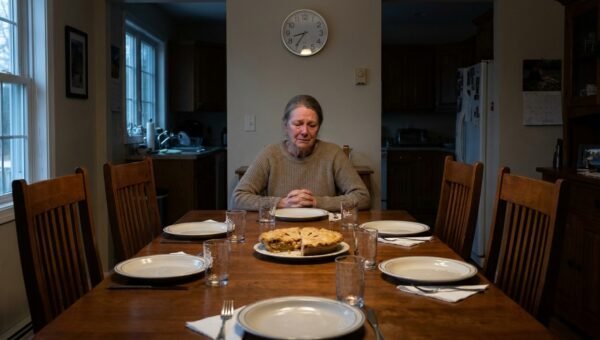
Page forty-one was held in the spiral binding by a bent metal tooth, and I kept catching my thumb on it. Under the heading “Sunshine Potato Salad,” the church cookbook listed my recipe in the pastor’s wife’s name. I read it once standing by the counter, then again sitting down, because apparently my legs thought this was going to take a while.
I’m sixty-eight, twice widowed, and from a prairie town in Nebraska where a church cookbook is treated like a family record.
Pastor Paul’s wife, Marcy, was thirty-four and new to town. She’d come to a women’s retreat a few weeks earlier, watched me make potato salad, and written things down while I worked. I didn’t think much of it then. At the time, I thought I was being friendly.
“Sunshine Potato Salad” was what I’d called it since I took the county fair blue ribbon in 1987, or maybe 1988. My daughter June has the ribbons in a box with old school pictures and a few things I’d have thrown out if she hadn’t rescued them. The year doesn’t matter much to me. The blue ribbon does. I’d been a young widow then, making do with what I had, and that salad was one of the first things people praised without adding, “Considering.”
I looked at the printed steps. Boil potatoes. Add mayonnaise, yellow mustard, sweet relish, chopped eggs, salt, and pepper.
That was close enough to fool someone who’d only seen me set out bowls. It wasn’t my potato salad. I use a small amount of rendered duck fat from Sunday’s roast, warmed just enough to blend in, and finely grated sweet pickle gherkin juice. No yellow mustard. No relish. The printed recipe had the visible parts and missed the thing that made the whole bowl taste right.
I could’ve called the cookbook committee that afternoon. The secretary, Lorna, would have taken it seriously. I could have shown her the ribbons, the date on an old fair program, and the recipe card in my own handwriting. Instead, I closed the book and told myself I’d wait.
That was my bad call.
I’ve spent a lot of Sundays waiting for people to say what they meant. It’s a habit, and not always a useful one. I told myself that if I made the salad for the picnic, the difference would be plain. No speech. No fuss. Just a table and two bowls.
At the retreat, Marcy had asked how much mayonnaise I used. I said I didn’t measure it anymore. She watched as I added a spoonful, then another. When I tipped in a little warm duck fat, I didn’t explain. I didn’t think it was a secret, exactly. It was more that I’d learned it by using what was in the kitchen, and I never thought of it as something that needed a name.
Marcy was trying hard. That part I understood. The new pastor’s wife gets watched as soon as she walks into a small church, even when people are being nice about it. She was on the cookbook committee, helped set up coffee, and remembered everybody’s grandchildren. I’d seen her scan the room before answering a question, as if there were a right answer the rest of us had agreed on.
She wanted to belong. She also wanted to look like she already did.
I could have helped her. I didn’t, because I was irritated that she’d written my recipe under her name. I told myself the picnic would teach her without me having to embarrass her. That sounds more generous than it was. I wanted the room to notice.
So I made my potato salad.
On the morning of the picnic, I boiled the eggs and potatoes at home, then mixed everything in the chipped stoneware bowl I’d used for years. The bowl had a tiny rough spot on the underside that snagged the dish towel if I dried it too fast. June used to tell me to replace it. I never did. It held enough for a church picnic and had never once tipped over in my hands.
I brought the duck fat out of the fridge, spooned off what I needed, and warmed it. I added the pickle juice a little at a time, grated fine so it disappeared into the dressing. I tasted it from the spoon, added salt, tasted again. The salad was right. I knew it before I covered the bowl.
Marcy arrived with a large white melamine bowl that looked new enough to still be proud of itself. She carried it carefully and set it on the table beside mine. Her salad was a little yellow, which was the mustard. I noticed that right away. I also noticed the small flecks of relish.
“Looks like we brought the same thing,” she said.
“Looks that way,” I told her.
She smiled, but I could see she was checking my face. I could have said something then. I could’ve told her the printed recipe was wrong and offered to help. Instead, I said I needed to put out the serving spoons.
For the first hour, people took a little of everything. The fried chicken went quickly. The baked beans went quickly. The potato salad on my left got a few polite spoonfuls. Mine got more. That’s how it started, not some big announcement. A woman came back for another scoop. Then one of the men did. Then June stood behind the table with her paper plate and gave me one small nod.
“You brought the good one,” she said.
I acted as if I didn’t know what she meant. I knew.
Marcy’s bowl stayed mostly full. People weren’t rude. They didn’t wrinkle their noses or make a show of it. They took a bite, chewed, and moved along to the coleslaw. I saw the moment one of the older women stopped halfway through a forkful and reached for a roll. It was dry and heavy, and the mustard came through first. It didn’t taste bad enough to complain about. It just didn’t taste like anything you’d want a second helping of.
By noon, my bowl was scraped down to the glaze.
I didn’t feel triumphant. Not exactly. But I did feel the small, mean satisfaction of being right, and I wish I could say I didn’t. The trouble was, Marcy was standing nearby with her hands folded in front of her, watching the empty space where my salad had been. I’d wanted the truth to show itself. I hadn’t thought about how it would feel to be the person standing beside it.
Then Pastor Paul came over with his paper plate. He’d been eating at the far end of the tables, where he could talk to the older men without having to stand up every few minutes. He looked from my empty bowl to Marcy’s nearly full one and asked if there was any left.
“Scrape the bottom,” I said.
He lifted the stoneware bowl in both hands and turned it as if he were checking for a hidden serving. There was only a bit of egg yolk near the edge. He laughed, loud enough for the people at the next table to look over.
“Whoever made the bottom dish ought to be canonized,” he said. “I need to know who to thank.”
That was the moment I’d expected to enjoy. Instead, I felt the room turn toward the table, and I wanted one more second to decide how to act.
Lorna had the cookbook open in her hands. I hadn’t seen her pick it up. She flipped to page forty-one and read the heading, then Marcy’s name beneath it. She didn’t say it sharply. She sounded like she was checking a note at a meeting.
Marcy’s face reddened. She stepped away toward the beverage cooler, carrying her paper plate. Pastor Paul was still holding my bowl. He was looking from the cookbook to me, finally catching on that this was more than a potato salad question.
I could’ve let the silence sit. It would have done its job. But I’d already got what I wanted, and there was no reason to make a public lesson out of a woman who had made one bad choice while trying to be liked.
“I made this one,” I said. “A recipe is words on paper until somebody lives in it.”
A few people laughed, mostly because Pastor Paul did. He carried the bowl back to me like he was returning something important. I took it from him and saw the egg yolk still stuck near the rim.
The ladies from the auxiliary didn’t gather around Marcy or lecture her. Lorna closed the book. June met my eyes and made a tiny face that meant she had been waiting for this all morning. I tried not to smile. I’m not above enjoying a little vindication, but I didn’t need to rub it in.
Marcy stayed by the cooler until the picnic started to break up. Afterward, I brought my bowl into the church kitchen to rinse it. I heard the door open behind me. She came in alone and set her plate by the sink.
“I copied what I saw,” she said. “I thought I could make it work.”
I turned the tap off. The water had gotten hotter than I meant it to. I put the bowl down on a towel before I answered.
“I figured you were trying to get it right,” I said.
She looked at the bowl instead of me. “I should’ve asked.”
“Yes,” I said. “You should’ve.”
That was enough for a minute. I wasn’t going to pretend I’d been saintly about it. She hadn’t asked, and I hadn’t offered. I’d chosen silence because I thought the room would take my side without me having to ask. That’s the part I don’t feel proud of.
Marcy said she’d talk to Lorna about the next printing. I told her the book didn’t need to come apart over one recipe, but the credit should be fixed. She said she understood. I believed her, though I don’t know if she understood all of it yet.
I showed her what she’d missed. Not at the picnic table, not in front of the committee. Just there in the kitchen, with my bowl on the towel between us. I explained that the duck fat needs to be warm, not hot, and that too much makes the salad heavy. The gherkin juice has to be finely grated and added in small amounts. It isn’t yellow mustard. It isn’t relish. It’s the balance.
She asked me to write it down.
I told her I wouldn’t. Not because I was guarding treasure. I’d never written it down myself. I could tell her how I did it, and she could make it with me next time. That was different from copying a list and putting a name on it.
The next cookbook printing got an errata slip. It said the recipe on page forty-one had been adapted from mine and named me as the original cook. Lorna brought me a copy. I read the slip once, folded it carefully, and tucked it behind the old fair program with my ribbons.
Marcy started coming by on Sunday afternoons now and then. We didn’t become close friends, but we got more comfortable around each other. She brought potatoes once. I gave her the bowl and let her do the mixing. The first try was too sharp, so we added a little more mayonnaise. She didn’t rush to tell anyone it was hers.
June came by one afternoon with my granddaughter, who wanted to learn the recipe. I showed her how to warm the duck fat, how to grate the pickle so the pieces disappeared, and how to taste before adding more. She watched my hands more than the measuring spoons.
“Should I write it down?” she asked.
I said, “You can if you want.”
She didn’t. She stood beside me and made it herself, and I let her get the balance right without correcting every little thing. The bowl was on the oilcloth kitchen table, clean except for one stray crumb of hard-boiled egg yolk, while outside the prairie wind stirred the high summer grass.