
I thought Dad’s new sign meant he’d finally erased me from the hardware store. Then my son brought home a birdhouse with a note nailed under the roof, and the first line said, “I owe your mother an apology.”
I read it twice at the kitchen counter. The cedar smelled sharp, like a pencil being sharpened. Leo stood beside me with his backpack still on, waiting for me to say something about the birdhouse. I pointed at the note instead.
“Who put this here?”
“Grandpa did,” he said. “He said you’d know what it meant.”
I hadn’t spoken to my father in eight years. I wasn’t sure I wanted to know what it meant. Still, I couldn’t bring myself to pull the paper off and throw it away.
The note was folded small and fixed under the little roof with one nail. Dad’s handwriting was blocky, every letter leaning forward. I knew it from the price tags he used to write for the store. I didn’t read past the first line then. I put the birdhouse on the counter and told Leo I’d take him to school in the morning.
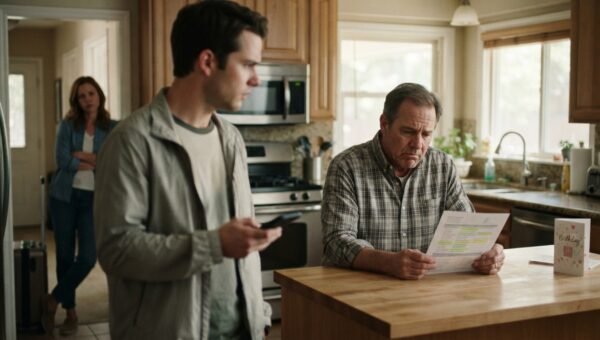
That night, the old dinner came back to me in bits. My sister passing the potatoes. Mom asking Dad to stop. Dad saying I was “unreliable” in front of everyone because I wouldn’t take over the store.
I’d been doing the books and online orders for years, but he acted like that didn’t count as real work. I left before dessert. No one came after me.
At the time, I thought the insult was about whether I could do the job. I know now there was more under it. But for years, all I had was that dinner and his voice saying the word.
I used to close the store books at our kitchen table after Leo went to bed. I’d enter invoices, check the online orders, and print the next day’s pick list. Dad handled the customers and the repairs. He could tell the size of a screw by looking at it, but he didn’t want to talk about computer orders.
“People still come in here,” he’d say.
“They do,” I told him. “And some people order from home.”
“I don’t need a screen to sell a hinge.”
I didn’t push every time. Sometimes I got tired of arguing and placed the order myself.
His store stayed open, so we both pretended that meant we agreed.
When he asked me to take over, I said I couldn’t. I had my own work and a child to raise. I also didn’t want to spend my life begging him to let me change the way he did things. I said that part badly. He heard only the no.
The next morning, I drove to the store. I almost turned around on Oak Street. The old sign was gone. A clean new one hung above the door: Miller & Son Hardware. I sat with the engine running, looking at it long enough that the window started to fog at the edges.
Inside, a man was restocking a shelf near the counter. I recognized him after a second. Marcus had worked there part-time when he was younger, mostly stocking and sweeping. He looked older now, of course. He also looked like he belonged behind the counter.
He saw me and put down the box.
“You’re here,” he said.
I didn’t like how sure he sounded. “Do I know you?”
“I’m Marcus. Your dad told me you might come.”
I looked at the sign through the window behind him. “He sold the store?”
“Six months ago. I bought it from him.”
I’d come ready to hear Dad out. I hadn’t come ready to find out he’d transferred the place to someone else without telling me. For one sharp second, I thought about leaving. It would’ve been easy. I’d had practice.
Marcus seemed to notice me looking at the door. “He didn’t leave you out,” he said. “He asked me to give you something.”
I kept my hand on the strap of my bag. “What?”
“An envelope. And the books he printed out.”
He led me to the back office. It looked smaller than I remembered, though maybe I’d just been younger when I worked there. A faint smell of cardboard and machine oil was still in the air. Marcus opened the desk drawer and took out a thick envelope with my name written across it.
“Your dad said you should read the last pages first,” he told me.
“I’m not sure I want to read anything he wrote.”
“I understand.”
I wanted to ask why Marcus was involved in this. Instead, I let him show me the printed spreadsheets, stacked and bound in folders. My old columns. My order numbers. The notes I’d added when a supplier raised prices or a customer had to wait for a part.
Marcus touched one folder. “He kept all of it.”
“He had copies?”
“He printed them when he started getting ready to sell. Said they mattered.”
I opened the envelope, but there were too many pages to read standing in that little office. At the top was a note about the sale. Marcus had bought the store on terms they agreed to together. Dad had stepped down because his hands and back couldn’t keep up with the work anymore. There was no trick in it. No hidden fight over who owned what.
Then I found a handwritten addendum, signed by Dad. He listed the work I’d done: the online orders, the bookkeeping, the supplier records, the inventory system. At the bottom, he wrote that the store would not have stayed solvent without me.
I read that line once. Then I read it again.
“Why didn’t he say that to me?” I asked.
Marcus didn’t rush to answer. “I think he was ashamed he needed help.”
“That doesn’t make calling me unreliable all right.”
“No,” Marcus said. “It doesn’t.”
I was glad he didn’t try to smooth it over. I slid the papers back into the envelope and thanked him. Before I left, he told me Dad had started teaching woodworking at the community center. That was where he’d been working with Leo.
I sat in my truck outside the store and took out the folded note from the birdhouse. It had more writing on the other side. My thumb kept catching on the little crease. I read slowly.
“I owe your mother an apology. She asked me to tell you the truth before she died. I told myself there would be a better time. There wasn’t.”
The next lines said Dad had been scared. Not of me, exactly, but of what he couldn’t do anymore. He didn’t understand online orders. He couldn’t keep up with the books. He saw every change as proof that the store he’d built was becoming something he didn’t recognize.
He wrote that when I refused to take over, he took it as a judgment on him. So he called me unreliable before the family, as if making me small could make him feel less afraid.
Then came the part I didn’t expect. Mom had confronted him while she was sick. She told him anger wasn’t the same as strength, and that he needed to stop making me pay for being able to do things he couldn’t. She’d asked him to apologize and admit what I’d done for the store.
He hadn’t done it. Not before she died. Not the year after. He kept finding reasons to wait.
At the bottom, he wrote, “I saw Leo sand the birdhouse the way you used to sand the porch rail. I thought I had run out of chances. I don’t want to keep waiting.”
I put the note down on the passenger seat. For a minute, I just looked at the old store. It had taken me less than ten minutes to drive there. It had taken me eight years to decide I could go inside.
I drove straight to the community center.
The woodworking room was downstairs. I could hear the saws before I got to the door, a steady whine that stopped while I stood there. Dad was helping two students fit pieces of wood together. His shoulders looked smaller in his old work shirt. There was sawdust stuck to one sleeve.
Leo saw me first.
“Mom,” he said.
Dad turned. For a second, neither of us said anything. Then he set down the clamp he was holding and wiped his palms on his jeans.
“Hi,” he said.
“Hi.”
I’d brought the birdhouse and the envelope. I put both on the workbench. The cedar roof made a small tapping sound against the wood.
“Why did it take a nail and a cedar roof to talk to me?” I asked.
Dad looked down at the birdhouse. His mouth tightened. I could tell he wanted to answer with some practical thing, maybe explain how he’d attached the note. He didn’t.
“I kept waiting to know what to say,” he said. “Then I kept waiting because I was ashamed I’d waited.”
“You called me unreliable.”
“I know.”
“You said it where everybody could hear.”
“I know.”
He said it quietly. Not to excuse it. Just to own it. I had pictured this conversation for years, though I’d never admit that to anyone. In some versions I yelled. In others I walked out before he could speak. Now I had the papers in my hand, and all I could think was that Mom had asked him to do this while there was still time for her to hear it.
“I should’ve told you the store needed you,” Dad said. “I should’ve said I was scared. Instead, I made you sound like the problem.”
I looked at the old ledgers. “You kept these?”
“All of them I could find.”
“Why?”
“Because they were yours. Because they were the truth.”
He rubbed one thumb along the edge of the workbench. “I thought being the one who knew every shelf meant I could run the whole place. I didn’t want to admit I needed what you knew.”
That wasn’t the same as giving me back the years, or my mother, or all the evenings I’d spent thinking I’d failed at something I hadn’t even agreed to do. I wanted him to understand that. I also wanted him to know I could hear what he was saying now.
“I’m still mad,” I told him.
“You should be.”
“I don’t want to pretend it didn’t happen.”
“I’m not asking you to.”
He picked up a finishing rasp and held it out to me. It was the kind he’d taught me to use when I was a kid. I took it, mostly because my hands needed something to do.
“I’m sorry,” he said. “I was wrong about you. You were never unreliable. I’m grateful for every hour you gave that store.”
I turned the rasp over in my palm. It had a rough place on the handle where the varnish had worn away. I remembered the feel of it from the garage, Dad correcting my grip without looking up from his own work.
Leo stood beside the bench, quiet. Dad glanced at him, then back at me.
“Is there still a place for me at your kitchen table?” he asked.
The question was plain. No big speech. Maybe that was why I believed he meant it.
“There’s a place,” I said. “But we’ll have to talk. Not just sit there like this fixed everything.”
“I know.”
I asked Dad to come over for dinner on Sunday. Leo kept going to the workshop, but now I came along sometimes, too. Marcus kept running the store. Dad didn’t ask me to take it back, and I didn’t feel guilty that it was no longer mine to save.
A few weeks later, we mounted the birdhouse on the post outside my kitchen window. Dad sealed the cedar shingles while Leo held the ladder. I stood nearby with the screw tin, passing one over whenever Dad asked. The note stayed in the envelope inside the house.
The birdhouse sat level on the post. Beneath its little roof, the nail hole was empty.