
I had my hand on the phone when Ross said his aunt had died. I was sitting at my desk in the payroll office, looking at a stack of time sheets with coffee dried on one corner, and I thought he was calling to tell me the funeral date.
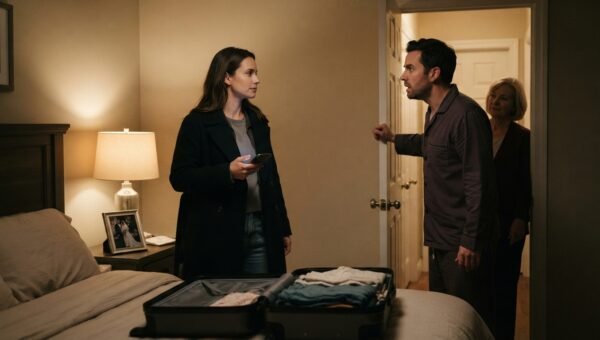
Instead, he said, “My aunt just died, and I inherited $960 million. Pack your things and leave before I get home.”
I asked if he was serious. He said the lawyer had called that morning and confirmed the amount. Then he told me he didn’t want to spend the money “explaining himself” to me. That was how I learned I was about to lose my marriage. Not from a fight, not from a long talk. From a call at work that lasted less than two minutes.
Ross had always liked money. He liked talking about what he’d buy if he ever got a big break, though he’d never had more than a few thousand dollars saved at once. His aunt Ruth had plenty. She was sharp and private, and she didn’t hand out money just because someone asked. Ross called that stubborn. I used to call it her business.
I’d been married to Ross for eleven years. We had a rented house outside Eau Claire, a set of dishes we’d picked out together, and a life that was mostly bills, work, and little habits.
He put his keys in a blue bowl by the door. I reminded him to take leftovers for lunch. I don’t say that because it was some great love story. It wasn’t. But it was a life I thought we were both still in.
When I got home that night, a stack of divorce papers was sitting on the kitchen counter beside the blue bowl. Ross wasn’t there yet. I stood in the doorway with my work bag still on my shoulder and read the first page twice, even though I understood it the first time.
He’d filled in his name and most of mine. The papers said we’d divide our ordinary things and keep our own accounts. There was no mention of the inheritance. Ross had made sure of that. At the bottom of the counter, he’d left a black pen.
I could have called my sister. I could have called a lawyer.
I did neither right away. I went upstairs and packed two suitcases, then stood in the bedroom trying to remember which towels were mine. That was the sort of thing my brain picked to work on. Not the fact that Ross had heard “nine hundred sixty million” and thought first about getting rid of me.
When Ross came in, I was back downstairs with the papers. He looked at the suitcases and said he was glad I wasn’t making this harder than it needed to be. I signed every page he’d marked. My hand shook a little on the last one, which annoyed me, so I set the pen down and waited until it stopped.
Then I slid the pen across the counter to him.
“Enjoy your fortune,” I said.
He laughed. Not loudly. More like I’d made a joke he could afford to ignore. He said I’d understand when I saw what the money could do. I told him I already understood what he’d done with it.
I left before he could answer. I took my work clothes, the old recipe box from my mother, and the coffee mug with a chipped handle that I’d had since the 1990s. I forgot the good winter coat in the hall closet. I didn’t go back for it.
The next two days were not dramatic. I stayed in a small furnished apartment near work and called my sister from the car because I didn’t want to cry in the room. I changed my mailing address, moved my paychecks to a new account, and made a list of what I still needed. Ordinary things. Socks. Dish soap. A shower curtain.
Ross sent one text. He said he was taking care of the paperwork and asked me not to make trouble over the house or the money. I read it twice, then wrote, “I’m not asking for your inheritance.” I didn’t add anything else. I wanted him to know I wasn’t trying to take a piece of it, and I wanted him to have no reason to tell people I had.
He took the inheritance in a hurry. I knew that much from his cousin’s Facebook post, which said the family was “finally getting the good news Aunt Ruth promised.” There was a picture of Ross with a glass of champagne. The family seemed to think he’d become rich in the simple way people win a prize. I was still trying to figure out what I’d missed.
On the third day, my phone started ringing before 8:00 in the morning. Ross’s mother called first, then his cousin Marcy, then a number I didn’t know. I let all of them go to voicemail. At 8:41, Marcy sent a text saying, “Did Ross read the trust papers?”
That was the first time anybody mentioned a trust.
I called her back. She was crying, or close to it, and talking fast enough that I had to ask her to start over. She said the family had been called into a meeting with the estate lawyer. Ross had signed the acceptance papers, but the actual inheritance wasn’t a check or a pile of cash. It was a family trust.
“What did he sign?” I asked.
“The whole packet,” Marcy said. “The rider too, I think. He said it was boilerplate.”
She told me the lawyer had explained the terms that morning. Ross was the primary beneficiary, but the trust required him to personally guarantee Aunt Ruth’s historic legal and charitable liabilities. It also required him to cover basic living costs for every living blood relative for twenty years. If he failed, the trust could take back the principal, and the agreement added a personal penalty debt.
I wrote it down on the back of a grocery receipt. I had to ask Marcy to repeat the part about the penalty because I didn’t believe I’d heard her right.
“Ross can’t just refuse?” I asked.
“He signed acceptance,” she said. “The lawyer says he can’t walk away without triggering the forfeiture and debt.”
The words sounded too big for that little receipt. I kept looking at the corner where I’d written “20 years” and the price of milk from my last grocery trip. It was a silly detail to notice, but that’s where my eyes stayed.
I called the estate lawyer myself. I didn’t want to rely on Marcy, who was frightened and already asking if I could talk Ross into helping the family. The lawyer couldn’t give me private details about the trust, but she confirmed the basic terms because I was still listed as Ross’s spouse in the divorce filing. She said the obligation was real, and Ross had accepted it. She also said Ruth had spent years making sure the terms were clear.
That part stayed with me. I remembered Ruth at Thanksgiving, once, watching Ross talk over his mother about a loan. Ruth had asked him to listen. He had checked his watch instead. I’d thought she was irritated about the noise. Now I wondered if she’d been taking notes in her head, the way I used to track overtime errors at work.
By that afternoon, the family had figured out the money did not belong to Ross in the way they’d imagined. They had also figured out he controlled the trust payments. The calls kept coming. His mother needed help with her house. A cousin had a business debt. Another relative said Ruth had promised to pay for medical expenses. Marcy wanted to know if I could “get him to be reasonable.”
I told her I wasn’t going to do that. I wasn’t even sure what “reasonable” meant when the agreement was written down and signed.
“He’s still your family,” she said.
“He isn’t,” I answered. Then I felt mean for saying it, which lasted about ten seconds. I was his wife on Monday morning. By Monday night, he’d decided I wasn’t worth keeping around. I couldn’t be everybody’s soft place to land just because Ross had made a mess.
I heard from him the next evening. His number came up on my screen while I was unpacking the kitchen things in my apartment. I had just put my chipped mug in the cupboard. I almost let the call pass, but I answered because I wanted to hear him say it plainly.
He sounded tired. He asked if I’d spoken to the lawyer. I said I had. He started explaining that he’d been told the trust had “some obligations,” but he hadn’t understood how much was attached. He said he’d thought the relatives could be paid from the trust income, not that he’d personally guaranteed the expenses and debts.
I asked if he’d read the papers.
He didn’t answer right away. Then he said the lawyer had gone through the main points and he’d signed where he was told. He said he’d been excited. That was the closest thing to an apology I got.
He asked me to help him figure out a way out. Maybe I could take part of the money. Maybe if I spoke to Ruth’s lawyer, she’d listen to me. He kept saying he didn’t know what else to do, like I had been the one who left the pen on the counter.
I could hear a television in the background. Some game show, probably. I remember that because the audience laughed while Ross was asking me to rescue him.
“I didn’t accept the trust,” I said. “You chose it alone.”
He started to say I was being cold. Then he asked if I could at least call the lawyer again. I said no. I told him I wasn’t going to be involved with the trust, his relatives, or his money. I didn’t shout. I didn’t need to.
He said, “You’re really going to leave me with this?”
I hung up.
After that, I blocked his number and the numbers that had called me for him. The divorce took a few months to finish. Since we’d kept our own accounts and had no children or shared property to fight over, there wasn’t much to argue about. I signed the last papers at a lawyer’s office on a rainy Tuesday. Ross didn’t come in. The divorce was final by the end of that month.
I don’t know what happened to every part of the trust. I know relatives kept asking for help, and I know Ross stopped posting champagne pictures. I heard the estate lawyer had to handle a lot of angry calls. That’s all I know, and it’s more than I needed to know.
My own life got smaller for a while, in a good way. I bought a used sofa. I put the recipe box on a shelf. I kept working in payroll, where the numbers were still numbers and a mistake could be fixed with a correction form. There was no secret fortune there. Just a paycheck that belonged to me.
Some mornings I still wake up expecting Ross to be in the kitchen, dropping his keys into that blue bowl. Then I remember the bowl was his, and I left it there. I make coffee in the chipped mug and sit by the window of my new apartment. The city is starting up below me, buses and people on their way to work.
I signed away a marriage. I did not sign for his burden.