Why do I still remember the paper cup of water Dr. Miller left beside my bed before I told him what Richard had done?
It was the kind they give out in hospitals, thin and soft at the rim. I didn’t drink it right away. I was busy trying to understand why a doctor had asked how long I’d been married, and why Richard had stopped answering him.
I’d been married to Richard for seven years. For most of that time, I told myself the mornings were the worst part, which was a stupid way to measure a life.
Every morning, he dragged me into the backyard and hit me. He said I’d failed him because I couldn’t give him a son.
Our town in Nebraska is small enough that the railroad crossing can hold up half the morning traffic. The houses sit close together. I knew the neighbors could hear me. I knew because I heard one of them shut a window once.
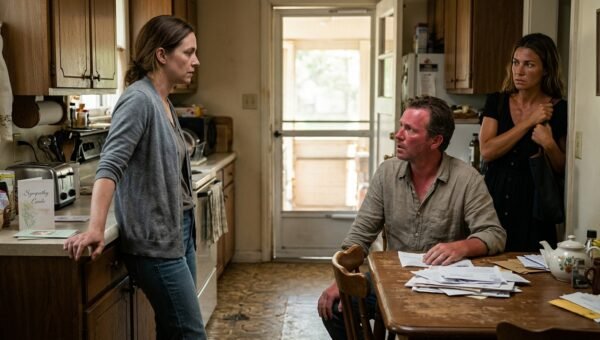
Evelyn, Richard’s mother, lived with us. She’d sit inside with her rosary beads moving through her fingers. The back door was usually cracked open. She could hear me, and I knew she could. I would look toward that door anyway.
I don’t know why I kept hoping she’d come out. Maybe because she was a mother. Maybe because I wanted somebody else to decide that what was happening to me was wrong.
That morning, the grass was wet under my cheek. Richard had been angry before he came outside.
I can’t even recall what set him off. He said, “You still can’t give me a son.” I told him to stop. He hit me again.
My hands were up near my face. I remember the smell of wet dirt, and one of my sleeves stuck to my arm. I tried to get to my feet, but my legs wouldn’t do what I wanted. Then I couldn’t answer him.
When Richard realized I wasn’t responding, he got scared. That part still makes me mad, if I’m honest. He could see me hurt and keep going, but he couldn’t stand the thought of being caught.
He hauled me to the car and drove to the hospital. Before we went inside, he leaned over me and said, “You fell down the stairs.” I didn’t answer. He said it again, slower, like he was helping me remember.
At triage, he gave the same story. “She fell down the stairs,” he told the nurse. “She’s clumsy.” He kept one hand on my shoulder while she asked me questions.
His fingers were pressing hard enough that I knew what the answer was supposed to be.
Dr. Robert Miller came in after the first checks. He asked where I hurt. Richard answered for me. Dr. Miller looked at him, then back at me.
“Can she answer for herself?” he asked.
Richard gave a little laugh. “She’s confused.”
I wanted to say I wasn’t confused. I wanted to say I knew the difference between stairs and a backyard. But I was tired, and I had practiced keeping quiet for years. At home, a sentence could make the next morning worse.
The X-ray came next. I was taken down the hall, then back to a room with a curtain and a thin blanket. Richard waited outside. He kept asking when we could leave.
I heard him say, “We don’t need all this.”
Dr. Miller didn’t answer him at first. He was looking at my films. Then he asked Richard, “How long have you been married?”
Richard frowned. “Seven years. Why?”
The doctor held the X-ray up again. I couldn’t see what was on it from my bed. Richard could. He stopped talking.
“Because this X-ray shows something that makes your story impossible,” Dr. Miller said.
That’s the line I remember exactly. Not because it sounded like something from a show. It didn’t. He sounded tired and careful, like he had to choose his words while watching Richard’s hands.
The images showed several old fractures. Some had healed. Some were at different stages of healing. There were breaks along my ribs, including injuries that fit with me trying to protect myself, not with one fall down a staircase.
Dr. Miller saw those first. Then he saw the surgical clips in my pelvis.
Eight years before that day, before I met Richard, I’d needed emergency surgery after a serious pelvic injury. I had a full hysterectomy and both ovaries removed. I was twenty-six. The doctors told me plainly that I wouldn’t be able to have children.
I can still remember the little paper folder from that hospital. I’d kept it with my old medical records, then left it at my childhood doctor’s office when I moved. It was one of those small decisions that seemed boring at the time. I didn’t know I’d need it to prove what I already knew.
Richard knew, too.
When he was courting me, I told him about the surgery. He sat with me at my kitchen table and said, “It doesn’t matter to me.” I believed him. I wanted to believe him. We got married the next year.
For a while, he didn’t bring it up. Then he started saying he wanted a son. He’d say it when he was mad, then when he was calm, then for no reason I could see. Somehow, the thing he’d promised didn’t matter became the reason he said I deserved what he did to me.
I used to think maybe he had changed his mind about wanting children. That was easier than thinking he had made the promise knowing it would give him something to use against me later. I don’t know when I figured out that no explanation was going to make it make sense.
In the hallway, Dr. Miller told Richard the scans showed old injuries and that the police were on their way. Richard’s voice got loud.
“This is between my wife and me.”
“No,” Dr. Miller said. “It isn’t.”
Richard tried to walk toward the exit. Hospital security stepped in front of him. One guard took his arm. Richard jerked away and said, “Get off me.”
I heard the scuffle from the bed. My hands started shaking, so I curled them around the blanket. I was afraid he’d somehow get back to me. I was also afraid he’d leave before anyone believed what the doctor had seen.
Officer Bradley arrived while security kept Richard in the hall. He came in to check on me and told me I was safe there.
“Is he coming back?” I asked.
“Not to this room,” he said.
I wanted to believe that. I still asked him twice.
When I woke later in the ICU, Dr. Miller was beside my bed. The room was quiet except for the soft beeping near my shoulder. I had that same paper cup by my hand.
He told me he’d seen clear signs of old injuries and the clips from my surgery. He said I didn’t have to talk until I was ready. Then he waited.
I asked him, “Did Richard know what the surgery meant?”
Dr. Miller didn’t answer for him. “That’s something you can tell us.”
I was scared to say it. That sounds strange now, since the truth was already there on the X-ray. But a scan can’t tell people how many times I’d been told to keep quiet. It can’t show how many mornings I’d sat at the kitchen table afterward, pressing a napkin to my mouth so Evelyn wouldn’t see me cry.
I told Dr. Miller and the hospital social worker that Richard had been beating me. I told Officer Bradley, too. I said it happened in the backyard most mornings. I said he blamed me for not having a son, even though he knew I couldn’t get pregnant before we married.
They asked if I had anything that could help confirm the surgery. I gave them the name of my childhood doctor’s office and told them where I thought my records were. I also told them about a journal I’d kept in a locked drawer at home. I’d written down dates when I could. Sometimes I wrote only one word, like “Tuesday,” because I didn’t have the energy to write more.
It wasn’t a brave plan. I hadn’t been building a case. I was trying to keep a record of my own life, so I’d stop telling myself it wasn’t that bad.
Evelyn came to the hospital that afternoon. She had her rosary wrapped around one hand. Her eyes were red, and she looked at my bandages before she looked at me.
“Richard made a mistake,” she said.
I stared at the blanket.
“Please don’t do this to our family.”
I asked her, “Where were you?”
She squeezed the beads. “I was praying.”
“You heard me.”
Her mouth opened, then closed. For years, I had been waiting for her to say something that would make those mornings less lonely. She didn’t have anything like that to offer.
She said, “He’s still my son.”
I said, “I’m still a person.”
She started crying. I’m not proud of how blunt I was. I also don’t take it back.
I told her I wouldn’t drop the charges to protect the family’s name. I wouldn’t go home with Richard. I wouldn’t pretend the X-ray had made some mistake.
She left without touching me.
Richard was arrested in the hospital lobby. I didn’t see his face as they led him away, but I heard his voice. He was still saying the whole thing had been a misunderstanding. Security and Officer Bradley took him out in handcuffs. He was held without bail while the case moved forward.
The medical report, the old records from my doctor’s office, my journal, and my statement all became part of the case. Richard was indicted for felony battery and domestic violence. I got a protective order, and I filed for divorce. The legal parts took time. The first part was just learning to sleep without listening for his steps.
I moved to a secure place after I was strong enough to leave the hospital. Recovery wasn’t clean or quick. I had appointments, paperwork, and days when a door closing too hard made my shoulders jump. I went to counseling. I learned to make a choice without checking first to see if Richard would be angry.
I didn’t speak to Evelyn again. I used to feel guilty about that. Sometimes I still do, then I remember the open back door and the rosary beads moving in her hands while I was outside asking for help.
Months later, I sat in the rehabilitation garden beside a sunny window. The morning light was on my lap. My hands were resting there without gripping the blanket or covering my face.
The X-ray had shown the clips from my surgery before I ever met Richard. He had known what they meant when he promised it didn’t matter. The paper cup Dr. Miller left beside me was the first thing anyone had offered without asking me to lie in return.
I sat with my hands open in the light, and nobody was waiting for me to explain myself.