For six years, I let myself believe my mother killed my father.
I was twenty-three when the state set Evelyn’s execution for six o’clock. I’d been seventeen when she was convicted. I could tell myself I was still a kid then, but I knew what I was doing. I saw her letters arrive, put them in my desk, and didn’t open them. I thought the case was plain. Dad dead in the kitchen.
A knife under Mom’s bed. Blood on her robe. I said it was enough.
The last visit was supposed to be short. A guard had told us we’d get ten minutes, though I’m not sure the clock on the wall was right. Mat stood beside me, picking at a loose thread on his cuff. He was twelve now, but he was still small enough that people sometimes spoke over his head. I kept thinking about how Mom used to cut his toast into strips because he didn’t like the crust.
Evelyn came in wearing handcuffs. She looked tired, not in some big dramatic way. Just tired, like she’d been awake too long and had stopped expecting a decent night’s sleep. She asked Mat if he was eating enough, then asked me if I was still working at the feed store. I said yes.
“Don’t cry for me,” she said. “Just take care of Mat.”
I nodded. I couldn’t make myself say I would. That was the kind of coward I’d become.
Mat stepped close and hugged her. A guard let him have a few seconds. He leaned into her ear and whispered, “Mom… I know who hid the knife under your bed.”
My mother’s eyes moved to me. The guard reached for Mat’s shoulder. I caught his arm first.
“Wait,” I said.
The guard told me visiting time was over. Mat was crying now, saying the name over and over, but I couldn’t hear it clearly in that room. I just heard my mother say, “What did you see, sweetheart?”
Then the guard pulled us apart.
Outside, Mat sat on the curb in the prison parking lot. The air smelled like wet pavement and the dust that collects along the road after a dry spell. I stood over him, trying not to grab him again.
“Who?” I asked.
He covered his face. “Uncle Alan.”
Alan was Dad’s brother and business partner. He’d become our guardian after Mom went to prison.
He paid the bills, took care of the house, and drove Mat to school. For six years I told myself that was what a good uncle did.
Mat was six the night Dad died. He’d come downstairs for water and seen Alan in the hall. He said Alan had a knife in his hand and Dad was on the kitchen floor. Alan wiped the blade, shoved it under the bed, and told Mat he’d cut my throat and his if either of us talked.
“I was little,” Mat said. “I thought he’d do it.”
“You should’ve told me.”
“I know.”
I was mad for one awful second. Then I heard myself. He’d been six. I was seventeen and had more chances to ask questions than I used. I had made my choice, and Mat had been left alone with his.
“Why now?” I said.
Mat wiped his nose on his sleeve. “They said she was going to die today.”
I took him to my truck and called Mom’s lawyer. I had the number written on an old receipt in the glove box.
The lawyer, Ms. Velez, answered while we were still in the parking lot.
“Tell me exactly what he said,” she said.
I did. She went quiet, then told me to bring Mat to her office and call the prison back. She said she’d start asking for an emergency stay. I looked at the time. It was 5:19.
There was one thing I could do before I got to her. Mom’s letters were in my old desk drawer at home, and I had a bad feeling about what I’d find in them. I drove there with Mat beside me. Neither of us spoke much. I remember that the truck’s heater made a little ticking sound when I turned it off. I noticed it because I couldn’t make myself notice anything else.
The letters were tied in a stack with kitchen string. Six years of them. My name on the envelopes, in Mom’s handwriting. I’d told myself I couldn’t read them because it would make it harder to move on. That was a lie. I didn’t want to hear from her if she was guilty.
The first one began, “I love you. I know you don’t want to hear that from me.” I sat on the floor to read it, then read the next one. She never called me cruel. She never asked why I’d stopped coming. She asked about Mat, whether he still hated peas, whether I was eating. I had to keep stopping because my hands were shaking enough to tear the paper.
The letters also talked about Dad and Alan. Mom wrote that Dad had found forged invoices and missing money in their contracting business. He’d planned to confront Alan the night he died. She said she’d heard them arguing about “the second set of books,” and that Dad had hidden his backup ledger in a lockbox under a loose floorboard in his workshop.
I read that part twice. Then I put the letters in my coat and called Ms. Velez again.
“His workshop is still there,” I said.
“Can you get to it?”
“Yeah.”
I took Mat with me. I wanted him where I could see him. The workshop was behind the house, dusty and mostly unused since Dad died. I remembered him keeping nails in old coffee cans and swearing when I mixed them up. Mom’s letter said the floorboard was near the workbench, on the side with the cracked concrete.
I pulled the first board up with a flat bar from the tool rack. It didn’t move. Mat found a screwdriver, and we got the edge loose together. Beneath it was a metal lockbox. The key wasn’t there, so I used the flat bar again until the latch bent.
Inside were ledgers, invoices, and a small envelope with Dad’s name on it. The figures didn’t mean much to me at first. Then I saw Alan’s initials beside payments to companies I’d never heard of. The dates ran over several years. The total was far more money than I’d ever seen written down in one place.
Mat leaned over my shoulder. “That’s his?”
“I think so.”
I called Ms. Velez and read her the names and dates. She told me to bring everything straight to her office and not touch anything else. She said the letters mattered, but the ledger could show motive and give them something they could verify. I drove faster than I should have.
At her office, a second lawyer was already on the phone with the state. Ms. Velez took Mat into a small room to record his statement. I sat with the ledger open on her desk, trying to keep the pages from sliding off. One invoice had Dad’s handwriting in the margin: “Ask Alan where this went.”
That plain little sentence was the first thing that made me understand he’d known. He’d been looking into his own brother. Mom’s letters had said they were fighting, but I’d never read them. The case against her had treated the robe and knife like the end of the story. It hadn’t asked why the business records were missing.
The lawyers also found the old evidence report in the case file. A forensic note said the blood transfer on Mom’s robe didn’t match the way prosecutors had described it at trial. There was also a partial palm print on the knife handle that hadn’t been identified. It wasn’t proof by itself, but it was enough to make the state listen when it was put beside Mat’s account and the ledger.
Mat came out after signing his statement. His face was blotchy from crying. He sat down beside me.
“Are they going to believe me?” he asked.
“I don’t know,” I said. “But they have to hear you now.”
At 5:46, Ms. Velez told me the appellate judge was reviewing an emergency request. She sent the letters, the ledger pages, and Mat’s statement to the state court. One of the lawyers got through to the governor’s office. I kept asking if anyone had called the prison. Nobody had yet.
At 5:52, a prison official called Ms. Velez. The execution team was preparing. I could hear someone in the office say, “We need the judge now.” I picked up the desk phone, then put it down because I had no one to call. My hands didn’t know what to do.
The red phone rang at 5:55.
Ms. Velez answered. She listened, wrote down a number, then said, “I understand. Please send it in writing.”
She hung up and looked at us. “There’s a temporary stay. The execution is stopped.”
I sat down hard. Mat bent over with his face in his hands. I didn’t feel relief right away. I felt like I’d just been handed back something I’d already helped lose.
The next weeks were not simple. The state opened a new investigation. Mat gave a full deposition, and I went with him. He told the investigators how Alan had threatened us. He had to tell it more than once. Each time, he looked younger afterward.
Investigators searched the workshop and confirmed the ledger entries against the business records. They also reopened the knife evidence. The partial print belonged to Alan. The robe’s blood pattern did not fit the state’s account of how Mom had supposedly killed Dad. Alan’s story was that he’d never been in the kitchen that night, but the records and Mat’s statement made that hard to keep saying.
I had to face him with investigators present. He was sitting in the front room of the house where he’d been our guardian. I brought a copy of the ledger. He stared at it like I’d brought him a bill he didn’t recognize.
“You don’t understand what you’re looking at,” he said.
“I understand you took Dad’s money.”
“He was going to ruin all of us.”
“You killed him.”
Alan looked at Mat. “You were six. You don’t remember that right.”
Mat stood close enough to me that our sleeves touched. He was trembling, but he didn’t move away.
“I remember your shoes,” he said. “I remember you telling me to shut up.”
Alan tried to talk over him. One of the investigators told him to stop. Then they turned him around and put handcuffs on him. He didn’t look like the man who’d brought us groceries or signed my school forms. He looked like a man who’d run out of people willing to believe him.
The state indicted him for first-degree murder and grand larceny. Mom’s conviction was vacated. She was formally cleared, though the words on the court papers didn’t give her back the six years. They didn’t give me back the years I’d spent refusing to read her.
When Mom was released, Mat and I drove to the prison together. I had rehearsed what I’d say. I wanted to tell her I was sorry, that I should’ve opened the letters, that I’d been wrong. But when she came through the gate, I couldn’t get it out.
She hugged Mat first. Then she held me. She didn’t make me explain myself right there. She just kept one hand on the back of my head, the way she had when I was little and had a fever.
“I’m sorry,” I said into her shoulder.
“I know,” she said.
That was all. I didn’t deserve more, and she didn’t owe me less.
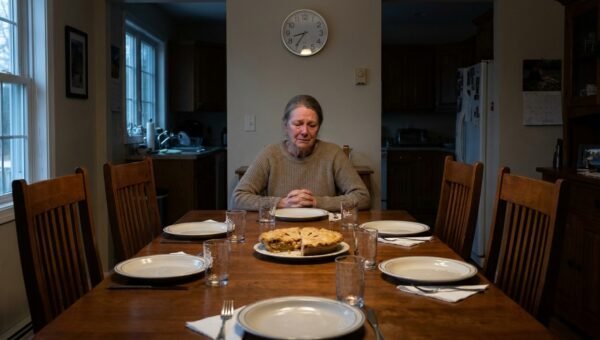
A few months later, I came over in the morning. Mom was making tea at the kitchen table. The letters were there, untied and smoothed flat, with the envelopes stacked beside them. She poured a cup for Mat and one for me, then laid both hands over the pages.
I had spent six years keeping those letters shut. That morning, Mom held them open beneath her free hands.