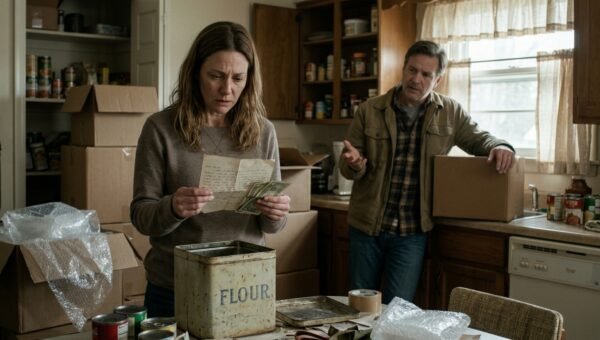
The manila folder had my sister’s name written on it in Dad’s shaky printing.
I was standing at the bank counter when the manager set it down between us. I’d come in to report fraud. I thought Denise had been taking money from our 84-year-old father, and I was ready to make it official. Then I opened that folder and saw the first note clipped behind a withdrawal slip.
I read it three times.
The money wasn’t stolen. Dad had been paying to get Denise and her husband out of a place that was eating them alive.
A year earlier, Dad had $70,000 in his savings. By the time I noticed, he had $8,500 left. Every Friday, Denise drove him to the bank. I knew that much. I just hadn’t asked what happened inside.
I’m Cal. I’m 58, and I live outside Amarillo. I’ve always been the one in the family who likes a plan and a number written down. It can be useful. It can also make me act like a fool with confidence.
Dad, Raymond, was never careless with money. He kept receipts in an old biscuit tin and wrote the date on the back of every check. But his memory had been going for a while. He’d ask the same thing three times, then get mad at himself when I answered all three.
I knew he needed help. I also knew I didn’t want to be the one to take over his life.
Denise did more of the practical stuff. She took him to appointments, brought groceries, and drove him to the bank on Fridays.
She’d bring him home with a paper sack of rolls from the bakery by the highway. Dad liked the ones with too much cinnamon. He’d get it on his shirt and insist it was nothing.
I told myself I was helping by checking in. Truth is, I called when it fit my day.
Then the bank alert came through while I was paying a bill. I looked at the balance, refreshed it, and looked again. The drop was too big to shrug off. Dad’s account had been close to $70,000. Now it was $8,500.
I went to Denise’s house that evening. Her husband, Wade, was still at work. She had a grocery list on the counter and a damp dish towel over one shoulder. I could hear the old fridge clicking on and off.
“How much have you taken from Dad?” I asked.
She put the dish towel down. “I haven’t taken anything.”
“His savings are almost gone.”
“I know.”
“Then tell me where it went.”
She looked at the floor. I was already mad, and I could tell she was scared of me being mad. That should’ve slowed me down. It didn’t.
“Cal, please,” she said. “Please don’t make me.”
I heard that as guilt. I thought she was asking me not to look too closely because she had done something wrong. I said she had no right to keep quiet about our father’s money. She didn’t argue. She just stood there with both hands on the counter.
I left and told myself I was protecting Dad.
Monday morning, I went to the bank and filed a fraud report. I was an authorized signer on Dad’s account, which meant I could help with bills if he asked. I hadn’t been looking at the statements. I had told myself that was respecting his independence. That excuse looked pretty thin once I saw the balance.
The manager, Mr. Patel, asked me to sit down. He checked the account and the dates, then went into the back. When he came out, he had the manila folder.
“I can’t tell you what your father intended without his records,” he said. “But I can show you what he signed.”
The folder made a heavy little sound when it hit the counter.
There were withdrawal slips, one for nearly every Friday. Dad’s signature was shaky, but it was his. Behind each slip was a note in his handwriting. The first one said: “$900. Denise and Wade deposit. Don’t tell Cal yet.”
I read it three times because that was the part I couldn’t fit into my head.
Mr. Patel waited. I could smell the lemon cleaner they used on the counter, and for some reason I kept noticing the blue pen tied to the desk with a string. Dad used to complain that bank pens never worked. I was standing there with a fraud report open and a pen that worked fine, staring at proof he had chosen every withdrawal himself.
I should’ve felt relieved right away. I didn’t. I felt ashamed, then defensive, then ashamed of being defensive. I started flipping through the notes faster, like the next one might say Denise had tricked him after all. Some were only amounts and dates. Others had a few words. “Storage unit, first month.” “Attorney fee, housing papers.” “Truck deposit.” “New apartment, two bedrooms, safe wiring.” The amounts lined up with each step.
The account hadn’t been drained in one panicked week. Dad had planned it. He had taken out money in pieces so Denise and Wade could leave without their landlord realizing they were going.
I called Denise from the bank parking lot. She didn’t pick up. I sent a text asking her to meet me at Dad’s house. Then I called Mr. Patel back and canceled the report. He said he’d note that the account holder had authorized the withdrawals and that I’d withdrawn the complaint.
Three weeks earlier, I’d have called Denise from the car and demanded an answer. That day, I had no idea what words I deserved to use. So I waited at Dad’s place.
He was in the sunroom, sitting beside the window with his hands folded over his belt. Sometimes he knew me right off. Sometimes he asked if I was home from school. That afternoon he got my name after a few seconds.
“You look worried,” he said.
“I found the notes.”
He watched my face. “Which notes?”
“The bank ones.”
Dad rubbed his thumb across the side of his hand. He did that when he was trying to find a word. I wanted to ask why he’d left me out. I wanted to say that $8,500 wasn’t enough for the care he might need. I also wanted to ask if he understood what he’d spent.
Instead I said, “Did Denise ask you for the money?”
He frowned. “No. I offered.”
That was all he gave me. He seemed tired, so I didn’t press him. Not then.
Denise came over after Wade got home. She brought the folder I’d left at the bank, along with a small stack of papers from the new apartment. We sat at Dad’s dining table, the same one where we used to do spelling tests while he worked through his bills.
I apologized before she could say anything.
“I thought you were taking it,” I said. “I should’ve asked you before I went to the bank.”
“You did ask,” she said. “You just didn’t listen.”
That landed where it belonged.
She told me their old landlord had started adding repair charges to their rent. Wade had fixed a leaking pipe himself, but the landlord billed them for the work anyway, then claimed they owed money for damage they hadn’t caused. He made them sign a repayment paper when they were behind by two months. After that, he kept adding fees. He’d threaten to change the locks and said their belongings would stay if they left before paying.
Wade worked long hours at a tire shop. Denise cleaned offices three mornings a week. They were trying to pay rent, groceries, and the made-up balance. Every time they got close, another fee showed up. They were embarrassed. Wade kept saying he could get them out of it if he picked up extra shifts.
“I thought we could handle it,” Denise said. “I didn’t want everybody looking at us like we’d messed up.”
“Did the landlord threaten you?” I asked.
“He said he knew when Wade left for work.”
Her voice got smaller on that part. She told me the landlord had started showing up at their door late, banging until Wade answered. One night, he came in without waiting for them to open it. He said the lock was his and the house was his. Denise called Dad afterward because she couldn’t sleep and didn’t know what else to do.
Dad had asked a few questions. He’d asked her to bring the papers over the next day. Then he found a local lawyer who handled rental disputes and asked what it would take to leave without making things worse. The lawyer got them out of the repayment deal, but there were legal fees and a deadline to move. The apartment deposit, truck, and storage unit came after that.
“I didn’t know he was using that much,” Denise said. “At first he told me it was money he’d set aside for moving costs. I thought he had a different account.”
“When did you find out?”
“Maybe six months in. He showed me one statement by accident. I said we could stop. He told me he’d already decided.”
She said Dad had made her promise not to tell me until they were settled. He was afraid I’d go to the landlord and make things worse. He also knew I’d be furious about the money.
“I can handle the truth,” I said.
Denise gave me a tired look. “You get loud first, Cal.”
I wanted to argue. There was history behind what she said, and none of it made me look good. When we were younger, I’d been the one who charged into a room and tried to solve the problem before anyone had finished explaining it. I’d called that being protective. Denise had often called it making things harder.
Dad had known that about me. He also knew my pride. He didn’t want me to hear that Denise and Wade needed help and turn it into a family emergency where I was the hero. I hate that he was right about me.
Wade had thought the move was paid for with a loan from Dad, not Dad’s savings. Denise thought the same at first. By the time she saw how much Dad had taken out, they were already safe in the new apartment. She’d asked him to stop. He told her he wanted to do it, and he wasn’t going to ask for repayment.
The next morning, Denise and I went back through the whole folder. I was quieter this time. The notes tracked the move by small pieces: the legal consult, the storage unit, the deposit, the truck. I had pictured money disappearing. What I was looking at was a route out.
The account still had $8,500. It wasn’t enough to pretend Dad had no future care needs. I’d been right about that, even if I’d been wrong about Denise. We put the remaining balance and his monthly bills on one sheet of paper. Denise knew the appointments and the medicines. I knew his insurance and the bank forms. We had both been doing parts of the work and acting like the other person had none of it.
So we made a plan. I took over the monthly bills and set up a proper review with Dad’s financial adviser. Denise kept the Friday visits and medical appointments. We agreed that neither of us would move money without telling the other. We also agreed to say when things were getting hard instead of waiting until Dad had to notice.
I didn’t say we’d never fight again. That would’ve been silly.
Dad’s memory kept slipping. Some days he asked Denise why she was visiting. Other days he remembered the apartment and asked if Wade liked the place. He was still Dad, though. His mind could lose the day and keep the part of him that worried about his kids.
Last Friday, Denise came to pick him up for the bank. We don’t need a bank trip every week now, but Dad still likes the drive. I was there because I’d told her I wanted to come along. Dad looked at me and asked if I was riding with them.
“If there’s room,” I said.
Denise helped him to the passenger seat. She didn’t rush him. I stood by the open door with the last note I’d found in the folder. The writing leaned hard to the right, and the paper had a crease through the middle.
It said, “Don’t let Denise pay me back. She’s my girl.”
I held it in my palm while Denise helped Dad fasten his seat belt. Then she shut the door gently, and I folded the note along its old crease.