I was folding the last hospital blanket when Greg shut Evelyn’s jewelry box and carried it downstairs. I still had detergent on my hands. Mark stood near the bedroom door while his brothers decided what belonged to them.
“Jewelry’s blood family only,” Greg said.
Mark said nothing. I put the blanket in the washer and went home.
That was three days before the pharmacy called. I’m starting there because I spent twelve years telling myself I was part of that family.
It took one envelope to show me what they thought of me, and what Evelyn had known all along.
Evelyn’s prescriptions started in 2012, after her kidneys and heart began giving her trouble. Some of the medicine was regular. Some had to be mixed at the local compounding pharmacy, and the monthly bill could be more than my car payment.
Mark told me his brothers couldn’t afford much. He said Greg had his own bills and Todd’s work was uncertain. He said it in that tired, reasonable way that made arguing seem mean.
So I used my paycheck. I worked in the billing office at a clinic, and I had steady hours. I paid each copay with my own card at the pharmacy counter. I never asked Evelyn to pay me back. She was family, and I loved her.
That part was true. I liked that she called me on Sunday afternoons just to ask if I’d eaten.
She kept peppermints in a chipped blue bowl and always slid one across the kitchen table, even when I told her I didn’t want one.
The payments became a habit. Every month, I’d make the pharmacy run, tuck the little register slip into my purse, and forget about it. I wasn’t keeping count. Not then.
Mark sometimes said his brothers were putting money toward the medicine. I thought he meant they helped with other things, or sent a little cash when they could. He didn’t ask me to compare notes, and I didn’t. I trusted my husband. I also liked being the person Evelyn could count on, which is not my best quality to admit.
A year before Evelyn died, she asked me to bring her medication tote to the pharmacy. I’d dropped it off after a visit, and she said she’d forgotten one bottle. I noticed she had a little bundle of slips near the zipper, but she was always saving scraps of paper. I didn’t ask.
I didn’t know she’d been looking at those receipts. I didn’t know she’d gone back to the pharmacy herself, or that she’d talked to a local notary. I only knew she’d started thanking me more often. I’d say, “It’s fine,” and she’d give me a look like she didn’t believe me.
Evelyn died on a Monday. The house got quiet after the nurse left. There was a glass of water by her bed and a little white pill still on the nightstand. I took care of the hospital blanket because I couldn’t think of anything else useful to do.
I was at the laundry sink when I heard the drawers opening upstairs. Greg and Todd had arrived with Mark. They weren’t being loud, exactly. That was what made it worse. They sounded like men doing a job they’d planned ahead of time.
I came upstairs with wet cuffs and saw Greg holding Evelyn’s jewelry box.
Todd had opened the hall cabinet and was making a pile of photo albums and small items to take home. I asked what they were doing.
“Just sorting things before the realtor comes,” Todd said.
No one had told me a realtor was coming. I looked at Mark, but he was staring at the floor.
Then Greg said the jewelry was for blood family only. I heard him. I heard the whole thing. I still stood there waiting for Mark to say something, which was a choice I made, I guess. I wanted him to prove I hadn’t been wrong about him for twelve years.
He didn’t.
I folded the blanket, put my detergent back in the bag, and left. I was hurt, but I was also embarrassed that I’d been standing in their house with damp sleeves while they divided Evelyn’s things.
On the third day, the phone rang while I was putting away dishes. Mr. Henderson, the pharmacist, asked if I could come by. He said there was a personal envelope in Evelyn’s final medication tote, and she’d left instructions about who should collect it.
I asked if Mark could pick it up.
“No,” Mr. Henderson said. “She was very clear about that.”
I drove over. I almost turned around once, at the light by the feed store. I can’t explain that. Maybe I was afraid of getting one more thing wrong.
Mr. Henderson brought out a thick manila envelope. It had my name on it in Evelyn’s handwriting. He said she’d asked him to hold it until after her death and give it only to the woman whose card had paid the bills.
I opened it in my car. There were pharmacy receipts, stacked and sorted by month. The earliest ones were from 2012. The last ones were from just a few weeks before she died.
I knew my card number from the little printed line at the bottom. Every slip had it. I flipped through them slowly, then faster, like the total might change if I didn’t look too hard.
A handwritten ledger was clipped to the stack. Evelyn had written the dates and amounts beside each receipt. The total at the bottom was $48,600.
I read it twice. Then I found the notarized pages and a letter addressed to me.
Evelyn wrote that she knew I had paid for every prescription. She’d seen my name on the pharmacy slips and realized Mark’s brothers weren’t helping, whatever I’d been told. She thanked me for taking care of her and said she didn’t want her sons turning my work into something they could ignore once she was gone.
The legal papers named the debt for her medical care and placed a claim against the house for $48,600. No heir could sell or divide the property until the debt was paid. If the estate couldn’t pay it, the house could be transferred to me to settle the claim.
I read the language carefully. It wasn’t just a note in a drawer. The notary’s seal was there. Mr. Henderson told me Evelyn had brought the paperwork in herself and had made sure the receipts matched the ledger.
Then I reached the addendum.
Evelyn wrote that Mark had told her Greg and Todd were contributing cash each month to a joint fund for her prescriptions. She didn’t know where the money went. She wrote that she worried Mark was lying to all of us.
I sat in the car with the envelope on my lap. I wasn’t crying. I was trying to remember every time Mark had told me his brothers couldn’t afford much. Every time I’d paid at the counter and he’d kissed my cheek when I got home.
I drove home and took out the bank statements I’d kept in a file box. I still had my tax returns, and some old checking records. I had no idea what I expected to find. I knew what the envelope said.
Mark was at the kitchen table when I came in. I laid Evelyn’s letter and the ledger in front of him.
“Did you know I paid all of it?” I asked.
He looked at the receipts. He didn’t pick them up.
“Evelyn told you,” I said.
He rubbed his face. “I didn’t want to start a fight with Greg and Todd.”
That wasn’t an answer. I waited.
He finally said his brothers had each been giving him $300 a month. They thought it was going toward Evelyn’s copays. Mark said he’d meant to put it aside, then other bills came up. He said it started small. He said he’d planned to pay it back.
Twelve years. Three hundred dollars from each brother every month, by his own account. More than $40,000 that he’d taken while I covered the actual prescriptions.
I asked him why he’d told me they couldn’t help.
He looked at the table. “I thought you could handle it.”
I’d heard him say that before about other things. The water bill. His truck payment. Things he could have handled himself. It sounded different now.
I’d been so proud of never making Evelyn feel like a burden that I hadn’t asked my own husband what he was doing with the money. That’s on me. It doesn’t make the lie his fault any less.
I told Mark we were going back to Evelyn’s house. He said it wasn’t the right time. I said the right time had passed while I was washing a blanket and his brothers were taking jewelry.
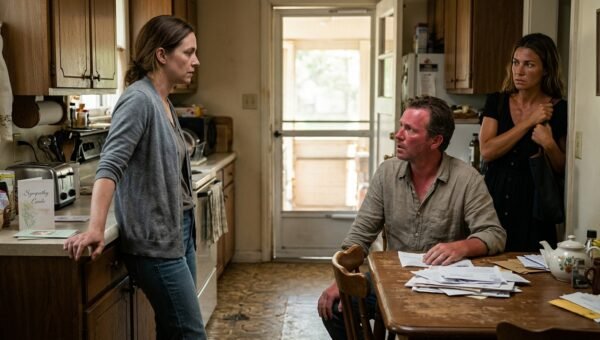
At Evelyn’s house, Greg and Todd were at the dining table with a realtor’s appraisal. They had pages spread out and a calculator between them. Mark walked in behind me. I set the notarized papers and the receipt ledger on the table.
Greg looked at the first page and pushed it back. “You’re not entitled to family money.”
I didn’t raise my voice. I pointed to the seal, the claim, and the amount. The estate couldn’t sell the house or pass the title without paying my $48,600 in certified funds. If they didn’t pay, the claim remained against the property.
Todd leaned over the page. He read the same lines again. Greg asked Mark what this was.
Mark didn’t answer quickly enough.
So I told them about the $300 a month. I told them he’d said it was going toward Evelyn’s prescriptions, while I paid the pharmacy with my own card. I showed them the line in Evelyn’s addendum where she’d written down what Mark had told her.
Greg stood up so fast his chair scraped the floor. “You took our money?”
Mark started saying he could explain. Todd told him to stop talking. The appraisal pages were still on the table, but nobody was looking at them anymore.
I didn’t enjoy that part. I didn’t feel like I’d won some contest. I was watching three men deal with something they’d let me carry alone, and I was tired clear through.
The estate lawyer later confirmed the claim would be handled before any inheritance was divided. The brothers could pay it with certified checks, or the house could be sold and the first proceeds would go toward the debt. They couldn’t simply list it and split the money.
They didn’t pay me from their own pockets. The house was sold through the estate, and the first $48,600 went to my account. The rest was handled after the sale under the estate process. I didn’t take any furniture or jewelry. I wanted the money Evelyn had made sure I was owed, not a piece of her life to argue over.
Mark and I separated our finances that week. I moved my paycheck into an account with only my name on it and changed the bill payments I handled. I packed his clothes into two suitcases and set them by the door. He said he was sorry. I told him I wasn’t ready to talk about our marriage.
The brothers stopped calling me. I didn’t call them. Mark and I are still apart. I haven’t decided what happens next with us, and I don’t have to decide it because someone else wants the house settled.
I kept Evelyn’s letter. I kept the receipts too, though I don’t need them anymore. There’s a line in the letter where she says she knew I never made her feel like an expense. I have read that line more times than I should.
The hospital blanket is clean now. I folded it and put it in a donation box by my front door. The next morning, I sat on my porch with coffee and Evelyn’s note in my hand. The blanket was ready to go. My account was mine. Nobody was asking me to pay for another person’s lie.