The text from my daughter came while Mabel was asleep on my couch: June wants to pick her up Saturday. I read it twice, then looked at the little girl curled under my old quilt, one sock halfway off. June was the person Mabel had called her other grandma. I knew what the timer meant by then. I still typed, “Let’s talk before anyone makes plans.”
A week earlier, I’d nearly said no to having Mabel for the summer.
She was eight, my daughter Beth’s stepdaughter, and not my blood grandchild. I’m ashamed to say the thought that held me up wasn’t complicated. It was groceries. I worked out that feeding another person for two months could run close to $300, then felt cheap and mean even while I was doing the math.
Beth and her husband, Aaron, needed help with summer care. Aaron’s daughter Mabel had lost her mother when she was little, and June, Aaron’s former stepmother, had helped with her before. Beth said Mabel could stay with me while they sorted out their work schedules. I said yes, but I didn’t say it warmly enough. I can still hear myself telling Beth, “I suppose we can make it work.”
Mabel arrived with one small bag and a book she kept pressed to her chest. She was polite in a way that made me uncomfortable. She asked before taking a glass of water.
She put her shoes in a straight line beside the door. When I said there were peaches in the fridge, she asked if she could have one.
“Of course,” I said.
She took half and wrapped the rest in a napkin. I told her she didn’t need to save food here. She smiled, but didn’t answer.
The first week was quiet. I brought her to the library and let her pick cereal at the store. She liked the blue bowl with the chipped rim, so I washed it and left it by her place at breakfast. Nothing dramatic. Just the kind of small stuff I figured a kid should get to do without asking permission.
On the seventh night, we were in the kitchen after dinner. Mabel had been drawing a house with a green roof. I was wiping the table, and she kept watching my face like she was trying to figure out whether I was mad.
Then she asked if I had a rule about how long she was allowed to stay.
I put the dishcloth down. “You can stay all summer,” I told her. “This is your home while you’re here.”
She pinched the paper in both hands. Her voice was so low I had to lean closer. She said her other grandma had a timer. When it beeped, Mabel had to go to the garage.
I remember the smell of dish soap on my hands. I asked what happened in the garage, as gently as I could. Mabel said June shut the door and left her there. Sometimes it was cold. Sometimes she sat by the inside door and listened for footsteps. If she told anyone, June said, her dad would get hurt. Or lose everything. Mabel didn’t seem sure which. She was sure it would be her fault.
That was the part I couldn’t answer cleanly. I wanted to scoop her up and tell her no one could touch Aaron, but I didn’t want to make promises I couldn’t keep.
I sat down beside her and asked if she was safe with me.
She nodded, but she was crying without making a sound.
I held her. She stayed stiff for a while, then leaned into my shoulder. I said, “You don’t have to earn your place here.” I wish I’d said that the first day.
The next morning, the microwave beeped. Mabel dropped her spoon and covered her ears. She was shaking before I could reach the counter. I unplugged the microwave, then crouched beside her and told her it was off. She kept staring at it.
“I didn’t know it was going to do that,” she said.
“I know,” I told her. “It’s not your fault.”
I was careful not to ask for every detail at once. I’d read enough to know that a child can feel pushed into answering just because an adult wants the story. So I asked one thing at a time, and I wrote down what she told me after she went to bed. Dates, as best she could remember. The garage. The timer. The threats about Aaron. I hated making notes about a little girl’s words, but I hated the idea of forgetting or mixing them up more.
For the next few days, I thought things might be getting better. Mabel started asking for seconds. She left her book on the couch instead of keeping it in her arms. She laughed once when I burned a pancake and told her it looked like a map of Wisconsin. It wasn’t a big laugh, but I heard it.
Three weeks later, I got the text about June wanting to pick her up.
I called Beth. She was quiet for a moment, then asked what Mabel had told me. I told her. I heard a chair scrape on Beth’s end of the call. She said June had watched Mabel during some school breaks and a few weekends when she and Aaron were stretched thin. No one had told Beth that Mabel was being locked in a garage.
“Did Aaron know?” I asked.
“He knew she got upset there,” Beth said. “He thought she was being dramatic. June told him Mabel hated being corrected.”
I got mad at Aaron then. I still do, some days. But I also know how easy it is to believe the grown-up who has a ready answer, especially when the truth would mean admitting you left your child with someone unsafe. That doesn’t excuse it. It just makes the whole thing sadder.
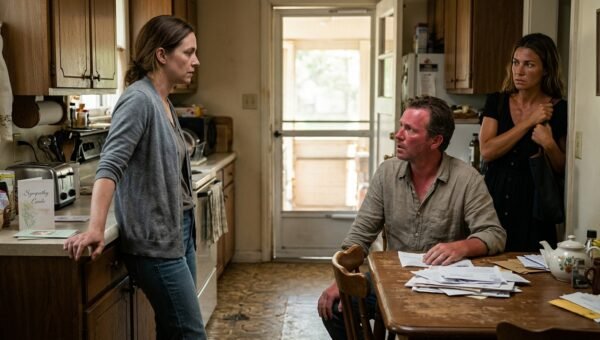
Beth called Aaron, and he came over that evening. He sat at my kitchen table with both hands around a mug he didn’t drink from. Mabel was upstairs with my neighbor, who’d offered to read with her while we talked. Aaron looked like he hadn’t slept.
He said June had told him Mabel was difficult and needed firmer rules. He’d never heard about the timer or the garage. I asked if he’d seen anything that should have made him ask more questions. He rubbed his thumb along the mug and said Mabel had come back from visits jumpy and with small bruises once or twice. June said she was clumsy. He’d accepted that because he wanted the visits to work.
I told him I was angry with him. I also told him I wasn’t going to send Mabel back there while the adults tried to sort out their feelings.
He nodded. “She’s not going back.”
It was the first thing he said that made me believe we were all on the same side.
The next morning, Beth and Aaron called Mabel’s pediatrician. They asked for the records from the times she’d come home with unexplained marks and talked with the school counselor, who had noted that Mabel got anxious around sudden sounds and closed rooms. Those notes didn’t prove every detail. They did show that more than one adult had noticed something was wrong.
We also called a child counselor and followed her advice. We didn’t ask Mabel to repeat the story for a crowd. We kept the notes, saved messages, and made sure Aaron put the safety plan in writing with the people involved in Mabel’s care. June would not pick her up or be alone with her. Beth and Aaron spoke with the right family support people about how to keep that boundary in place. It wasn’t one dramatic phone call that fixed everything. It was a stack of careful steps.
June called me once. I didn’t put Mabel on the phone. June said she’d only been trying to teach the child to behave and that I was making a normal family disagreement into something ugly.
I told her she wasn’t allowed to contact Mabel through me. Then I ended the call. My hand was shaking, which made me mad at myself, but I didn’t call her back.
The first counselor visit was hard. Mabel sat on the edge of the chair and watched the door. She didn’t say much. The counselor told us to let Mabel set the pace and keep home predictable. So we did. I kept the kitchen timer unplugged. We used the wall clock instead. If I needed to bake, I stayed in the kitchen and let Mabel know before the oven made a sound.
I didn’t turn every beep into a lesson. I didn’t want her whole life to become one long reminder of June. Some days we did nothing but read, make lunch, and sit in the yard. She liked watching the neighbor’s dog try to catch a tennis ball and miss.
One afternoon, Mabel asked if she could stay after summer. She said it like she was asking for another peach.
I told her she could always come to me. Then I made sure I wasn’t making a decision that belonged to her parents alone. Beth and Aaron were already working out a longer-term plan, and they both wanted Mabel to have a steady home with us close by. They talked with the counselor and family support staff about what would help her feel secure. The final plan was that Mabel would live with Beth and Aaron, with my home always open to her and regular time here built in. No more stays with June. No more asking Mabel to carry adult problems.
I told her, “You’re not a guest I’m counting down.”
She looked at me for a long time. Then she went back to her drawing.
A few days later, she drew our kitchen. There was a table, a blue bowl, and a clock on the wall. She drew the door to the backyard wide open. She didn’t draw the garage.
I used to think that $300 was a real reason to hesitate. I won’t pretend money stopped mattering. Groceries cost what they cost, and I still look at the receipt. But I know what I was measuring wrong. Mabel didn’t need me to be rich or perfect. She needed one more adult to believe her and mean it when I said she belonged.
This week we baked a pie. I let Mabel measure the flour, and she got some on her nose. The timer was still unplugged on the counter, with the wall clock keeping the time. Mabel laughed at the flour on my sleeve, and I laughed too.