Mom asked if Matthew had eaten before we came in.
That was the last ordinary thing she said. She was sitting behind the thick glass in the visitation room, her hands cuffed in front of her, and she still worried about whether her thirteen-year-old son had eaten lunch.
Then Matthew leaned toward the glass.
“Mom, I know who hid the knife under your bed.”
I was seventeen when Dad was found dead in our kitchen. The kitchen knife was under Mom’s bed.
There was blood on her robe. She kept saying, “I didn’t do it,” and I doubted her anyway.
Six years later, she was minutes from execution. I had a stack of her letters in my coat pocket, most of them unopened.
Mom looked at Matthew. Her voice came through the speaker, small and scratchy.
“Don’t cry for me,” she said. “Just take care of Matthew.”
I had heard her say some version of that before. She’d been taking care of us even from prison, asking about school, reminding me to bring in the trash bins at the house. I’d barely answered.
I thought I was there to say goodbye. I didn’t yet understand what Matthew had just put in motion.
The guard tapped the glass and pointed at the clock. Our visit was nearly over. I reached for Matthew’s arm, but he wouldn’t turn around.
“Tell me,” I said.
He shook his head once.
“Not here.”
I wanted to be mad at him for waiting. I was mad.
But I saw how hard he was gripping the edge of the chair, and I remembered he’d been seven when Dad died. I’d been old enough to understand what Mom’s conviction meant. I’d still let Ray tell me what to think.
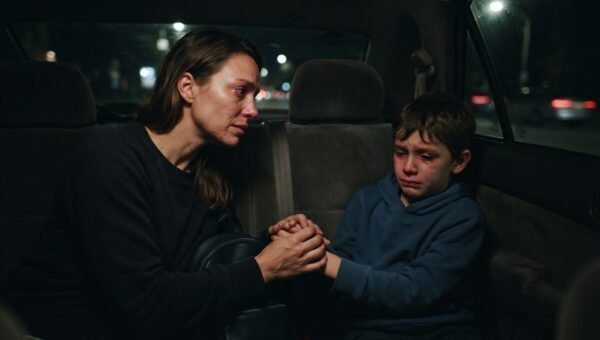
Outside, I got Matthew into the passenger seat and shut the door. The prison lot smelled like hot pavement and the peppermint gum he chewed when he was scared. I kept asking him to start at the beginning.
He said, “Uncle Ray did it.”
I stared at him. Then I told him to say it again.
“He killed Dad,” Matthew said. “He put the knife under Mom’s bed.”
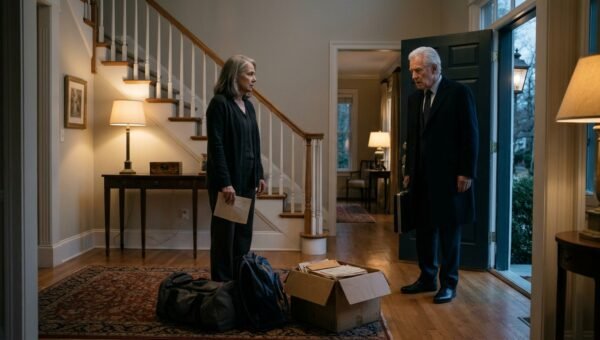
Ray was Dad’s brother. He’d taken us in after Mom was arrested and sat beside us at the trial. He brought groceries, paid bills, and told the neighbors he’d do anything for family. He was the person I trusted when I didn’t know how to trust my own mother.
“What did you see?” I asked.
Matthew rubbed his palms on his jeans.
“Ray came out of your room,” he said. “He had the knife.”
Our house had a long hallway. Matthew told me he’d been standing near the bathroom door, too scared to move. Ray saw him.
“He said he’d kill us if I told.”
“Both of us?”
Matthew nodded. He said Ray told him he knew where we slept. He said Ray could get to us before anyone could help.
Matthew had been seven. I was seventeen and thought he was too young to understand the trial. I hadn’t asked what he saw. I’d been busy being angry at Mom, and then I was busy believing the person who told me she had done it.
“I thought if I talked, he’d come back,” Matthew said.
I wanted to tell him it wasn’t his fault. I tried, but what came out first was, “Why didn’t you tell me?”
He looked at me, and I wished I could pull the words back.
“You stopped believing Mom,” he said. “I thought you’d tell Ray.”
I had no answer.
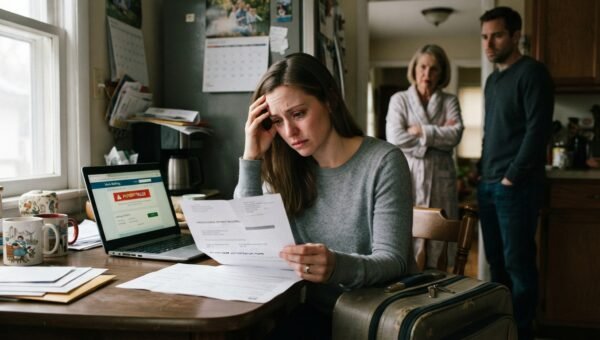
The stack of letters in my pocket felt like it weighed more than it did. I pulled them out. They were creased from being carried around, their edges soft from the times I’d moved them from one drawer to another without opening them.
I opened the top one.
Mom wrote that she loved us. She asked whether Matthew still slept with the hall light on. Then she said she heard heavy footsteps on the attic stairs the night Dad died.
I read it twice.
The next letter mentioned a creak above the hallway. The third asked me not to harden my heart against Matthew, even if I was angry or confused.
My throat felt tight, but I kept reading. Mom had written about the house, about sounds, about the night she’d gone to bed after arguing with Dad. She never accused Ray. She never had proof. She just kept writing down what she remembered.
Matthew said Ray had gone into the attic that night.
The prison guard had told us we had minutes. Now I was looking at the clock on the dash, and it showed three hours until the scheduled injection. I called Mom’s attorney, Vance.
“I have a witness,” I said. “And I think there’s evidence at the house.”
Vance told me to get Matthew somewhere safe and not touch anything. He said he’d start calling the court and the governor’s office, but they’d need more than a frightened child’s statement.
“I’m going to the house,” I said.
“Don’t go alone,” he said.
I didn’t have anyone else I could trust to move fast enough. I drove to the house where I’d grown up. Ray had told me not to go back there without him, but he was at the prison making arrangements for after the execution. He’d said he was “handling everything.”
Matthew came with me. I told him he could stay in the car. He said no.
The front door was locked. I found the spare key under the flowerpot where Ray still kept it, like he had when we were kids. I hated that I knew exactly where it was.
The attic hatch was in the hall ceiling. I dragged a chair over, climbed up, and pushed it open. Dust fell onto my hair. Matthew held the flashlight.
“Ray said not to go up there,” he whispered.
“I know.”
The attic was cramped, with old boxes along the rafters and insulation that got into my sleeves. Matthew pointed toward a loose pine board near the far wall.
“He lifted that one.”
I used the end of a screwdriver from an old toolbox to pry it up. Under it was a shallow space, covered with a strip of tape. Inside was a package wrapped in a plastic grocery bag.
I opened it just enough to see the work gloves. They were stained dark brown in places, and the initials R.H. were written inside one cuff. A brass key sat beside them. Matthew said it belonged to Dad’s lockbox. A watch was tucked underneath.
I did not touch the gloves barehanded again. I folded the bag closed and called Vance.
Then I heard the back door open.
Ray called my name from downstairs.
Matthew went still. I put the bag inside my coat and told him to stay behind me. I couldn’t think of anything brave to say. I just remember the loose attic board pressing into my palm as I climbed down.
Ray stood at the end of the hall. His eyes went to the open hatch.
“What are you doing?” he asked.
I said, “I found what you hid.”
He looked at Matthew. The old Ray disappeared for a second. Not because he shouted or did anything dramatic. He just looked at my brother the way he’d looked at him six years ago.
“You don’t know what you’re talking about,” Ray said.
Matthew took hold of my sleeve.
I could have confronted Ray alone. I could have tried to make him admit it. Instead, I remembered the way he’d spent years speaking softly while making decisions for us. I knew I couldn’t let him control the next few minutes too.
“I’m taking this to Vance,” I said.
Ray stepped toward me.
“Put it down.”
I didn’t. I got Matthew out the back door and into the car. Ray followed us onto the porch, but he didn’t grab either of us. He stood there, watching, while I backed out too fast and nearly clipped the mailbox.
I drove straight to Vance’s office. He met us at the door with a county prosecutor on speakerphone. They took the bag, photographed the gloves, and asked Matthew to tell what he’d seen on video.
Matthew’s voice shook. He said where Ray had stood. He said the knife was in his hand. He said Ray had threatened us.
Vance asked him to repeat the threat.
Matthew closed his eyes for a moment, then said it again.
The glove had a partial bloody palm print. The prosecutor said it appeared to match a print on the kitchen door frame from the night Dad died, a print the state hadn’t tested against Ray. The lockbox key also matched the one Dad had reported missing.
It wasn’t enough to prove every part of what happened in that attic or kitchen right there in Vance’s office. But it was enough to show the state had ignored evidence and that a living witness had come forward. Vance called the judge. The prosecutor called the governor’s clemency board.
We waited with the phone on speaker.
At one point, the office clock clicked so loudly I could hear it over the voices. I kept looking at my own hands. There was dust in the creases from the attic, and one small splinter in my thumb.
With twelve minutes left, the judge’s clerk said the emergency request was being reviewed.
Vance put his hand over the phone.
“Stay here,” he told us.
Then he called the prison warden, Miller. I heard him say the execution had to be paused while the court considered new evidence.
No one answered for a few seconds. Then Miller said, “I’m calling the chamber.”
We couldn’t see Mom. We couldn’t hear the people in the death chamber. We waited while Vance kept the phone against his ear and Matthew held the edge of my coat in both fists.
The phone rang again.
Miller said, “The governor granted the stay.”
Twelve minutes before the injection.
I sat down hard in the nearest chair. Matthew let go of my coat, then covered his face with both hands. I didn’t know what to say to him. I didn’t know what I could say to Mom after six years of letters I hadn’t read.
Ray was arrested at the prison gates. He’d arrived expecting to play the grieving brother. The troopers took him in for questioning, and the prosecutor filed charges for Dad’s murder, tampering with evidence, and threatening a witness.
Mom was taken off the execution schedule. The district attorney moved to have her conviction vacated. The glove and key were tested, Matthew’s statement was added to the record, and the court set aside the conviction. Ray was charged. Mom came home.
It took time for the official papers to catch up with the truth, but she didn’t die in that prison. Matthew didn’t have to carry Ray’s threat by himself anymore.
At our first visit after the stay, Mom had no cuffs on. I kept thinking I should say something that would cover all six years. There wasn’t anything.
“I’m sorry,” I said.
She looked at me for a long time.
“I know,” she said.
I asked her why she’d kept writing when I never answered.
“Because I’m your mother,” she said. “And you were still my child.”
Then she put her red, bruised wrists on the wooden table and took both our hands in hers. Matthew’s on one side. Mine on the other. The daylight lay across our fingers, and she held on.