My mother called me a toilet scrubber in front of 200 people. I had on my dress blues, and she had a microphone. The little badge above my ribbons was the only thing Master Chief Vance looked at before he stopped beside her.
I keep coming back to that badge because I wore it for years without explaining it to my mother. In my inside pocket, I also had a folded citation card with the safe, unclassified words about the work behind it.
I’d brought it because I thought she might ask. She never did.
The banquet was at my mother’s estate outside Bakersfield. I almost didn’t go. The invitation came with a handwritten note saying, “It would mean a lot to have you there.” I knew that could mean she missed me, or that she wanted the uniform in the family photos. I went anyway. I wanted one night where I didn’t make myself smaller before I even walked in.
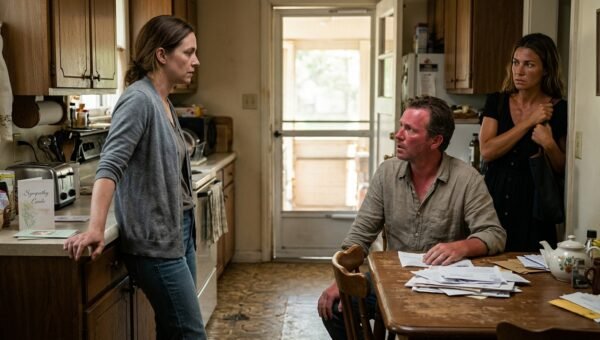
My mother, Diane, had called me a disappointment since I was a kid. At ten, I scratched the edge of her dining table with a pencil. I don’t remember doing it. I remember the wall. She made me stand with my face against it for four hours while she checked on the scratch every so often. “You need to learn to respect what matters,” she said.
She meant the table. I thought she meant me, for a long time.
That’s the thing about a long watch. You can get used to standing there and start thinking the job is to take whatever comes. I left home as soon as I could and enlisted. I stopped calling after a few years, but I never really stopped hearing her voice.
I worked my way into military intelligence, then into a joint operational unit where the hours were long and the mistakes mattered. I’m not going to dress that up. I was good at it, and I worked hard to be good. I also used work as a reason not to look too closely at my family. When my mother sent invitations, I usually said no.
This time, she told me Master Chief Vance would be there. I knew his name. Most people in my line of work did. He’d been invited as a guest of honor, and my mother was proud to have him at her event.
She told me he was “the kind of man who makes a family look good.” She didn’t say that about me.
I wore the dress blues anyway. The ribbons took longer than I remembered, and I had to redo one of them because I’d set it crooked. I kept checking the small badge above them. The pin had a rare unit seal and a serial mark on the back. It wasn’t a thing I wore to show off. It was just part of the uniform I’d earned.
The hall was packed. Servers moved between tables. My mother held court near the head table while Victoria, her favorite, stood close by. Victoria had always been the one she bragged about, even when there wasn’t much to brag about. Her work connected her to a defense vendor with military contracts, and my mother liked to talk as if that made them important to people like Vance.
When I arrived, my mother looked me up and down. “You actually wore that,” she said.
“It’s the right uniform for the event,” I told her.
She gave me the thin smile I remembered from the table. “Try not to make this about you.”
I took my place at the side of the room and didn’t answer. I’d learned that arguing with her was like staying late after a shift to mop a floor somebody kept walking across. It didn’t make the floor any cleaner.
I didn’t know Vance was watching me until my mother took the microphone. She thanked the guests, named a few local officials, then brought him beside her. She spoke warmly about his service and how proud she was to have a real warrior at her table. Vance looked uncomfortable, but he stayed polite.
Then she pointed at me.
“This is the son I always wished I had given birth to, an elite warrior, not a toilet scrubber clinging the military’s skirts.”
There were 200 people in that room. I know because the banquet program listed the seats, and because I’d counted the tables while trying not to look at anyone. A fork tapped a glass somewhere. My mother smiled as if she’d made a harmless joke.
Victoria laughed once, then stopped when no one joined in.
I kept my shoulders square. I could feel the stiff collar at the back of my neck. My mother had always counted on me either apologizing or leaving. I was done doing both on command. I didn’t move.
Vance had turned toward me. His eyes were on the badge.
He stepped away from my mother and came closer. “That seal,” he said. “Where did you earn it?”
My mother lowered the microphone a little. “She’s in support,” she said quickly. “Nothing glamorous.”
I looked at the folded citation card in my pocket. I could feel its edge through the fabric, but I didn’t reach for it. Vance knew what the badge meant. He was checking something. The room got quiet enough that I could hear a server set down a tray behind me.
Vance read the name on my uniform. “Lieutenant Commander Hale,” he said. Then he looked at my face. “Are you Ghost-Actual?”
My mother’s smile stopped. Victoria’s fingers tightened around the chair beside her. I didn’t answer right away. Ghost-Actual was the call sign used during the operation, not a name I’d ever expected to hear at my mother’s banquet.
“I was the tactical lead,” I said.
Vance nodded once. “You authorized the rescue sweep that got my people out.”
He didn’t give the guests the details. He couldn’t, and I wouldn’t have wanted him to. The mission had happened months earlier, during a classified extraction. My work was to sort out a bad stream of location information, figure out which parts were still safe to trust, and make the call on the sweep that opened a route for Vance’s team.
A wrong call could have sent people into the wrong place. A delay could have left them there. I’d signed the authorization myself. Afterward, the official citation used careful words about judgment under pressure and lives saved. That was what the card in my pocket said. It didn’t say how long I’d stared at the map before I trusted my read.
Vance glanced at the badge again. “I’ve been trying to find you since we got back.”
My mother raised the microphone. “There must be some mistake.”
“There isn’t,” Vance said. He didn’t raise his voice. “I know her record.”
I watched my mother look around the room, checking faces as if someone might give her a way out. Nobody did. She had made her whole life out of knowing who was important and standing close to them. Vance was standing close to me now.
Victoria had gone quiet. She’d been involved in the vendor side of that operation, helping pass along routine logistics before the extraction. During the review, investigators found that someone on that side had forwarded position information that should never have left the secure channel. I couldn’t share the report in that room, and I wasn’t going to accuse Victoria without it in front of me. But she knew what the review had found.
Vance kept his words careful. “The breach put my team at risk,” he said. “The review confirmed where it came from.”
My mother looked at Victoria. Victoria looked down at the table.
“You told me it was all cleared up,” my mother said.
Victoria swallowed. “I thought it was.”
It wasn’t a confession. It wasn’t an answer to everything. But it was the first time I’d seen my mother realize that her favorite person could bring trouble to the door instead of praise.
Then my mother turned back to me. “You could have told me what you do.”
I nearly laughed. Not because it was funny. “You never asked.”
“I asked plenty.”
“No,” I said. “You asked whether I was still cleaning toilets.”
Her grip tightened around the microphone. “I was proud of you in my own way.”
That was her favorite kind of sentence, one that asked me to do the work of making it sound better. I used to help her. I’d say she was worried, or old-fashioned, or bad at showing love. I didn’t do that anymore.
“I was ten,” I said. “You made me face a wall for four hours over a scratch in your table. You called me a toilet scrubber tonight. Don’t tell me this was pride.”
She looked at me like I’d embarrassed her. I guess I had. That was the first time it occurred to me that I might have spent years worrying about hurting her feelings while she never worried about hurting mine.
Victoria tried to step in. “This isn’t the place.”
“It became the place when Mom picked up that microphone,” I said.
My voice shook on the last word. I hated that. I’d wanted to sound calm and finished. I didn’t. But I didn’t take it back.
Vance stepped between the head table and me, then stopped at a respectful distance. He raised his hand and saluted. The room was still. My mother had the microphone lowered now. Vance’s salute was not for her guests, or her estate, or the story she’d just told about me.
It was for me.
“Ma’am,” he said, “I’d like your official debrief report when you’re back at your office.”
I returned the salute. “You’ll have it.”
That was the moment the room understood the difference between my mother’s version of my work and the truth. The badge had led Vance to me. The citation in my pocket backed up what he already knew. And the report I’d signed months before would be read by the people reviewing the breach, including the vendor access Victoria’s work depended on.
My mother’s social circle had leaned on those military connections for years. She’d spoken about them as if she owned them. She didn’t. I had no power to decide what happened to a contract, and I wasn’t going to pretend I did. But my professional report mattered. Victoria knew it. My mother knew it now, too.
She started to speak, then lowered the microphone all the way. “We can talk at home,” she said.
“No,” I told her. “We can’t.”
I didn’t say it to punish her. I said it because I’d had enough chances to make that home feel safe, and she’d had enough chances to act like my mother. I’d kept waiting for her to want to know me. The truth was, she wanted the version she could brag about or put down, depending on the room.
The guests didn’t clap. I was glad. This wasn’t a show I needed them to approve. A few people looked away. One woman touched my sleeve as I passed, but I didn’t stop. I’d done enough standing still for that family.
I left the folded citation card in my pocket. I didn’t need to pull it out and read the safe lines to prove anything. Master Chief Vance had seen the badge and knew the work behind it. My mother had heard him say it in front of everyone she’d invited.
At the door, I heard my mother say my name. I didn’t turn around. I knew she might be calling me back to fix the scene, not to make things right. I’d learned to tell the difference, even if it took me longer than it should have.
The heavy mahogany doors swung shut behind me. I walked down the steps into the cool night air, and the gold buttons and ribbons on my dress blues caught the streetlights.