The truck smelled like diesel and wet cardboard. I noticed it before I noticed the curtains move in my parents’ front window.
Arthur Holloway had rolled his mail truck into the driveway ahead of me. He opened his door, looked at my uniform, then looked past me at the house.
“Don’t get out,” he said.
I thought he was worried about my surprise visit. I’d been gone four years, mostly overseas with the Army, and I’d pictured my mother crying when she saw me.
I thought my father might come out and clap me on the shoulder. That was the version I’d let myself carry all the way home.
Then my mother came through the front door with her phone in her hand.
I stayed in the car.
She pointed at me and started talking to the dispatcher. I couldn’t hear every word through the glass, but I heard “dangerous” and “escaped.” Then she said “prison.”
That was the first time I knew what she’d been telling people.
I had been back in town less than a minute.
Arthur walked over to my window. His mail truck was still running, and the diesel smell came through the crack when I lowered the glass.
“Stay here,” he said. “I’m getting something.”
I asked what was going on. He glanced at my mother, who was still talking into the phone.
“Your letters,” he said.
I didn’t know what that meant. I knew I had written them.
I knew I’d sent them to my parents’ address. I had no idea they’d been kept.
Four years earlier, I left after a fight with my mother about enlisting. She said I was walking away from my family. I said I wasn’t asking permission. My father was at the kitchen table and didn’t say a word. I was angry enough to make sure my last sentence hurt.
I signed up anyway.
For a while, I thought the silence from home was just how it was going to be. My calls went unanswered. Letters didn’t get answered either, but I kept sending them. It wasn’t anything special. I wrote about where I was, how the food tasted, how I missed the cheap coffee at home. I asked if my dad had fixed the loose porch step. I told them I was fine, even when I wasn’t.
I figured they’d read them when they were ready.
That was one of the things I got wrong.
I didn’t know then that, around town, my parents had another story.
I found out later the lie had started not long after I shipped out. People asked why their child was gone. My mother told them I’d been convicted of a violent crime and was locked up in a state prison.
She said it like it was shameful and private. People stopped asking questions. Some brought casseroles. A few neighbors checked on her. My mother liked having a reason to be the injured one without having to explain our fight or say I’d chosen the Army.
My dad knew. He let her say it.
Arthur had delivered mail on our route for twenty years. My mother would hand him my letters when they came back to her, and tell him to get rid of them. That’s how he explained it to me later. He didn’t tell me what he said to her. He only said he took the letters and kept them.
At the time, I had no way to know any of that.
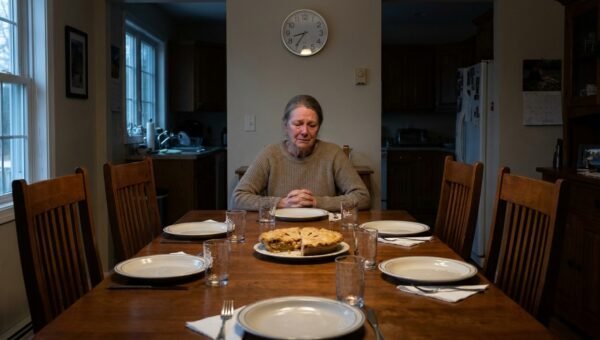
I had arrived home in uniform with one duffel in the back and no plan beyond getting to my parents’ house. I’d thought four years was long enough for the fight to lose its edge. I even stopped at a gas station on the edge of town to buy a pie because my mother liked the apple ones with the thick crust. It was on the passenger floor, sliding a little every time I turned.
I’m not proud of how much I wanted her to be happy to see me.
The siren came up the road while I was still in the car. My mother ended her call and stood on the walk with one hand on her phone.
My father appeared behind her. He didn’t come down the steps.
Arthur went to the back of his truck. He pulled out a weathered postal bin and set it on the ground. Then he lifted it with both hands and carried it toward the driveway. It looked heavier than a pile of mail should.
I opened my door.
Arthur turned around sharply. “Wait.”
So I sat back down. I felt foolish doing what he said, but his face was serious. The police cruiser turned into the driveway a few seconds later. My mother took two quick steps toward it.
“He’s an escaped inmate,” she said. “He’s dangerous. I told the dispatcher.”
One officer looked at me, then at my uniform.
“Sir, can I see your identification?”
I handed over my military ID. My hands were steady. The rest of me felt like I’d missed a step on the stairs and was waiting to hit the floor.
The officer checked the card and asked where I’d been stationed. I answered. He asked for my name and date of birth. I gave them to him.
My mother kept talking over us.
“He’s not supposed to be here,” she said. “He got out.”
The officer looked at her. “You said he was an escaped prisoner?”
“I know what I said.”
I got out of the car then. I didn’t want to have this conversation sitting behind a window. My mother stared at my uniform like it had appeared to prove something she didn’t want proved.
The second officer spoke to her in a low voice. She pointed at me again.
“That’s my child,” she said. “He’s been gone for years.”
There it was. The truth, but only the part she couldn’t hide.
Arthur set the postal bin down beside the cruiser. He didn’t make a speech. He lifted the top envelope and turned it so the officers could see my name and the military postmark.
“This was mailed from overseas,” he said. “There are more.”
My mother looked at the bin. Then she looked at Arthur.
“You had no right to keep those,” she said.
“I didn’t throw them away,” he answered.
The officer examined the postmark. He asked me if I’d sent the letters. I said yes. I had no idea how many there were.
My mother kept trying to talk over him. The words came too fast. She said she’d returned them because I was in trouble. She said she didn’t know where I was. Then she said she thought I was still in prison.
Arthur opened the bin.
It was full of envelopes. Some had bent corners. Some were held together with rubber bands. There were letters from the first year, the second, the third. My handwriting looked different on a few of them. I could see dates, postmarks, the careful block letters I used when I didn’t want my writing to turn into a mess.
I reached for the top one, then stopped.
I didn’t know if I wanted to read them there. I didn’t know if I wanted to touch proof of something I’d spent years telling myself wasn’t personal.
The first officer checked my ID again and spoke into his radio. The dispatcher confirmed what the card showed. I was an Army soldier who had returned home. I wasn’t an escaped inmate. There was no reason to arrest me, and the officers said so plainly.
My mother still didn’t apologize.
She said, “I was trying to protect this family.”
I looked at her. “From what?”
She had no answer that held up with the letters sitting there.
My father came down one porch step. He looked at the bin, then at me.
“Your mother was upset,” he said.
That was his whole defense. He said it the same way he used to say it when she’d spoken for both of them at dinner.
“You knew?” I asked him.
He looked at the ground. “I knew what she was saying.”
“And you let her.”
He didn’t answer. Then he turned and went back inside.
The neighbors were outside by then. Not a crowd, exactly. A woman stood by her garage with a dish towel in her hand. Someone across the street had come out onto the porch. I recognized a few faces, though I couldn’t tell if they recognized me.
Arthur picked up an envelope.
“This one’s dated March,” he said. “You wrote you were headed out for a long stretch.”
I remembered that letter. I’d written that I was okay and didn’t want them worrying. I’d included a dumb joke about Army coffee. I’d said I missed home.
Arthur read the postmark aloud. The officer looked from the envelope to my uniform.
My mother shook her head. “He could’ve written those later.”
“They have military postmarks,” Arthur said. “They came through my route.”
The officer told her the report was unfounded. He said that if she had concerns, she needed to be honest about them. My mother’s face tightened. She had called for police because she wanted them to take me away before anyone could ask why I was in uniform.
I could see that clearly by then. The lie had worked for her as long as I stayed gone. A criminal child gave her sympathy and kept people at a distance. A serving soldier standing on her lawn with four years of letters in a postal bin was a problem she couldn’t talk her way around.
She had called 911 because the story she’d built was standing right in front of the house.
“Come inside,” she said. “We can talk privately.”
I looked at the neighbors. Then at the letters.
“No,” I said.
She lowered her voice. “Don’t do this in front of everyone.”
“You called them here.”
The officer asked if I wanted to make a statement. I said no. There was no arrest, no charge, no big official moment. They took down the details and left after telling my mother not to make a false report again. The truth wasn’t going to turn into a courtroom case. It was just going to be the truth in a town where she’d spent four years telling the opposite.
The neighbors didn’t come over to me. They didn’t need to. They had seen the uniform and the bin. They had heard my mother call me an escaped inmate, then watched the officers hand my ID back.
My mother went inside. The screen door shut behind her.
I asked Arthur how he’d held on to the letters.
He rubbed the side of his thumb across the edge of one envelope. “I thought somebody should know you were trying.”
That was all he said.
I wanted him to say more. I wanted to ask why he hadn’t found a way to contact me. I wanted to ask why he’d let the letters sit in his truck or wherever he’d put them while I was overseas thinking my family didn’t care. But he had saved them, and I knew he hadn’t been the one who chose to keep me out.
I was angry at him for about ten seconds anyway. Then I was ashamed of being angry at the one person who’d kept the proof.
I took the bin from him. It was heavier than I expected. He offered me his spare room until I figured out where I was going. I said yes because I had nowhere else lined up, and because I didn’t want my first night back to be in a motel.
Before we left, I walked to the porch. My mother stood behind the front window. I could see her shape through the curtain, but I didn’t knock.
My father didn’t come back out.
I put the pie in the trash can by the curb. I couldn’t bring myself to take it with me.
The next days were mostly phone calls. The town found out what had happened. A neighbor apologized for believing the prison story. Another told me my mother had described me as “lost” and said she was praying for me. I listened. I didn’t know what I was supposed to say to any of it.
I didn’t go back to the house.
Arthur let me keep the letters. I read some at his kitchen table and put the rest back in the bin. There were small things in them I didn’t remember writing. The loose porch step. A bad meal. A note about a friend from my unit. I kept seeing the same line near the end: I’m doing fine. I’ll write again soon.
I had meant it every time.
I stopped calling my parents. I stopped trying to make a way back into a house where my mother had told the whole town I was behind bars. My father never called to explain why he stayed quiet. I don’t know if he was scared of her or just comfortable letting her choose the story. Either way, I was done waiting for him to say something.
Arthur drove me back to the house once, after I’d had a few days to think. I went up to the truck but didn’t get out. I only wanted to see it once without the police cruiser in the drive.
The front curtains moved.
I had the letters in my lap. I ran my thumb along the top edge of the oldest envelope, the one with the softened corner from sitting in the bin. Then the curtains snapped shut.
I stayed in Arthur’s mail truck, holding the letter she’d told him to throw away.