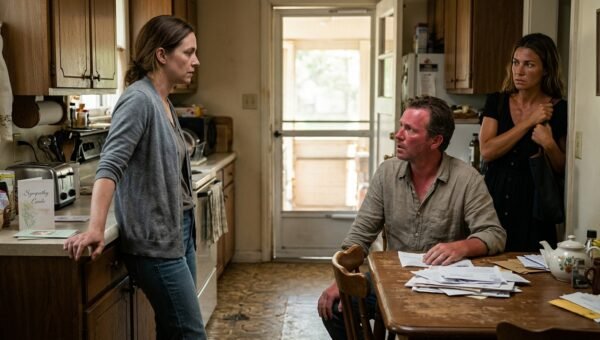
The coffee maker clicked off while Adam folded his shirts into a grocery-store box. I stood by the counter with my cup in my hand, watching him do it, and I knew I should tell him to stop. I was fifteen years older than him and still had the right to say, “Don’t go.” I didn’t.
That was 2004. I’ve gone over that morning so many times I remember the coffee had grounds in it.
I don’t remember what shirt he folded first. He was my only boy, and I let him leave because I thought getting him out of the house would make the house easier to live in.
My first wife, Adam’s mother, died in 2003. Adam was fourteen. I was so busy trying to act like I could keep going that I didn’t know how to talk to him about her, or how to look at him without seeing her eyes. I know how ugly that sounds. It was uglier to make him carry it.
Reba came into our lives the next year. I married her, and she wanted to make a home with me. She also wanted the spare room for a sewing studio. Adam’s room became that studio. Reba didn’t drag his things out herself. I helped. That’s the part I can’t hand off to her.
Uncle Dave had a farm and a place for Adam to work.
Reba called it a practical arrangement. I called it temporary. I told myself Adam would be better off with my brother for a while, away from the grief and the tension in our house. That was the story I used because the truth was I wanted the house quiet.
Adam was folding his shirts carefully, which made me mad for some reason. Like he was making it easy for me. Reba stood at the end of the hall, not saying much. I looked at her, then at him, and chose the words I knew would do the job.
“You’re a constant reminder of what we lost,” I said. “This farm is no place for someone who brings tears into the house.”
He stopped folding. He looked at me for a few seconds, then put the shirt into the box. I didn’t take the words back. I watched my fifteen-year-old son carry that box out.
I drove him to Uncle Dave’s. I told myself Dave could help him settle in, and that I’d call the next day. I did call, eventually. But a plan to call isn’t a call. That’s one of those things I’ve had to learn late.
For the next two years, Adam mailed me a birthday card each year. Each one had a twenty-dollar bill inside. I can still picture the first envelope, his handwriting on the front, a little crooked. I read the card, put the money away, and didn’t write back.
Reba said answering would stir things up. I let that count as a reason. I knew she didn’t want him back in the house, but I never made her be the one to say it. I was his father. I could have answered one card. I could have sent the twenty dollars back with a note, or kept it and written “I’m sorry.” I did nothing.
Reba left in 2011. There wasn’t one big blowup that made the house empty. She just decided she was done, and she went. By then Adam and I had spent years not talking, so her leaving didn’t bring him back. I ate Thanksgiving alone. Then Christmas. I got used to buying too much food and putting half of it away.
Years went by that way. I’d hear about Adam now and then through Uncle Dave. He had stayed on the farm for a while, learned to fix equipment, then moved to Bellwood and got work at a garage. He was good at it, Dave said. Eventually he had his own place. I was proud of that, though I hadn’t earned the right to tell him so.
Last month my truck broke down outside Bellwood. I got it towed to an independent shop, and while I waited I sat in the cab with the engine off, listening to the tow truck leave. The quiet felt familiar. I could have gone into the waiting area and kept to myself, but I’d spent enough years hiding from a boy who was now a grown man.
I stayed by the open bay. Someone slid out from under the truck on a creeper and sat up, wiping his hands on a rag. He had his mother’s eyes. I knew them before I knew him.
He looked at me. “You don’t remember what you told me that night. I do.”
I did remember. Not every word from the night he left, but those words came back all at once. I wanted to tell him I’d been grieving. I wanted to say Reba had pushed for it. Both things were true, and neither one excused me.
Adam stood up and put the rag on a shelf. He didn’t yell. He didn’t come over and hug me. He just waited to see if I’d turn the whole thing into somebody else’s fault.
I couldn’t make myself speak right away. My throat did that tight thing it does when I know I’m about to say something I should’ve said years ago. The truck sat open behind him, the repair still waiting.
I finally said, “I remember enough.”
Adam looked down at his hands. “I was fifteen.”
“I know.”
“You told me I reminded you of Mom.”
“I did.”
“And you said I brought tears into the house.”
There it was, plain and exact. No mistake for me to correct. No misunderstanding for me to smooth over. I had said it, and he’d had to live with it.
“I’m sorry,” I said. Then I stopped, because those words sounded too small. “I shouldn’t have sent you away. I shouldn’t have made your mother’s death your fault. It wasn’t.”
He rubbed the heel of his hand across his forehead. “You didn’t just say it once. You let me go.”
I nodded. I wanted to explain how lost I felt, how I couldn’t stand the reminders, how I kept thinking I’d make it right later. I didn’t say any of that. He didn’t need a list of the ways I’d made myself feel better.
“I let Reba have too much say,” I said. “But I chose it. I was a coward, Adam. I let you be the one who paid for it.”
He looked at me then. His eyes were his mother’s, but the rest of his face was a man I didn’t know. That hit hard. I had missed his growing up and had no claim to the years in between.
Adam turned back toward the truck. “I’ll check the belt and the alternator.”
It took me a second to understand that he was going to fix it. I almost thanked him like a customer, like we’d just done business and could leave it there. But he had already gone back to work, and I knew I wasn’t getting out of that bay without answering for more than a dead truck.
While he checked the alternator, he asked how long Reba had been gone. I said fifteen years. He asked if I was seeing anyone. I said no. He didn’t ask if I was happy, and I didn’t pretend.
“Still eat alone?” he asked.
“Most holidays.”
He tightened something under the hood. “You could’ve written back.”
“I know.”
I didn’t tell him I kept those two cards. I had them in a drawer at home, tucked into an old envelope with the twenty-dollar bills. I’d tell him another time, if there was one. The cards weren’t proof I’d been a good father. They were proof Adam had tried while I sat there doing nothing.
He found the problem and gave me the cost before he started. I said yes. He worked with his head down, and I waited nearby. When I shifted around, I caught myself about to say I was sorry again, as if saying it enough times could make him do something with it.
He finished the repair, wiped his hands, and slid a wrench across the workbench. Then he set down a coffee mug. It was stained around the rim, the kind of thing you’d use without thinking.
“Sit a minute,” he said.
So I sat. We didn’t cover twenty-two years in one afternoon. We talked about Uncle Dave, the shop, and the truck. We talked about his mother, too, though neither of us had much to say at first. I listened more than I spoke. That felt like the least I could do.
Before I left, Adam said he didn’t want me calling every day or showing up without asking. He also said he wasn’t promising that things would be like a family again. I told him I understood. I didn’t ask him to make it easier for me.
The next weekend I drove back to Bellwood without the truck. I called first. Adam said he was working but had time for coffee after he closed. I went. I kept going on weekends after that, not every single one, but often enough that it became something he could count on.
At home, I started clearing out what was left of Reba’s sewing studio. I’d kept things in there long after she left, partly because I didn’t want to decide what to do with them. I put the old fabric in boxes and made room for a chair. I wasn’t going to pretend that cleared the past. It was just one room I’d let stay stuck.
Adam and I still have quiet stretches. Sometimes he looks at me and I can tell he’s thinking about the boy with the box. I don’t rush to fill those pauses now. I’ve spent enough years filling them with excuses.
At the shop, the coffee mug sat between us on the workbench, grease on one side and a brown ring dried at the bottom. Adam set it down between our hands, and neither of us reached to move it.