Martha tied Leo’s birthday cards with blue ribbon and kept them in the top drawer of her dresser. She saved the plain ones too, the ones with a short note and no photo tucked inside. After the funeral, I was sorting that drawer when I found an envelope beneath the bundle, still sealed.
It was postmarked nine years earlier, the year Leo stopped coming home for Christmas. I nearly dropped it into the box with the old cards.
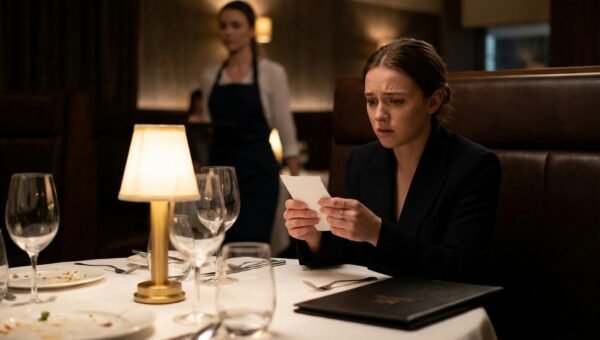
Then I saw the handwriting on the front. Leo’s. I opened it, and a hotel receipt slid onto the bed with a folded note.
The receipt was from the Palmer Drake Hotel in Chicago. I’d never been there. My name was printed on it, with another name beside mine: Julian. Then I unfolded Leo’s note. “Mom, I saw Dad here. I don’t know how to tell you.”
I sat on the edge of the bed with that paper in my hand. Martha’s dresser drawer was still half full of things I hadn’t been able to sort. I kept looking at the note, then at the receipt, as if one of them might change if I gave it enough time.
The next morning, I took the papers to my desk. I’m not a man who keeps a diary, but I kept my work calendars and old timecards because the plant office needed them for years.
I opened the 2017 planner and found the weekend printed in red: full inventory, all hands. I’d been at the shop three hundred miles from Chicago.
I checked the timecards anyway. Mine showed a punch at 5:52 Saturday morning and another at 6:11 Sunday night. I was leading the inventory at the manufacturing plant where I’d worked for most of my adult life. I remembered that weekend because we had a conveyor motor go bad, and I’d spent half a shift listening to it squeal.
The records were ordinary. That was what made them useful. I ran my thumb over the old paper until I found a coffee stain from that morning. I had proof I wasn’t in Chicago, but I still didn’t know why my name was on the receipt or why Leo had believed what he believed.
For nine years, Martha and I had guessed at the reason Leo stayed away.
He moved to London not long before that Christmas. He sent cards, called on birthdays, and kept the talk polite. When Martha asked if he’d come home, he’d say work was busy. I’d tell her to give him time. I thought I was being patient. Mostly, I didn’t want to hear him say he didn’t want to see us.
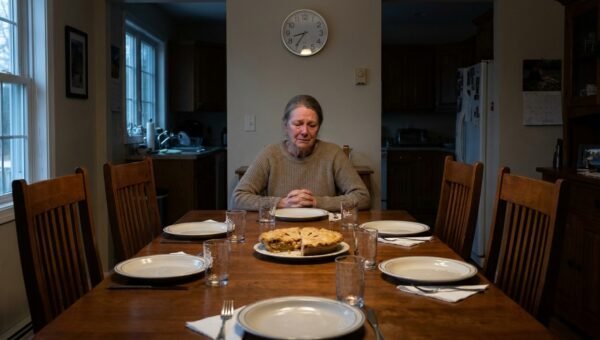
Martha had a way of keeping a place for him without making a show of it. She’d buy the coffee he liked, even though nobody else drank it. At Christmas she’d ask me to leave the chair at the end of the table pulled out. I’d do it, then get irritated when she asked. That wasn’t fair to her. I know that now.
I called Julian that afternoon. He’d lived with us for more than six years in his twenties, after a bad breakup and a run of money trouble. He was my younger brother, and he looked enough like me that strangers sometimes called him Arthur.
Martha and I gave him the spare room, helped him get work, and bailed him out more times than I can count.
“Can you come over?” I asked.
“What’s this about?”
“I found something with your name on it.”
He didn’t answer for a couple seconds. Then he said, “All right.”
I drove to his framing shop on the edge of town with the receipt in my coat pocket. Julian was behind the counter, trimming a mat board. The blade scraped the ruler in a way that made me remember how careful Martha used to be when she wrapped the framed pictures we gave people.
I put the receipt on the counter. Julian stopped cutting.
“Where’d you get that?” he asked.
“In Martha’s dresser. Leo sent it nine years ago.”
He picked up the paper, then set it down again. “I can explain.”
“Start with why my name’s on it.”
Julian looked past me at the shop door. He didn’t say anything for a moment. Then he rubbed his hands on his work apron, though they weren’t dirty.
“I used your card,” he said. “The old company one.”
I knew about the card. I’d let him use it for gas and supplies when he was trying to get back on his feet. I’d stopped trusting him with it before he moved out, but I hadn’t thought he still had the number.
“You booked a room under my name?”
“I did.”
“Why Chicago?”
He sat down on the stool behind the counter. He told me he’d gone to Chicago with his ex-partner, who he’d been seeing in secret again. He was drinking heavily then, he said, and didn’t want his own name on the hotel bill. The second name on the receipt was his. He’d used my charge account and my name because he knew they’d get him through the booking without questions.
“I wasn’t thinking,” he said. “I was trying to hide what I was doing.”
I wanted to believe him. I also wanted to ask why he’d been willing to let my son carry the pain of what he’d done. I said both things, though not very calmly.
“Leo saw you.”
Julian looked down at the receipt. “He did?”
“He thought you were me.”
Julian’s mouth tightened. “I never knew.”
That part I believed. He hadn’t known Leo was in the lobby. He hadn’t known Leo had picked up a discarded copy of the receipt, either. But he had still taken my name, and now there was no getting around what it had cost.
“You have to put it in writing,” I said. “Every bit of it.”
He nodded once. “I will.”
I told him I wanted the dates, the card, the hotel, and the name of the person he went with. I wanted him to sign it. I wasn’t trying to get him in trouble. I needed something more than his word if I was going to ask Leo to believe me after nine years.
Julian wrote the statement by hand that evening. He didn’t make excuses in it. He said he’d used my old corporate charge card and booked under my name. He said he’d been in Chicago with his ex-partner and that I hadn’t been there. He signed and dated it.
I put his letter with my timecards and the old planner. Then I sat at the kitchen table and looked at the empty chair Martha used to keep open for Leo. I couldn’t ask her what she’d seen in that envelope. She never saw it. Somewhere in the middle of her early appointments and the holiday rush, she’d put it in the drawer to open later. The cards covered it. Later never came.
I kept thinking about that note. Leo had tried to tell his mother without having to look at her while he did it. Maybe he thought he was sparing her. Maybe he thought I’d already broken the family and there was no reason to bring it up. I didn’t know. I only knew I’d let nine Christmases pass without asking the question that might have brought him home.
I booked a flight to London that night. It cost more than I should’ve spent without checking the dates twice, but I didn’t want another phone call where I could hear him choosing each word. I put the receipt, Julian’s signed statement, the timecards, and Martha’s blue ribbon in my carry-on. I didn’t bring the whole stack of cards. I brought the one Leo had sent.
He agreed to meet me at a quiet pub near his flat. When I saw him, he was thinner than I remembered and had gray starting at his temples. He hugged me, but it was quick. We sat down at a small table. He ordered tea. I ordered coffee, then forgot to drink it.
“I found your letter,” I said.
Leo’s face changed. “Mom got it?”
“She never opened it.”
He looked down at the table. “I sent it to her. I couldn’t say it to her face.”
“I know.”
I took out the sealed envelope, the receipt, and Julian’s letter. Then I set my old timecards beside them. I didn’t want to start with excuses. I told him I’d never been in Chicago that weekend. I showed him the dates on the cards and the line in the planner. Then I gave him Julian’s statement.
Leo read it without speaking. He read it once, then started over. His thumb stopped on Julian’s signature. I could hear cups clinking behind me and somebody laughing at the bar. I remember that because the sound felt too ordinary for what was happening at our table.
“Julian was at that hotel?” Leo asked.
“Yes.”
“You weren’t?”
“No. I was at the plant.”
He picked up one of the timecards and stared at the punches. Then he held the receipt next to Julian’s statement, as if the names might tell him something more. His eyes filled, but he kept reading.
“I thought I saw you,” he said.
“I understand.”
“No, Dad. I saw your coat. I saw your face from behind. I was sure.”
I wanted to tell him he should have called. I wanted to say he could’ve asked me directly. Both things were true, and neither one mattered as much as the fact he’d spent nine years carrying it alone. So I kept my mouth shut.
“I’m sorry,” he said. “I left Mom with that.”
“She never knew what you thought. She never read the letter.”
He put the paper down and covered his mouth with one hand. Then he started crying. I reached across the table, but I didn’t grab him. I let him take my hand when he was ready.
“I missed her last Christmas,” he said.
I couldn’t fix that. I couldn’t give him another visit with Martha, or let him tell her he was sorry. I told him she kept every card he sent. I told him she saved the boring ones, too. He started crying harder at that, and I sat there holding his hand while the coffee went cold.
We talked for a long time after that. Not about the hotel anymore. We talked about the years we’d both spent making guesses instead of asking each other. I told him I’d been afraid of hearing he didn’t want me around. He said he’d thought I’d already chosen the other life he believed he’d seen. We were both wrong in our own ways, and the years were still gone.
“I want to come home for Christmas,” he said.
I didn’t answer too fast. I didn’t want to make it sound like one visit fixed everything. “I’d like that,” I said. “We can make a plan.”
He opened his phone and booked his flight while we were still at the table. We checked the arrival time together, then wrote it on the back of an old receipt so neither of us would forget. Julian stayed at an honest distance after that. He’d apologized, and I accepted it, but I didn’t hand him another card or let him use my name again.
When I got home, I put Martha’s framed photograph on the dining room table. I opened the calendar to December and marked Leo’s flight arrival. Then I tied the blue ribbon around a new envelope, addressed it to Leo, and left it beside the picture. This time, I knew exactly where it was going.