The smell of burnt toast was still in the kitchen when Laura told me I could serve her husband or leave her home. I remember the toast because I’d made it for Greg, the way I’d made breakfast most mornings. I smiled, packed my suitcase, and walked out without raising my voice.
Seven days later, I woke up to twenty-two missed calls and one message I never thought I would receive.
I’m telling this from a booth in the diner where Laura and I met the next morning.
She’s sitting across from me now, rubbing a paper napkin between her fingers. I have a folder beside my coffee. I’ll tell you what was in it, but first I need to explain why I packed so quickly.
I moved in with Laura and Greg two years ago, after my wife died. Laura said the spare room was sitting empty and I shouldn’t be alone. I didn’t want to make myself a burden, so I told her I’d pay my share. She said, “We’re family, Dad. Don’t make it strange.”
I took that to mean we’d help each other. I sold my little house and put a large part of the money toward their mortgage. I kept the electric, gas, water, and internet bills in my name. I paid for groceries and covered the household credit card from my pension. If Greg’s car needed work, I paid the shop. It was my idea. No one held a pen to my hand.
I suppose I thought Laura knew what I was doing. I never sat her down and showed her the statements. I’d paid bills quietly for years, even when my wife was alive. I told myself that was what a father did. Maybe I also wanted to be needed. I can admit that now.
At first, we got along. I made coffee before Laura left for work, and she’d bring home the cinnamon bread I liked from the bakery. On Saturdays, I took the trash bins down to the road. I was happy to do those things. There’s a difference between helping your family and being ordered around, but I didn’t say that out loud soon enough.
Greg wasn’t working steady. He picked up a few jobs, but mostly he talked about the business he was going to start and the people he knew.
He liked a clean shirt and a new truck. I didn’t begrudge him any of that. I did notice he never asked how the mortgage got paid, or why I kept buying groceries when he said money was tight.
Two weeks before I left, he started speaking to me like I worked for him.
“Can you run to the store?”
“I just got back from the store.”
“Then go again. We’re out of coffee.”
I went. It was easier than getting into a fight over coffee. That was my thinking, anyway.
A few days later, he called from the living room. “Arthur, bring me a plate.”
I was washing a pan. I dried my hands and carried one in. Laura looked up from her phone but didn’t say anything.
I asked her about it after Greg went to bed. She said, “He’s having a rough time. Just don’t make every little thing an issue.”
I said, “I’m not making an issue. I’m asking you to notice.”
She didn’t answer. I let it go again.
The kitchen argument came on a Thursday. I’d made dinner, though I don’t remember what it was. Something with chicken. Greg came in late, looked at the counter, and said, “You forgot my plate.”
I told him there was food on the stove and he could help himself.
He gave a short laugh. “That’s what you’re here for, isn’t it?”
Laura was at the table. I waited for her to say something. She picked at the label on her water bottle.
“Greg’s had a long day,” she said.
“So have I,” I told her.
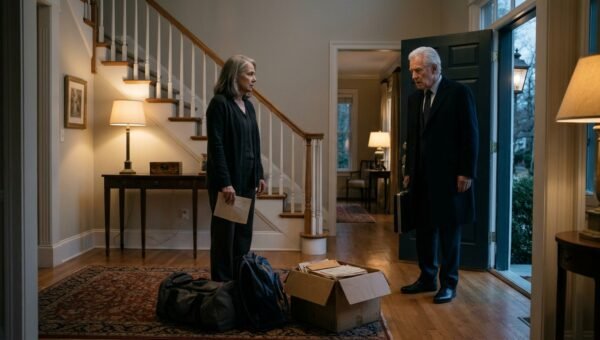
She stood up. Her voice got sharp, though she didn’t yell. “Dad, either serve him when he asks, or leave my home.”
The words were plain. No confusion about them. I had my hand on the dish towel. I folded it once and set it by the sink.
“All right,” I said.
Greg looked pleased for about a second. Then he seemed unsure what to do with me not arguing.
I went to the spare room and took out my suitcase. It was the same one I’d used when my wife and I went to visit our son years ago. I put in my shirts, my medication, my shaving things, and the small framed picture of my wife. I left the extra blankets in the closet.
Laura came to the doorway. “You’re really doing this?”
“You told me to leave.”
“I didn’t mean tonight.”
I looked at her. “You said it clear enough.”
She crossed her arms. “Dad, don’t make this bigger than it is.”
I almost told her right then about the money. Every bill I’d paid, every bag of groceries, how much I’d put toward the mortgage. I could feel the words waiting. But if I said them while she was angry, it would sound like I was charging her for being her father. So I didn’t.
I zipped the suitcase and carried it out. Greg was on the couch. He didn’t look up from his phone.
The rental I’d lined up was a small studio in a building near the highway. I’d found it months earlier, not because I planned to leave, but because I liked knowing I had somewhere to go if I needed it. The owner let me move in that night. I set my suitcase by the wall and ate crackers over the sink.
The next morning, I called the utility companies. I wasn’t trying to shut anything off. I asked to move the accounts out of my name and gave them Laura and Greg’s contact information. I stopped the grocery card’s automatic refill. Then I canceled the household credit card I’d funded from my pension.
It felt mean while I was doing it. I’m not going to pretend otherwise. I kept thinking of Laura at twelve, sitting at the kitchen table with a spelling list, asking me how to spell “necessary.” I’d shown her the word twice. She got it right the third time.
I also kept thinking of her at that table, telling me to serve Greg or leave.
For the first few days, the calls were ordinary. Laura left one voicemail saying she was upset that I’d gone without talking it through. Greg texted, “We need to discuss the bills.” I didn’t call back. That was deliberate. I needed enough quiet to make my own choices, not just react to the loudest person in the room.
On the fourth day, Laura left a message saying the card had been declined at the grocery store. Her voice was irritated.
“Dad, did you change something? Call me.”
I listened once. I didn’t listen again.
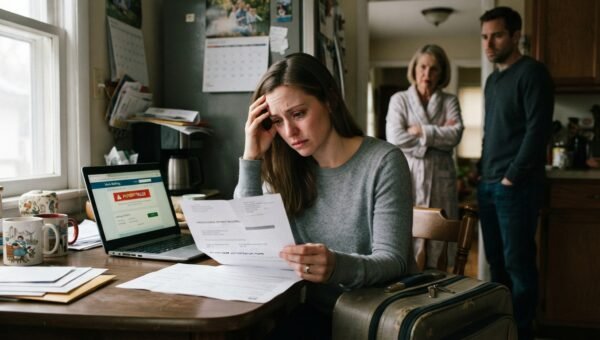
By the sixth day, her voice had changed. I heard paper rustling in the background.
“Dad, the electric company sent a notice. I thought you paid that.”
I was sitting at my little table with my bank ledger open. The pension came in on the first. I’d written down the payments I’d stopped: utilities, grocery card, vehicle shop account. The mortgage help wasn’t a regular transfer. I’d been making extra payments when I could, directly toward their balance. I had never told Laura how much.
I put the ledger away. I didn’t want to turn the whole thing into a scorecard. But I also wasn’t going to keep paying.
That morning, I woke up to twenty-two missed calls. I had turned off most phone notifications while I was trying to sleep. I saw the calls, then the text.
“Dad, please come home. Greg didn’t know you were paying for everything. We can’t do this without you.”
I read it twice. The first time, I felt relief. The second time, I felt sad. She’d found out what I paid. She hadn’t yet said she was sorry for how she treated me.
I called her after breakfast. She was crying, but trying to keep her voice even.
“Can we meet?”
“Yes,” I said. “At the diner by the pharmacy.”
She asked if I could come back first and talk at the house.
“No,” I told her. “The diner is fine.”
That’s where we are now. Her hands haven’t stopped moving. The coffee in front of her is untouched, and she keeps glancing at the folder.
“Greg thought you were helping out a little,” she said.
I took a sip of coffee. It had that diner taste, slightly burnt, and I’d had it worse. “Did he think I paid the electric bill a little?”
She looked down. “I didn’t know it was all of it.”
“I know.”
“Dad, I’m sorry.”
I believed she was sorry. I also knew the timing mattered. Her car payment had bounced. There was an escrow notice for the mortgage. The utility companies had told her the accounts needed to be transferred, and the pantry was nearly empty. Greg had finally asked where the money was coming from.
“He didn’t know,” she said again. “He thought you were living with us because you needed help.”
I looked at her hands. One thumbnail had a small chip in the polish. I don’t know why I noticed that. I suppose I was looking for the daughter I knew, and for the person who had stood beside her husband while she told me to leave.
“I didn’t tell him,” I said. “That part’s on me.”
She shook her head. “You shouldn’t have had to tell him.”
“No. But I should’ve told you what I was doing before it got this far.”
She wiped her face with the napkin. “Can you come back for a while? Greg will apologize. We can work it out. Things can go back to how they were.”
I put my hand on the folder. I had brought the account transfer papers, the final utility confirmations, and a list of the payments I’d been making. I had also brought the remaining mortgage-payment receipts. I didn’t need to prove my worth, but I wanted her to see the numbers clearly once, without me smoothing them over.
I opened it.
The pages were not dramatic. Just dates, amounts, account names. My pension had covered the monthly utilities and groceries. I’d paid $612 a month toward the mortgage for the last year, on top of what I’d already put down when I sold my house. I’d covered the car repairs and the credit card, too.
Laura read the sheet without speaking. Then she looked at me.
“I didn’t know,” she said.
“Greg didn’t know. You didn’t know. I didn’t make you look.”
She reached for my hand. I let her touch it, but I didn’t pull the folder back.
“I can fix this,” she said. “We’ll change how things are.”
“You can fix your budget,” I said. “You can work out the house with Greg. I can’t fix it for you.”
Her face tightened. “So you won’t come back.”
“No. I won’t live in a house where I have to earn basic respect by doing chores.”
“I didn’t mean it that way.”
“I know you didn’t plan it that way. But you said it.”
She looked at the folder again. “What do you want me to do?”
“Learn to live on what you and Greg bring in. Call the companies. Make a plan. I’ll answer the phone when you want to talk to me. I won’t pay the bills.”
She nodded, then started crying again. I wanted to comfort her. I did put my hand over hers for a moment. I’m still her father. That doesn’t disappear because I finally said no.
But love is not a spare bank account. I learned that late.
I gave her the account logins for the bills she needed to transfer and kept my own accounts private. She took the folder. We talked a little longer about ordinary things, which was somehow harder than talking about money. She told me they’d have to sell the truck or cut other costs. I told her that was theirs to decide.
Before we left, she asked if I’d come by on Thanksgiving.
“If you want me there as your dad, yes,” I said. “Not as the help.”
She looked down at the folder. “I understand.”
I hope she does. I’m not sure she does yet. But she knows now that my pension had been paying the mortgage, utilities, groceries, and more. The number is written on the page she took home.
I went back to my apartment and put my key on the table. In the morning, I sat by the sunny window and poured my own coffee. The key lay beside my cup, for a front door that belongs only to me.