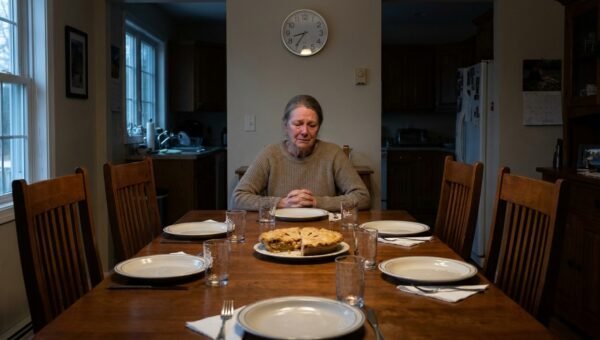
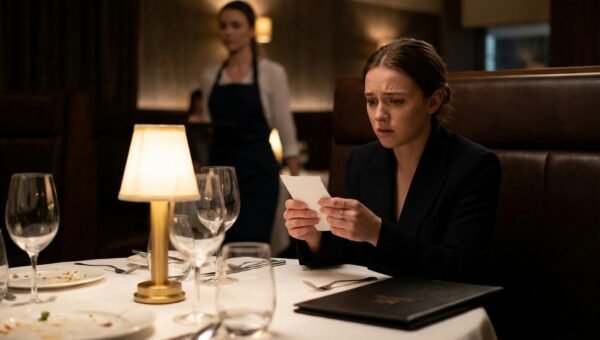
Boyd served me divorce papers in a hospital gown, then called three nights later because the new marriage and the loan he’d taken out in my name were both in trouble.
I know how that sounds. I didn’t know about the loan when he called. I only knew he’d laughed while I was wearing a hospital bracelet, then disappeared. The bracelet was still on my wrist when the phone lit up at 11:23 p.m.
The first problem was that I was too dizzy to stand.
I’d gone to the emergency room after the kitchen counter seemed to tilt sideways under my hands. The nurse asked me to follow her finger. I did, then had to close my eyes because the room started moving again.
“Any chest pain?” she asked.
“No.”
“Any trouble breathing?”
“No. Just dizzy.”
They put me in a bed and clipped a monitor to my finger. I remember the dry paper sheet sticking to the back of my leg. I remember a nurse named Pam bringing me ice water with a lid and straw, because I couldn’t keep the cup steady.
Then two doctors stepped outside my curtain to talk. I couldn’t make out the words, but they lowered their voices. That was enough to scare me.
I called Boyd.
He said, “I’m on my way.”
He arrived about forty minutes later, carrying a folder. I thought it had insurance forms in it.
I was still trying to figure out whether the doctors had found something serious, so I didn’t ask.
Boyd pulled the curtain closed and set the folder on my blanket.
“I filed for divorce,” he said.
I stared at him. “What?”
“I’m done. I want the house and the car.”
Then he laughed. Not loudly. Just one short laugh, like I’d asked something silly.
“You can’t take both,” I said.
“I can. You don’t even have a real income.”
That was the part I kept hearing after he left. Not the word divorce. Not even the house. That sentence.
I had a job. I’d had one for nine years. I managed billing operations for a health company, mostly from home, and my salary was $130,000 a year. Boyd knew I worked. He never asked what I made. He liked to call it “my computer thing,” and I let him, partly because arguing with him about money was exhausting and partly because I liked having something that was mine.
My paycheck went into an account he’d never seen. The house and the car had been bought while we were married, and I had my own records. I wasn’t hiding money from him to punish him. I was tired of being told every dollar I earned was “extra” while his money was “real money.”
I didn’t explain any of that in the hospital.
I looked down at the papers. My hands were still shaky from the dizziness, so the pages made a little sound against the blanket.
“You picked now?” I asked.
“You’re stable,” he said. “They said you’re stable.”
He said it like that settled everything.
I couldn’t tell whether he was trying to look cold or just trying to get through the conversation without feeling like a bad person. Boyd had never been good at sitting with discomfort. He’d change the subject, make a joke, or find a reason to leave.
He pointed to the signature line.
“I’m not signing anything here.”
“You don’t have to sign it today.”
“Then why bring it?”
He shrugged. “I want this handled.”
I wanted to throw the folder at him. I didn’t. My head hurt, and I was afraid the room would start sliding again.
“Please go,” I said.
He slid the papers onto the chair and walked out. I heard his laugh once more from the hall. Maybe it wasn’t even a laugh. I was tired and scared, and I’ve replayed it enough times that I can’t swear to that part.
Pam came in a minute later and found me looking at the folder.
“Do you want me to call someone?” she asked.
“No,” I said. “I just want this out of here.”
She put it in the drawer beside my bed. She didn’t ask what it was. I appreciated that.
Boyd didn’t come back that night. He didn’t call the next morning, either. I was kept for observation, and the doctors ran more tests. It turned out I was badly dehydrated, with a medication issue that had thrown my blood pressure off. Not a small thing, but not the worst thing I’d feared while listening to doctors whisper outside the curtain.
I was relieved. I was also embarrassed by how much I wanted Boyd to show up with a bag from home, or even a coffee. I’d been mad at him plenty of times, but I’d still expected him to act like my husband when I was sick.
On the second day, I opened the banking app on my phone. I don’t know why I did it right then. Maybe I needed one ordinary number to look at.
My salary deposit had come in. The balance was fine. Better than fine.
I stared at the number until it stopped looking like a number and started looking like proof. I’d be able to pay a lawyer. I’d be able to pay the mortgage. I could afford my own life, even if Boyd had spent years talking like I couldn’t.
When the nurse came in with my discharge papers, I asked if she could help me find a charger. My phone was down to eleven percent, and I needed it working.
“Calling somebody to pick you up?” she asked.
“I’ll handle it.”
I called a lawyer from the hospital lobby before I left. A friend from work had given me her name months before, after her own divorce. Her office took my call between appointments.
“I’m still in the hospital,” I said. “My husband served me divorce papers yesterday. He says he’s taking the house and car.”
“Has anything been signed or finalized?” she asked.
“Not by me.”
“Good. Don’t sign anything. Bring me every page he gave you.”
That was the first time I felt my mind settle on something. Not calm, exactly. More like having one clear task in front of me.
I went home the next afternoon. Boyd wasn’t there. His half of the closet was already getting empty, and his coffee mug was gone from the counter. He’d taken the car he usually drove, not mine. That was fine. I had the keys to my own car in my purse.
The divorce papers were still in the hospital folder.
I sat at the kitchen table and read them. Boyd had written that he wanted the house and both cars. He’d listed me as having “no significant income.” He’d also checked a box saying we had no joint debts besides the mortgage.
I made copies. Then I found the deed, the car title, my pay stubs, and the last tax return I’d filed. We filed separately because Boyd had always insisted his business expenses made his return complicated. I did the paperwork and he signed his own forms without looking at mine.
I know that sounds like I should have seen this coming. Maybe I should have. I also know I liked being the one who handled things. It made me feel useful, and I didn’t notice how often useful turned into invisible.
My lawyer, Jo, called me the next morning.
“He hasn’t transferred the house,” she said. “Filing for divorce doesn’t give him sole ownership.”
“I know.”
“And the car?”
“My name’s on that title.”
“Good. I’m filing to protect the property while we sort this out. Did you get any mail or email about a new loan?”
That made me stop.
“No.”
“Keep watching your accounts. Don’t answer anything for him, and don’t sign anything.”
I spent the rest of the day checking my email. I found a message from a lender in the junk folder, sent the day before. It asked me to verify my identity and confirm an application for a home equity loan.
I hadn’t applied for one.
I called the number in the message. A woman named Celia looked up the application. The loan was for $184,460 against the house. Boyd was listed as the only borrower. My name was listed as spouse, and there was an electronic signature that looked almost like mine.
“Did you sign this?” Celia asked.
“No.”
“Did you authorize the application?”
“No.”
She told me the loan had not closed. The lender needed a spouse’s consent because the house was jointly owned. They’d sent the verification message when the divorce filing came through, but the file still showed we were legally married.
I called Jo back.
“Don’t touch it,” she said. “Send me the email and the application details.”
I did. Jo contacted the lender and sent proof that I hadn’t signed. She also filed notice that there was a dispute over the house. I didn’t know exactly what would happen next. I only knew the lender had stopped the loan.
I called Boyd once. He didn’t answer.
I texted, “Did you apply for a loan against the house?”
He wrote back, “It’s temporary. I was going to explain.”
I stared at that for a while.
Then I wrote, “Don’t use my name or my signature.”
He didn’t answer.
The next morning, Jo called again. She’d found a marriage record for Boyd and a woman named Paige, dated the day after he filed for divorce.
I read the date twice.
“Can he do that?” I asked.
“Not while he’s still married to you,” she said. “A divorce filing isn’t a divorce decree.”
I had to sit down. My legs were still weaker than usual, and the kitchen chair felt like the safest place in the house.
“Is the marriage legal?”
“From what I can see, no. But I want to confirm the court record before we say more.”
I didn’t know Paige. I’d heard the name once, months earlier, as someone Boyd knew through a friend. I don’t know what he told her. I don’t know if she knew we were still married. I wasn’t going to call her and ask. I had enough in front of me.
At 11:23 that night, Boyd called.
I almost let it ring. I was in bed, looking at the hospital bracelet on my nightstand. I’d taken it off after I got home, but I hadn’t thrown it away. It felt silly to keep it. I kept it anyway.
I answered.
“Can you sign something for me?” he said.
His voice was different. It had gone thin and fast.
“What is it?”
“It’s just a paperwork mix-up.”
“What paperwork?”
“The loan. They’re saying the signature doesn’t match.”
“I didn’t sign it.”
“Just tell them you did. It’s only to get the loan through.”
“No.”
He exhaled hard. I could hear a door shut somewhere behind him.
“They’re asking questions about the marriage license, too,” he said.
“Because you’re still married to me.”
“I filed.”
“You filed for divorce. We aren’t divorced.”
He went quiet, then said, “I thought it would be done.”
That was it. Not sorry. Not I shouldn’t have done this. Just I thought it would be done.
“What did you tell the lender?” I asked.
“I said the house was mine.”
“The house is in both our names.”
“You weren’t supposed to make this hard.”
I actually laughed, which surprised me. Not because anything was funny. Because I had been lying in a hospital bed with a bracelet on my wrist while he told me I had no income, and he was still acting like I was the one making trouble.
“You laughed when you handed me those papers,” I said.
“I was stressed.”
“I was in a hospital gown.”
“I know.”
“No, Boyd. You knew what you were doing.”
He started talking over me. The lender had frozen the application. The county had questions about the marriage record. Paige was upset. He needed my signature so he could “straighten out” the file before it became a bigger issue.
I let him talk. For a while.
Then I said, “I make $130,000 a year. I have my own accounts, and I have a lawyer. The house and my car are staying where they are until the court decides anything.”
He didn’t say a word.
I should tell the truth here. I enjoyed the quiet. Not for long, but I did. He had spent years acting like my work was a hobby, and now he needed the income he’d never bothered to ask about. I felt mean for enjoying it. I didn’t take it back.
“Are you going to help me?” he asked.
“No.”
“Don’t do this to me.”
“You did it to yourself.”
“I need you to sign.”
“I’m not signing a lie.”
He tried once more. He said the lender might report the application as fraud. He said he could lose the house, though it wasn’t his alone to lose. He said Paige had been told the divorce was finished.
“I’m sorry,” he said finally.
I waited for more.
Nothing came.
“I’m not fixing this for you,” I said. “Talk to your own lawyer.”
Then I hung up.
Jo handled the lender and the court filings after that. The bank kept the loan frozen and sent the application for review. The court ordered neither of us to sell or transfer the house while the divorce moved forward. I stayed in the house. My car stayed with me. Boyd had to deal with the application and the marriage record without using my name to smooth it over.
I don’t know what Paige decided to do. I know the second marriage couldn’t stand while my marriage to Boyd was still legally in place. I also know the lender had enough to ask its own questions. That part was no longer mine to manage.
My dizziness went away. The doctors changed my medication, and I went back to work a few weeks later. The first morning I sat at my desk, I saw the hospital bracelet beside my keyboard. I put it in the trash then. No ceremony. Just done.
Boyd’s call stayed in my phone for a while. I didn’t listen to the voicemail he left after I hung up. Jo told me to keep it, so I saved it and turned off notifications from his number.
The house was quiet that night. I stood by the bedroom window and looked at the street, where nothing much was happening. Then I set my phone face down on the bedside table and turned off the light.