The water glass had a lemon seed stuck to the inside, and I remember that because I was trying to make the evening feel ordinary. I’d made a reservation for one at a restaurant on the square, the kind with cloth napkins and a menu that doesn’t show prices for some of the wine. I’d been looking forward to the window view all week. Then the server asked me to give up my table.
I’m 61, and I’ve spent most of my working life around people who think a person sitting alone is easier to push around. I ran the parts desk at a farm equipment shop for 29 years. I’m not saying that made me an expert on restaurants, but I know what it looks like when someone is trying to keep things moving because a boss is standing nearby.
The place was called Bellweather House. I don’t need to name it, I guess, but the name is part of what made the whole thing funny later. It had been open less than a year in our little county seat in the Missouri Ozarks, and people talked about it like it had arrived from somewhere more important. I’d saved the visit for a Thursday after a long week, not for a special occasion. I wanted a decent meal and a little time to myself.
The hostess took my coat and led me to a small table by the front window. I could see the courthouse clock and the line of cars at the light. I’d been seated maybe ten minutes when a young server named Eli came over with a glass of water. He kept glancing toward the front desk. I noticed, but I figured he was new.
He brought the menu and asked whether I wanted a few minutes. I said yes, and he came back later to take my order. I had chosen trout, which I don’t usually order because it costs more than I think fish ought to cost. I was feeling generous with myself. The seed was still caught against the side of my glass.
Eli came back before the food did. He said there was a family waiting and the restaurant needed to combine my table with another one.
He asked if I’d mind moving to a smaller table near the kitchen. He said it politely, but he was already looking sorry.
I asked if the other table was ready. He said it would be in just a minute. I said I’d rather stay where I was, thank you. I wasn’t trying to make a point. I’d booked the table, and I’d been sitting there long enough to order. He looked down at the floor and said, “OK.”
That was the first thing I should have paid attention to. Not the request itself. Restaurants move people sometimes. It was the way Eli said it, like he had failed at something he’d been told was simple. He picked up my menu, set it down again, then walked toward the host stand without taking it.
There were two women behind the stand, one with a tablet and one with a stack of paper menus.
Eli spoke to the woman with the tablet. She leaned close to him, then looked at me. Neither of them smiled. I couldn’t hear their words, but I saw Eli nod twice before he went back through the swinging door toward the kitchen.
I thought about leaving. I really did. I’d been raised to believe that if a place is trying to make you feel like a nuisance, the simplest thing is to pay and go somewhere else. But my drink had just arrived, and I didn’t want to let somebody else’s fuss decide my evening. I stayed seated. That’s all.
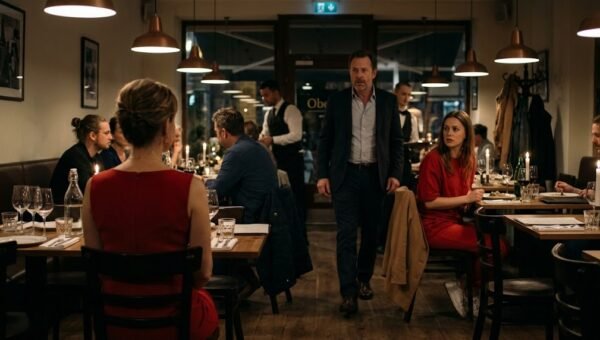
A few minutes passed. The dining room wasn’t full. There were open tables near the middle, and I could see at least one open spot closer to the back. The front desk kept getting little bursts of activity. A man in a dark suit came in, looked at the window section, then stepped aside to let two other men join him. Nobody looked related. They were all carrying slim folders.
I didn’t know who they were. I only knew the word “family” didn’t seem to fit. I kept my face in the menu, though I wasn’t reading it anymore. I could hear the kitchen door swing open and close. There was a faint smell of hot oil and lemon cleaner every time it opened. That lemon-cleaner smell is what I remember most.
Eli came out once with a water pitcher. He filled a nearby glass and asked if I needed anything. I said I was fine. His mouth moved like he might say something else, but he didn’t. He glanced toward the host stand again. I knew that feeling from the shop, when a manager had changed the plan and left the front desk to explain it.
Then a woman walked over. She was in a dark jacket and had a little gold pin on the lapel. Her hair was pulled back, and she moved like the staff already knew to get out of her way. She introduced herself as Marla, the general manager. She didn’t ask whether I was enjoying dinner. She said the restaurant was “working through a seating adjustment.”
I asked what that meant. She said a private party was arriving and the window tables had to be made available. She said it would help if I moved to a table near the kitchen. I told her Eli had said a family needed the space. Her smile stayed in place, but her eyes went toward the front desk.
“Well, it’s a group,” she said. “We can make it worth your trouble.”
She offered to comp my dessert and said she could move my order along. I hadn’t asked for dessert, and my food hadn’t arrived. I said I didn’t want either one. I wanted the table I’d reserved, and I wanted to know why the explanation kept changing. Marla’s fingers rested on the back of the empty chair opposite mine.
She said she understood, but the restaurant had to take care of “key guests.” I looked at her and said I was a guest too. It came out sharper than I meant it to. I could feel my old stubbornness rising up, that part of me that refuses to move after somebody has already decided I’m the easy one to move.
Marla lowered her voice. She said this was not the time to make things difficult for her staff. That was when I stopped trying to be pleasant for her benefit. I said I wasn’t making anything difficult. I’d ordered dinner and had declined to change seats. I asked if she wanted me to leave.
She paused, then said, “That table is reserved for the investors and the critic.”
There it was. No family. No large gathering. The men with folders were part of the investor group, and the restaurant was expecting a prominent food critic. Marla said the window section had been set aside for them. They wanted the best view and a clear picture of the dining room. She said it like I had forced her to tell me.
I asked if they planned to seat the whole group at the window. She said yes, and that they were trying to present the restaurant at its best. I looked past her. The men were still standing near the host desk. One of them had taken off his coat, and another was checking his phone. The two women from the desk were arranging menus at the window tables.
I understood then why Eli had looked so nervous. He had been asked to tell me something untrue because I was alone and they expected me to make it easy. The staff didn’t create that plan. Marla did. I felt bad for Eli, and I was mad at her, and I was embarrassed by how long I’d spent wondering if I was being unreasonable.
I asked Marla if she expected me to move just because the people arriving mattered more to the restaurant. She said that wasn’t what she meant. She talked about service and flexibility and how the dinner was important to the business. I let her finish. I didn’t interrupt again.
I asked for the check. She said my meal would be comped if I moved. I told her I wasn’t moving. I also told her I didn’t want a free meal. I wanted to pay for the drink I’d had and leave. She looked at me as if she thought I might change my mind if she waited long enough.
Eli came back with the check. He set it down carefully. His fingers were shaking just a little. I paid for the drink and left cash for him, more than the drink cost. I didn’t want him losing out because his manager had put him in the middle. I also know I was trying to make sure I left as the person who had acted decently. That’s pride, too.
Nobody made a scene. Marla stood by my table while I put on my coat. The men by the door stopped talking. The woman at the host stand held her tablet against her chest. I didn’t give a speech, and I didn’t ask anyone to apologize. I picked up my bag, said thank you to Eli, and walked out.
The glass doors were heavy. I had to pull twice because my hand was full, and when they swung shut, the restaurant noise cut off behind me. The air outside was cool enough that I zipped my coat. The courthouse clock showed 8:06, though I don’t know if it was right. I stood on the sidewalk for a second, mostly because I had nowhere I needed to be.
There was a little bistro two blocks over called June’s, the sort of place with handwritten specials and mismatched chairs. I’d passed it plenty of times and always thought I should try it. That night I went in. The woman at the counter asked if I wanted a table or a booth. I said I’d take the booth by the window if it was free.
She said it was. No speech about a party. No explanation. Just a booth and a menu with the prices printed right there. I ordered soup and toast. It wasn’t fancy, but the bread was warm, and the woman came back to ask if I wanted more coffee.
I still think about Eli sometimes. I hope he found another job, or that Marla stopped asking him to pass along lies. I didn’t go back to Bellweather House to find out. I’m not saying I handled every part of that night perfectly. I could have walked out sooner. I could have been less proud about it. But I didn’t owe them the window, and I didn’t owe them a performance of being agreeable.
At June’s, I stayed until my coffee was gone. The booth was beside the window, and nobody tried to move me.