The X-ray plate was still in Dr. Hayes’s hand when he asked Richard how long we’d been married. I was on a bed behind a curtain, trying to keep my eyes open. Richard answered for me: seven years. The doctor didn’t say anything for a few seconds. Then he asked Richard to come into the consultation room.
Richard told me I’d fallen down the stairs.
That was the story he had ready. I heard him repeat it to the nurse while she pressed a cold cloth near my hairline.
He said I’d missed a step at home, that he’d found me at the bottom. He sounded upset in the way people sound when they know someone is listening. I couldn’t speak clearly, and I didn’t correct him.
I don’t know why I remember the cloth smelled faintly of orange soap. I remember that better than the pain. Maybe because the nurse kept folding the same corner over and over while Richard talked.
I had been married to Richard for seven years. I’m not going to pretend every day was exactly the same. Some mornings he went to work without touching me. Some evenings he came home with groceries and asked if I wanted tea. Those little bits of ordinary life were part of why I kept telling myself things could still settle down.
But most mornings, Richard dragged me into the backyard and hit me. He blamed me for not giving him a son.
He said I was failing him, though neither of us had ever been to a doctor to find out why I hadn’t gotten pregnant. He didn’t want to go. He said a man didn’t need a doctor to know where the problem was.
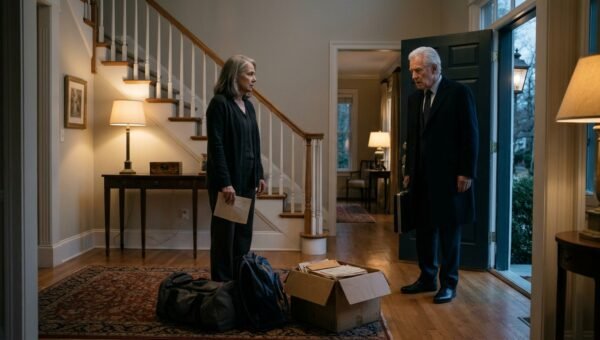
His mother, Joan, lived with us. She sat inside by the front window, turning her rosary through her fingers. On the table beside her was the small case for her pessary. I don’t know why I remember that, either. I think I wanted one small detail to prove she was really there, not just a voice in the house I made up later.
The neighbors heard me. I know they did because once, after a morning in the yard, I heard a screen door close across the fence. Nobody came over. I never asked anyone to. That was one of the things I did wrong. I thought asking would make it real, and it was already real enough.
I learned to keep things calm. I learned which words made Richard mad and which ones only made him quiet. Quiet was usually worse. If he accused me of hiding something, I denied it even when there was nothing to hide. If he asked why I couldn’t give him a boy, I said I was sorry. I said it because it sometimes ended the conversation faster.
It didn’t end that one.
That afternoon, the day I went to the hospital, Richard was already angry before he came outside. He’d been talking about his cousin’s new baby, a boy, and how the whole family had gone to see him. I was washing a mug in the kitchen. I said I was glad for them. I meant it.
He said I always sounded glad when another woman got what I couldn’t give him.
I wiped my hands and went out back because he told me to.
I know how that sounds. I could have stayed inside. I could have called someone. I could have gone to the neighbors. I’d gone over those choices so many times since then that they feel like old prayers, said by someone who already knows the answer won’t change.
Richard grabbed my arm. I told him to stop. He told me I’d embarrassed him in front of his family, though I hadn’t said anything about him at all. Then he hit me.
I won’t lay out every part of it. I remember the ground against my cheek and the taste of dirt. I remember thinking my left hand had landed under me at a bad angle. I remember Richard telling me to get up. I tried. My body didn’t do what I asked.
He said my name once, sharp and angry. Then he said it again, different.
I couldn’t answer.
That was when he got scared. Not sorry, exactly. Scared. He knelt down and kept touching my shoulder, telling me to look at him. I heard him call Joan from inside. She came to the back door but didn’t come all the way out.
Richard carried me to the car. On the drive he kept saying I’d fallen down the stairs. He told me what he planned to say at the hospital, even though I wasn’t answering. I could hear the blinker clicking at every turn. I tried to remember the way to the hospital in case I had to say something later.
The emergency room was bright and busy. A nurse asked what happened. Richard answered before I could make a sound. He said stairs again. He said he’d been in the kitchen and heard me fall. He said he was worried I had a concussion.
I wanted to tell the nurse the truth. I wanted to tell her about the yard, about the mornings, about Joan sitting inside. But I couldn’t get the words lined up. Richard stayed close to the bed, watching my face. I was afraid he’d see me trying.
Dr. Hayes came in and asked me to squeeze his fingers. I couldn’t do it well. He asked what hurt. Richard tried to answer, and Dr. Hayes told him he needed to hear from me. Richard said I was confused.
The doctor looked at him, then back at me. He didn’t argue. He ordered imaging.
While the staff took me down the hall, Richard stayed in the waiting area. Later, a nurse told me he paced for most of the time. He kept asking how long it would take and whether I could be sent home that night. He also asked if the hospital would call anyone.
I didn’t know any of that then. I was awake in flashes. The machine was cold under my shoulder, and the tech asked me to hold still. I tried. My head hurt too much for stillness to feel like something I could manage.
Dr. Hayes had me brought to a small room after the first images were ready. Richard came in behind him. He stood near the door. Dr. Hayes held the X-ray plate up to the light.
He asked Richard how long we’d been married.
“Seven years,” Richard said. “Why?”
Dr. Hayes kept his voice level. He told Richard the images showed more than one injury. Some of the fractures were new. Others had healed. They were different ages, in different stages of healing. They were in my ribs, my collarbone, and one arm. They did not fit one fall.
Richard said I’d been clumsy before. He said I’d fallen in the kitchen once and hurt my arm. He said there could be old injuries from before we met.
Dr. Hayes asked when that had happened. Richard gave him a year, then changed it.
I was looking at the plate. I could see pale lines I didn’t understand. I could also see Dr. Hayes watching Richard instead of the image. Richard had spent years making me feel that if I couldn’t prove what he’d done, then it hadn’t happened. Here was a doctor who didn’t need me to remember every date.
Dr. Hayes said he was concerned about the number and pattern of the fractures. Richard told him to stop making accusations and treat his wife. The doctor answered that he was treating me, and that he had a duty to report what he was seeing.
Richard moved toward the door. The security guard stepped in front of him.
That was when Dr. Hayes said there was something else on the imaging that needed more testing. He didn’t say it to shame me. He asked Richard to wait outside while the team ran a scan.
Richard objected. He said I needed him there. I didn’t say I wanted him there. That was the first useful thing I managed to do.
A nurse took Richard into the hall. I heard him complain that no one was listening to him. Then the door closed.
The next scan took longer. I was tired, and I kept asking the nurse if they knew what was wrong with me. She said the doctor would explain when he had the results. There was a small tear in the paper sheet near my right hip, and I kept running my thumb over it. I needed something small to focus on.
When Dr. Hayes came back, he pulled a chair close to the bed. He told me the X-ray showed an unusual shape to my pelvis. The scan had made it clear. I was born without a uterus. I could never carry a pregnancy.
He said it gently. He explained that the condition was rare, and that I should have been given care and answers long before then. He also said none of that changed what the old fractures showed.
Richard had blamed me for seven years for not giving him a son. My body had never been able to carry a child. He had never taken me to a doctor. He had never wanted to know. He wanted a reason to hurt me, and I had believed I owed him an explanation.
I had to look away from Dr. Hayes. I wasn’t crying yet. I was counting the words he’d said. No uterus. Born that way. Could never carry a pregnancy. It took me a while to understand that the fault he’d held over me didn’t belong to me at all.
Dr. Hayes went out to speak with the hospital team. I heard him tell someone to call the police and the hospital’s social worker. Richard came back to the room and asked what the doctor had told me. I didn’t answer.
He leaned toward the bed. He asked if I’d said anything about the backyard. I didn’t answer that either.
“You know what happens if you lie,” he said.
For once, I didn’t tell him I was sorry. I looked at the nurse standing beside me and said, “He did this to me.”
It was a plain sentence. It was all I had.
Richard said I was confused. He said I’d been hurt in a fall and was mixing things up. The nurse stayed beside my bed. Dr. Hayes came back in with the security guard and another hospital worker. Nobody raised their voice. Nobody needed to.
The police arrived before Richard could leave. They took him to another room and kept him there while they asked questions. I don’t know the exact order of everything after that. I know the social worker helped arrange a safe place for me to stay. I know the hospital treated my injuries and set up care for the condition they’d found. I know Richard didn’t come back into my room.
Joan didn’t come to the hospital. Later, I heard she was at the house when officers came to look around. She had her rosary with her. I don’t know what she told them. I haven’t asked.
Richard was detained while the police investigated. After that, there were statements, calls, and papers I had to sign. There was a protective order. The case did not turn into a quick, clean ending, and I won’t pretend it did. But he was no longer in charge of where I slept or whether I could speak.
I stayed with a woman from the hospital’s support team until I could make other plans. My injuries needed follow-up care. I also started talking to someone who knew how to help people leave homes like mine. I did not suddenly become brave. I still apologized when I didn’t need to. I still checked the door twice at night.
But I was away from Richard. That mattered.
The last time I saw the X-ray was in the viewing box at the hospital. The fluorescent light made the film easy to read. There were the fresh breaks, then the older ones, each one in its own place, laid out where no story about one fall could cover them.
Seven years of his version. One sheet of film. I could see my own bones clearly for the first time, and Richard’s story had nowhere left to hide.