PART 1
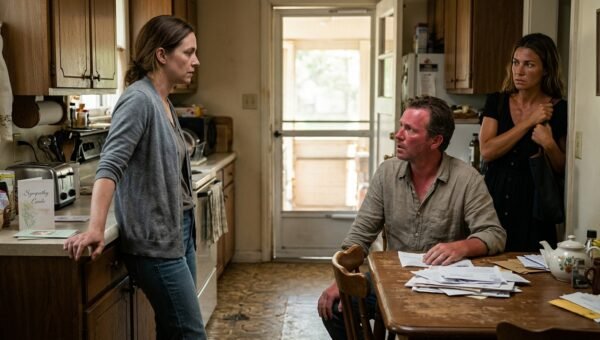
My sister Kendra set her glass of lemonade on my bare kitchen island, looked up at the cedar beams in the ceiling, and smiled like she was doing me a favor.
“This $1 million house has plenty of room for me and the kids,” she said.
She did not say it as a question. She said it while her twin eight-year-old boys were skidding across my newly refinished white oak floors in their socks, chasing my old golden retriever into the downstairs hallway.
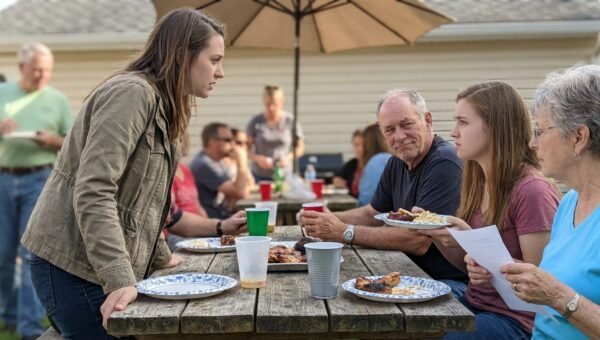
I was standing there with a pair of kitchen tongs in my hand, still wearing an apron over my jeans. I had twenty people out on the back deck eating ribs and potato salad. My friends from the commercial HVAC company where I spent fourteen years climbing through ductwork were out there laughing, balancing paper plates on their knees.
Before I could even set the tongs down, our mother stepped between us. Mom had her good purse hooked over her forearm, the beige leather one Kendra bought her three Christmases ago on a credit card Kendra never finished paying off.
“Be a good brother, Kevin,” Mom said. She kept her voice at that soft, church-pew pitch she used whenever she wanted to make an outrageous demand sound holy. “Let her stay. Her apartment lease is up in three weeks, and the school district over here is top tier. You have four bedrooms and an office. You are one single man.”
“Mom,” I said. “We are not doing this.”
“She is your blood,” Mom said. Her eyes narrowed just enough for the skin around her temple to pull tight. “Family does not let family drown when there is dry land right in front of them.”
I looked from Mom to Kendra. Kendra was already checking her reflection in the glass of the double oven, tucking a loose piece of blonde hair behind her ear. She was thirty-two, three years younger than me. In her mind, the conversation was already halfway decided because Mom was speaking for her. That was the rhythm of our family. Kendra made a mess, Mom framed the cleanup as my Christian duty, and I was expected to nod, open my wallet, and take the hit.
Except this was not a fifty-dollar gas loan or co-signing for a used sedan. This house sat on a half-acre lot at the end of a cul-de-sac in Franklin, Tennessee.
I closed on it three weeks earlier, after twelve years of living in a four-hundred-square-foot cinderblock duplex next to a gravel yard, working eighty-hour weeks during heatwaves, and saving every dime while running my own contracting crew.
I laid the tongs down on a paper towel. I reached into my pocket, took out my phone, and unlocked the screen.
“Mom,” I said, keeping my voice quiet so the guests outside couldn’t hear over the deck speakers. “Remember when you threw me out at nineteen?”
Mom’s hand dropped off her purse strap. For half a second, her mouth parted, but nothing came out.
“That was sixteen years ago, Kevin,” she said, recovering her tone quickly. “We all made mistakes back then. You were being stubborn, and you know it.”
“I was nineteen,” I said. “It was November fourteenth. It was forty-one degrees outside, and it was raining. You changed the deadbolts while I was working a shift at the auto parts counter.”
“You refused to pay your sister’s private school tuition,” Mom said, her voice rising half an octave, sharp enough to cut through the hum of the refrigerator. “Your father had just walked out on us. We needed everyone pulling the wagon. You wanted to keep your little paycheck for yourself.”
“My paycheck was four hundred and ten dollars every two weeks,” I said. “Kendra was a sophomore. You wanted me to drop out of community college, work full-time at the warehouse, and hand the check over to you so Kendra wouldn’t have to switch to public school. When I said I had to pay my own tuition, you put my clothes in three black garbage bags on the porch.”
Kendra rolled her eyes and crossed her arms. “Are you really going to hold that over our heads today? In front of your friends? Look around, Kevin. You made it. You won. Why do you have to be so bitter about ancient history?”
“It’s not about being bitter,” I told her.
I tapped the screen of my phone twice. I had scanned the yellowing notebook pages into a cloud folder four years ago, right after I incorporated my business, just so I would never forget where ground zero was.
I turned the screen toward Mom.
“Look at the ledger, Mom,” I said. “Take a good look at the bottom line.”
PART 2
Mom squinted at the screen, but she didn’t take the phone from my hand. She didn’t want to touch it.
“I don’t need to read your old scrapbooks,” she said.
“It’s not a scrapbook,” I told her. “It’s the list of what I had to do after you locked that door. That first night, I slept in the cab of my 1998 Ford Ranger in the gravel lot behind the car wash on Route 96. I had seventy-four dollars in my checking account and a half-eaten sleeve of saltines in the glove box. When I asked you the next morning if I could at least come inside to get my winter coat and my birth certificate, you told me through the screen door that tenants who don’t pay rent don’t get house privileges.”
Kendra sighed, loud and dramatic. “Kevin, seriously. Nobody is saying that was great. But Mom was stressed. Dad had just vanished to Florida with that woman from his bowling league. We were all hurting.”
“You weren’t sleeping in a truck,” I said. “You were sleeping in a heated bedroom with cable television while I was washing my hair in a sink at a Shell station before my eight o’clock shift.”
“And look how strong it made you,” Mom said without missing a beat. She actually reached out and patted my forearm, her fingers dry and cool against my skin. “It gave you grit, Kevin. You wouldn’t have this beautiful place if you hadn’t learned how to work hard. God used that trial to build you up. But Kendra is a woman alone with two small boys. You can’t compare your situation to hers.”
That was Mom’s gift. Every cruelty she ever handed out was instantly rebranded as tough love that built character, while every failure of Kendra’s was an unfair tragedy that required everyone else to sacrifice.
“Kendra isn’t alone,” I said. “Kendra’s ex-husband pays twelve hundred dollars a month in child support, court-ordered, direct deposit on the first of every month.”
Kendra’s face tightened. “How do you know what Greg pays me?”
“Because Greg used to buy filters from my shop,” I said. “And unlike you, he actually talks to people honestly. You didn’t lose your apartment because the rent went up, Kendra. You lost it because you haven’t paid the property management company since February. You got an eviction summons three weeks ago.”
The kitchen went dead quiet. Out on the deck, someone laughed at a joke, the sound drifting through the screen door along with the smell of hickory smoke.
Kendra shifted her weight. She didn’t look at the double oven anymore. She looked at her sandals.
“Greg is late half the time,” she mumbled.
“Greg’s pay is garnished through the county clerk,” I said. “He can’t be late. The money comes out before he even sees his stub.”
Mom turned on Kendra, not with anger, but with that frantic, protective flutter she always got when Kendra was cornered. “Well, what was she supposed to do, Kevin? Inflation is through the roof. Groceries cost double what they used to. A mother has to feed her children.”
“She bought a brand-new Peloton in April,” I said. “I saw it in the background of her video when she called me on Easter asking for five hundred dollars for the boys’ shoes.”
“It was on a payment plan!” Kendra snapped, her cheeks flushing red. “Thirty-nine dollars a month! You make thousands of dollars a week, Kevin, and you’re tracking my thirty-nine-dollar exercise bike? You’re disgusting.”
“No,” I said, setting my phone face-down on the counter. “What’s disgusting is walking into a party celebrating what took me fifteen years of sweat to build, announcing to my friends on the porch that you’re taking the upstairs suite, and expecting me to play the dutiful son.”
“We are not talking about strangers,” Mom said, her voice dropping into a hard, scolding register. “We are talking about your nephews. Are you telling me you would let your own nephews go to a motel while you sleep in a four-bedroom house alone?”
“I’m telling you they aren’t going to a motel,” I said. “Because they’re going to your house.”
PART 3
Mom took half a step backward, nearly tripping over the edge of the kitchen runner.
“My house?” she said. “My house is a two-bedroom cottage. I don’t have room for two eight-year-old boys. They’re loud, they run through the living room, and my blood pressure has been acting up since the spring.”
“Your spare bedroom has been sitting empty for six years,” I said. “Ever since Aunt Clara moved to the assisted living facility in Murfreesboro. You keep your sewing machine in there.”
“That is my hobby space,” Mom said, her voice stiffening. “I am sixty-eight years old. I have earned my quiet. You are thirty-five, you have endless energy, and you have three extra rooms sitting empty right above our heads. It makes no practical sense for them to cram into my little place when you have this.”
“It makes total sense,” I said. “Because you’re the one who created this.”
“What is that supposed to mean?” Mom asked.
“Sixteen years ago, you told me that living in your house required an adult contribution,” I said. “You told me that if I didn’t hand over my money to support Kendra, I didn’t deserve a roof over my head. I took that lesson seriously. I lived by it. I didn’t ask you for five dollars when my transmission blew up on Highway 100. I didn’t ask you for a bed when the duplex had a pipe freeze and flooded two winters ago. I handled my own life because you made it clear I was on my own.”
I looked directly at Kendra.
“You never taught Kendra that lesson,” I said. “When she dropped out of beauty school, you paid off her credit cards. When she wrecked her car without collision insurance, you took out a second mortgage on your cottage to get her that crossover. When her marriage ended, you told her she didn’t have to work full-time because being a mother was enough, and you covered her electric bills. You created a thirty-two-year-old woman who thinks four walls and a roof are things other people are obligated to hand her.”
“I am their mother!” Mom hissed. “A mother helps her children!”
“You had two children, Mom,” I said. “You helped one. You discarded the other one the minute he wouldn’t finance the favorite.”
Kendra stepped between us then, her hands clenched into fists at her sides. “You think you’re so much better than us, don’t you? With your big contractor truck and your quartz countertops. You think because you have a bank account you get to treat us like dirt.”
“I invited you here for ribs and pie,” I said calmly. “I bought the boys new baseball gloves last month and took them to the batting cages. I have never treated you like dirt. But you didn’t come here to celebrate my house. You came here with a moving plan you and Mom cooked up before you even put your car in park.”
Kendra didn’t deny it. She couldn’t.
“You knew about the eviction three weeks ago,” I continued. “Mom knew about it too. That’s why Mom called me on Tuesday asking if the upstairs bathroom had a tub or just a walk-in shower. She wasn’t making polite conversation. She was measuring the space for the boys.”
Mom’s eyes flicked away, unable to hold mine.
“You planned to corner me here,” I said. “In front of Dave, in front of my crew, in front of our neighbors. You thought if you announced it out loud, with Mom backing you up, I’d be too embarrassed to say no. You thought I’d cave just to avoid making a scene.”
I walked over to the sliding glass door that led out to the deck. I pulled it open an inch. The laughter outside had died down a little; people could hear that the tone inside had changed, even if they couldn’t make out the words. Dave, my lead installer, was standing near the railing, keeping an eye on the door with a quiet, watchful look.
I turned back to face my mother and my sister.
“Kendra,” I said, “your boys are welcome to come swim in the pool whenever Dave or I are out here grill-sitting. I will buy their school supplies in August like I always do. But you are not moving one box into this house. Not for three weeks, not for three days, not for one night.”
“Kevin,” Mom started, her voice dropping into a desperate plea. “Please. Think about what people will say.”
“I don’t care what people say,” I said. “They already know you threw me out at nineteen. I told Dave that story ten years ago when he hired me as an apprentice.”
“You told strangers?” Mom gasped, her hand flying to her chest. “You aired our private family business to common laborers?”
“Those common laborers gave me a job, loaned me tools, and taught me how to run a business,” I said. “They treated me more like family than you ever did.”
ENDING
I walked over to the kitchen counter, picked up Kendra’s glass of lemonade, and poured it down the stainless sink. I rinsed the glass with cold water, set it in the drying rack, and turned to face them one last time.
“The party is over for you two,” I said. “Get the boys’ shoes. I want you off the property before we cut the cake.”
Kendra looked at Mom, waiting for the cavalry. She waited for the speech, the tearful guilt trip, the family scripture, anything that would force me to fold.
Mom opened her mouth, but she looked at my face, and whatever she was planning to say died right on her tongue. For sixteen years, Mom had operated under the belief that I was still that nineteen-year-old boy standing on her front porch in the rain, terrified of being alone in the world, desperate for her approval.
She finally saw that the boy was gone.
“You’re going to regret this, Kevin,” Kendra said, her voice shaking with pure spite. “When you’re old and alone in this big empty house, don’t you dare call me.”
“I didn’t call you when I was nineteen,” I said. “I won’t need to call you when I’m sixty.”
Kendra grabbed her purse off the stool, walked to the back door, and yelled for Liam and Noah. The boys came running in from the hallway, their socks dusty, their faces flushed from playing with my dog. They didn’t understand what was happening, but they felt the freeze in the room. They put their sneakers on without a word.
Mom walked out behind them. On the front porch, she stopped and turned around, holding the brass handle of the front door.
“I gave you life, Kevin,” she said, her voice small, almost bitter.
“And you took the roof away when I was a kid,” I answered. “We’re even.”
I closed the heavy front door and locked the deadbolt. The click of the brass mechanism sounded remarkably solid.
I stood in the entryway for a full minute, listening to the gravel crunch under the tires of Kendra’s crossover as she backed out of the driveway and sped down the road. Through the frosted side glass, the street was quiet and sunny, lined with green maples and neat brick mailboxes.
I walked back through the kitchen and out onto the deck.
Dave was standing by the smoker with a pair of tongs, turning over the last rack of ribs. He looked up at me, saw my face, and nodded once. He didn’t ask what was said. He didn’t ask who was right. He just reached into the ice chest, pulled out a cold bottle of ginger ale, and held it out toward me.
“Everything