PART 1
When Daddy’s will was read in the lawyer’s back office, my brothers split the two hundred-acre farm and the $90,000 in CDs right down the middle. I sat on the low couch between them and got his beat-up fiddle in a taped alligator-print case.
“Always were the sentimental one, Mary,” Tom said. He folded his copy of the inventory, shoved it in his jacket, and didn’t even look over at me.
Billy tapped his car keys against the wood armrest. “You spent all those nights sitting up with him anyway. You two always had your little routines. Makes sense you get the memories.”
I had nursed Daddy the last four years. I cleaned his feeding lines, ground his pills into applesauce, turned him every two hours so his hips wouldn’t raw up, and handled the hospice visits while Tom and Billy stopped by on Christmas Eve for twenty minutes with grocery-store tins of butter cookies. When the paperwork was filed, they took the deeds, took the bank drafts, and left me with the mud on my tires and a cardboard box of Daddy’s flannel shirts.
I carried that taped case out to my sedan, set it on the backseat, and drove thirty miles back to my own little kitchen. I was sixty-two years old, exhausted down in my joints, and too drained to start a fight I had no money to win.
The fiddle went onto the top shelf of the hallway closet behind two spare quilts. It stayed there for a month. I did not want to touch it. Every time I reached for a fresh washcloth, the cracked faux-leather corner caught my eye and brought back the smell of rubbing alcohol, stale broth, and the quiet kitchen where nobody called to ask if I needed five dollars for groceries.
Then two Saturdays ago, my grandson Tyler came over. He is nine, small for his age, and has the same stubborn cowlick Daddy had. He leaned against the hallway doorjamb, watched me fold laundry, and pointed up at the top shelf.
“Is that the violin Granddaddy played?” Tyler asked. “The one from the stories about the barn dances?”
“That’s his old fiddle,” I said. “He stopped playing it before your mama was born.”
“Can I learn?” Tyler asked. “The band teacher at school said fifth graders can start strings in the fall, but Mom said rental fees are forty-five dollars a month.”
My chest pulled tight. My daughter Sarah was working double shifts at the clinic, pinching every single dollar.
I brought the step stool over, hauled down the case, and snapped open the two rusted brass latches. The green felt inside was eaten away in patches by moths. Two strings were missing, the bridge had collapsed flat against the belly, and the bow hair looked like cobwebs. But the wood itself was a deep, warm amber under the gray film of rosin dust.
On Monday morning, after dropping Tyler off at school, I drove over to Miller Street in town. There is a narrow shop wedged between a dry cleaner and a cobbler called Henderson Stringed Instruments. An old man with thick silver hair and grease-stained cuffs came out from behind the pegboard counter. His name was Arthur.
“Just needs new strings and a bridge check so my grandson can mess with it,” I told him, laying the case across the velvet pad on the counter. “Nothing fancy. Just enough so a kid can scrape out a tune.”
Arthur didn’t answer right away. He clicked on a heavy green-shaded lamp, swung it low, and carefully lifted the instrument by the neck. He turned it once, his thumbs resting very lightly against the bouts.
Then he went completely quiet.
He picked up a small penlight, walked around the counter, and held the fiddle right up to the morning light coming through the shop window. He tilted it, peering directly through the left F-hole. He squinted at the yellowed paper slip glued against the back wood inside. He stood there for a long time, pulled a pair of jeweler glasses down from his forehead, and looked again.
He set the fiddle down on the velvet like it was made of blown sugar. When he looked up at me, his hands were steady, but his mouth had gone hard and tight.
“Where did you get this instrument, ma’am?” Arthur asked.
“My daddy gave it to me,” I said, my voice faltering a little. “Well, he left it to me. He played it back in the forties and fifties.”
Arthur took off his glasses and set them beside the lamp. “Your daddy didn’t play a Sears catalogue fiddle, Mrs. Lewis. Did he ever have anyone look at this after his father died?”
“No,” I answered, feeling the hair prickle on my arms. “It was just an old fiddle in the closet.”
Arthur leaned in across the wood counter. “That label says Testore. Carlo Giuseppe Testore, Milan, 1704. If the carving on this scroll and that inner rib construction mean what I think they mean, you aren’t holding a two-hundred-dollar school rental. You’re holding an Italian masterpiece worth more than your brothers’ farm.”
PART 2
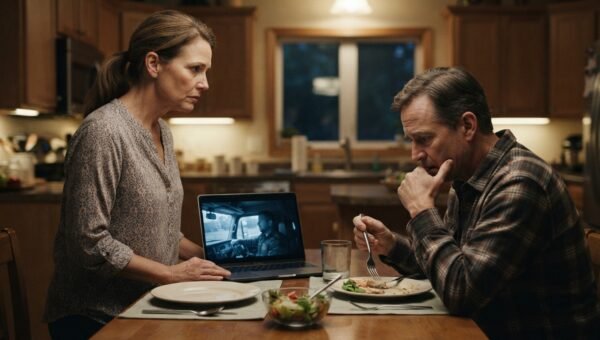
I didn’t answer him right away because my breath caught in the middle of my chest. I thought about the linoleum in Daddy’s front hallway, the peeling edges taped down with gray duct tape, and how he used to cut his blood pressure pills in half with a razor blade when the Medicare gap hit every October.
“That’s impossible,” I told Arthur. “Daddy worked forty years on gravel roads for the county road commission. He didn’t have art. He had a 1988 Ford truck with a rusted floorboard.”
Arthur didn’t argue. He walked back into his small rear workroom and came out with a magnifying loupe, a set of brass calipers, and a thick blue reference volume. He measured the upper bout. He measured the stop length from the top edge to the bridge mark. He turned the fiddle over and examined the spruce top, following the tight, straight grain lines right down to the lower block.
“Look right here,” Arthur said, holding the glass so I could see down into the left soundhole.
Through the circle of glass, the tiny printed Latin script was brown with age, but the name stood out clear: *Carlo Giuseppe Testore all’Aquila, Milano, 1704*. Beside it was a faint purple ink stamp that looked like a bird inside a circle.
“I won’t string this,” Arthur said, his voice flat and deliberate. “I won’t even put tension on the soundpost. If this is authentic, the varnish alone has to be protected. You need to take this to Chicago. Kenneth Warren and Son, or Darnton & Hersh. An appraiser with international papers.”
“How much?” I asked. My fingers were gripping the edge of the glass counter. “Just tell me a real number, Arthur. Not a fairy tale.”
“A verified Milanese master from that era?” Arthur laid the cloth over the strings without pressing down. “At auction, cleaned and certified with clean provenance, you are looking at between $175,000 and $250,000. Maybe more, depending on condition.”
I carried that case back to my car with both arms wrapped around it, holding it like a sick baby. My knees were shaking so hard I could barely press the gas pedal.
The whole drive home, my thoughts raced back through the four years I spent sleeping on Daddy’s fold-out sofa. I remembered the night he took a bad turn in the fall of 2024, when the heat went out in the front bedroom. I had asked Tom for $300 to help service the furnace burner. Tom had stood in Daddy’s gravel driveway, hands in his fleece pockets, and said, “The farm accounts are locked up in his CDs, Mary. We can’t crack a $90,000 certificate early without paying a penalty. You’ll just have to put another space heater in there.”
Tom had bought himself a new fishing boat three months after that conversation.
When I reached my house, I locked the front door, carried the case straight into Daddy’s old cedar chest, and shut the lid. Then I sat at the kitchen table and pulled out the yellow legal pad where Daddy had kept his tractor receipts and seed bills.
Near the very back, between two pages of blank receipt stubs, was an envelope addressed to me in Daddy’s crabbed pencil handwriting. He had written my name, *Mary*, on the front, but the flap wasn’t licked shut. It had been tucked inside the pad since the day he died.
I opened it. Inside were two pieces of paper.
The first was a yellowed receipt from a pawn and music dealer on North Clark Street in Chicago, dated November 14, 1946. It listed a payment of $120 made by my grandfather, Thomas Lewis Sr., right after he came home from the Pacific. Written in ink at the bottom of the slip were the words: *Italian violin, signed Testore, sold as authentic estate property*.
The second paper was a note from Daddy, written about six months before his final stroke.
*Mary,* the pencil line shook across the blue lines. *Your granddad knew what this was, but we never had the papers or the money to fight over it. When my time comes, Tom and Billy will grab the dirt and the bank book. They always count what’s in plain sight. Let them take the farm. They never gave a damn about the house anyway. Take the fiddle, get it appraised properly, and take care of yourself and Tyler. You gave me my last years. Love, Daddy.*
I sat at that table until the sun went down. He hadn’t been tricked by them. He hadn’t been confused or feeble. He knew exactly what they were waiting for, and he let them pick the prize they could measure with an assessor’s map.
PART 3
Two days later, my brother Tom called.
“Hey, Mary,” he said, not asking how I was doing. “I’m coming by Thursday afternoon. Billy and I were going through Dad’s old tax folders, and we found an old insurance slip from 1952 that mentioned an old violin. The lawyer says we need to inventory all personal property that wasn’t itemized line by line in the schedule.”
My hand tightened around the telephone receiver. “The will listed household contents and personal effects, Tom. The lawyer specifically asked if there were any objections to me taking Daddy’s clothes and his musical instruments. You both signed the waiver right there at the table.”
“That was before we knew it was listed on a specialty rider back in the fifties,” Tom said. His voice had that quick, sharp edge he always used when he wanted to cut off an argument before it started. “We just need to get it looked at. If it’s worth fifty bucks, you keep it. If it’s worth something more, it belongs in the estate pot to be divided three ways. That’s only fair.”
“You split the farm two hundred ways,” I said. “You split ninety thousand dollars in CDs between the two of you and left me with sixty-four dollars in Daddy’s checking account after the water bill was paid.”
“That was Daddy’s arrangement, Mary. You said yourself you didn’t want the land work.”
“I’ll see you Thursday, Tom,” I said, and hung up.
I didn’t wait until Thursday. The next morning, I took Sarah with me, and we drove two hours down the interstate to an accredited member of the Appraisers Association of America who specialized in antique stringed instruments.
The appraiser, a woman named Dr. Evans, spent four hours with the instrument. She inspected the spruce under ultraviolet light, ran the measurements against the 18th-century Milanese guild registers, and checked the scroll carving.
When she sat us down in her office, she had the Chicago receipt from 1946 laying on her desk next to her certificate draft.
“It is fully authentic,” Dr. Evans said. “It has the original neck, which was lengthened in the early nineteenth century, which is standard. The back is a single piece of native Italian maple with an exceptional flame pattern. I am placing an insurance valuation of $210,000 on this instrument, with a conservative auction estimate of $185,000.”
Sarah grabbed my arm so hard her fingernails dug into my wool sleeve.
“The title is clean,” Dr. Evans added, looking at the receipt and the signed final probate decree from our county court. “The probate order explicitly awarded all unitemized musical instruments and personal effects to Mary Lewis as sole distributee. The estate closed three weeks ago. There is no claim anyone can make against this property.”
On Thursday at three o’clock, Tom’s truck pulled into my gravel driveway. Billy was sitting in the passenger seat.
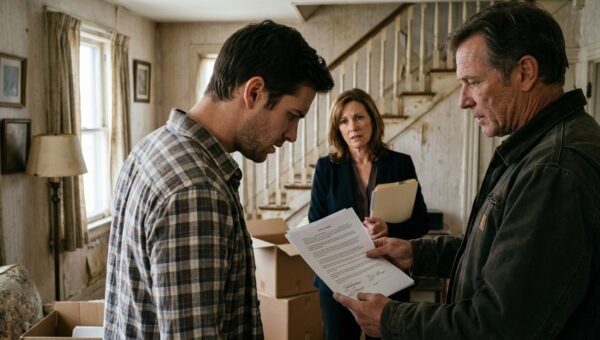
They walked up my front steps without wiping their boots and came into the living room. Tom pulled a printed page from his pocket.
“We talked to a buddy of Billy’s who does estate cleanouts,” Tom said, setting the paper on my coffee table. “He says old Italian copies can bring two or three thousand dollars online. We’re willing to give you five hundred cash right now, Mary, and take it off your hands so we don’t have to reopen probate.”
Billy nodded, jingling the coins in his pocket. “Saves you the hassle of trying to sell an old box of wood.”
I didn’t reach for his cash. I walked over to the sideboard, picked up the certified appraisal folder from Dr. Evans, and set it directly on top of Tom’s paper.
“Read page two,” I said.
Tom frowned, picked up the heavy white folder, and flipped past the color photograph of the back plate. His eyes hit the bold line near the bottom: *Appraised Market Value: $210,000.00.*
He stopped. The color left his forehead, moving down past his jaw until his neck looked gray.
“What is this?” he asked. His voice wasn’t loud anymore. It sounded thin, like dry paper.
“That is Daddy’s fiddle,” I said. “The one you told me was for memories because I was the sentimental one.”
Billy leaned over Tom’s shoulder, squinting at the number. “That’s a lie. That’s a misprint. Dad didn’t have two hundred thousand dollars sitting in his closet.”
“Granddad bought it in 1946,” I told them. “Daddy kept the receipt in his tractor book. He knew what it was. And he sat in that bed for four years watching you two come by twice a year to ask when the deed paperwork was going to be ready. You wanted the farm because you thought dirt was the only thing with value.”
Tom’s mouth opened, then shut. He looked at the paper, then looked at me. “Mary, we’re brothers and sister. We can’t let Daddy’s mistake tear us apart. If the estate had an asset this big, the law says—”
“The law says you signed the final distribution release three weeks ago,” I told him. “The probate judge signed the closing decree on the fourteenth. The farm is yours. The ninety thousand dollars is yours. The fiddle is mine.”
ENDING
Tom tried calling three times that weekend. Billy had his wife drive out to my porch on Sunday afternoon with a pie and a story about how their roof was leaking on the north pasture house, but I didn’t unlock the screen.
I didn’t yell, and I didn’t take them to court to undo what they did with the CDs. I simply stopped answering their numbers.
Two months later, through an established musical foundation in Boston, I placed the Testore fiddle on a long-term loan to a twenty-two-year-old conservatory student from Ohio who couldn’t afford a professional instrument for her audition tours. The foundation pays a yearly maintenance and insurance fee directly to me, and the fiddle is scheduled for private sale to their endowment fund next spring for $195,000.
Last week, Sarah and I used the first deposit to pay off her remaining nursing school loan. We set up an education trust for Tyler that will cover his college tuition and whatever lessons he wants to take.
On Tuesday afternoon, Tyler had his very first violin lesson at the community center down on 4th Street. He wasn’t using the Testore. He was using a sturdy half-size student rental that Arthur fitted for him, complete with a clean rosin cake and a bright red case.
I sat in the little folding chair by the door, watching him tuck the small wooden chinrest under his jaw. His elbows were awkward, and his bow slid sideways across the steel string with a loud, squawking scrape that made the teacher smile and gently guide his wrist back up.
I listened to that raw, noisy scrape echo off the linoleum, thought of Daddy sitting quiet by his kitchen window, and felt my shoulders drop for the first time in five years.