PART 1
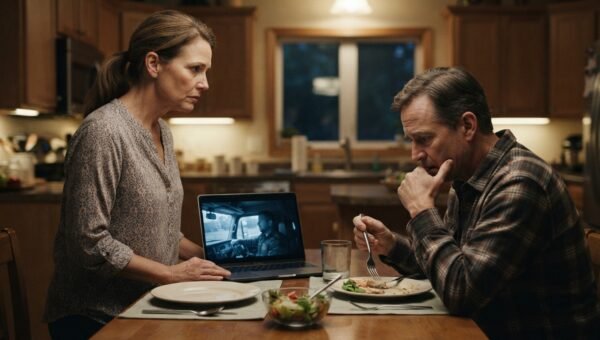
In 1968, my brother Danny and our father had an argument that shook the rafters of our house, and by sunrise Danny was gone.
I was barely fourteen that year. I remember sitting on the second step of the stairs in my nightgown, listening to the kitchen floorboards groan beneath Daddy’s work boots. Daddy yelled until his throat scraped, and Danny answered back in that quiet, stubborn pitch of his that always drove Daddy crazy.
It was about Daddy’s drinking, and the fact that Daddy had pawned our mother’s silver ring to settle a card debt behind the feed store. Danny told him straight to his face that a thief had no business calling himself head of a family. Daddy hit him across the jaw. The sound of that crack made my stomach turn over. Then Danny walked out the back screen door, leaving it flapping in the November wind.
We heard through an uncle that Danny caught a ride out west, out toward Colorado or Washington State, and then the trail dried up completely. No letters arrived in our tin mailbox. No long-distance phone calls ever rang through the hall. Mama kept Danny’s plate at the table for two months before Daddy told her to clear it or throw it in the trash. After six years passed without a word, Mama quietly put Danny’s name into her nightly prayers right alongside our little sister who had died of croup as a baby.
That was how our family handled grief back then. We buried folks while they were still breathing somewhere, just so the silence would stop stinging every morning.
Daddy died fifteen years ago with that same stubborn anger locked tight in his chest, and Mama passed five years after him. I stayed in our hometown, worked thirty-two years keeping accounts for the county water district, raised two girls of my own, and helped clean the parish hall at Grace Baptist every Tuesday morning. By this past April, I was seventy-one years old. I had long accepted that Danny was either dead in an unmarked grave somewhere past the Rockies or living a life where he did not care to remember any of us.
Then, on a Tuesday morning after Easter, our nursery director, Sarah Vance, called me into the back room by the fellowship hall. Someone had left a donation by the side entrance before choir practice: a solid walnut rocking cradle, complete with curved rockers and smooth, sanded rails.
Sarah asked me to help her wipe it down with lemon oil. The moment my fingers touched the corner joint, I stopped breathing.
It was joined with hand-cut dovetails, spaced unevenly on purpose, three fat pins and two narrow ones. On the inside of the headboard, tucked low where a blanket would cover it, someone had used a hot iron nail to burn a five-pointed star with a rounded center hole.
Our grandfather, Thomas Miller, had built rocking chairs and pie safes for people all through this county during the Great Depression. He always put that little notched star inside the joints where only a carpenter would look. Granddaddy had five grandsons, but Danny was the only one who ever sat on the wood shavings in his shop on Saturdays. Granddaddy taught only Danny how to heat that square iron nail and press the star clean into green walnut without scorching the grain.
I sat back on my heels on that linoleum floor, my knees aching, staring at that burnt mark.
“Sarah,” I said, and my voice came out thin. “Who dropped this off?”
“A gentleman named Donald Miller,” she said, looking down at a yellow donation receipt on her clipboard. “He lives over on County Road 14, just past the county line. That’s only about two miles north of the old quarry road. He said he builds wooden toys and baby furniture in his garage, and his church down in the hollow had plenty.”
Danny’s legal name had been Donald. He had been twenty miles north of me this whole time, living under the name on his birth certificate while my mother died believing he was in a California ditch.
I did not finish wiping down the nursery chairs. I got into my sedan, drove through town, and took the two-lane blacktop out past the creek beds. The house at the end of that gravel lane was small, painted faded green, with a detached pole barn and stacks of seasoned oak under blue tarps.
I parked by the pump house, walked up the steps, and stood on the porch gathering myself. My chest felt hollow, like somebody had scooped the breath out of me. Just as I lifted my hand to knock, the front door swung inward.
PART 2
The man standing in the doorway had thick gray hair and a white beard trimmed close along his jaw. He was wearing denim overalls over a gray work shirt, with yellow sawdust clinging to the front of his pocket bib. He had our mother’s round hazel eyes, but the sharp line of Daddy’s jaw had settled into his chin.
He looked at my face, and his eyebrows drew down. He didn’t drop his keys or gasp. He just stood there with his hand on the brass doorknob, taking me in, inch by inch, until he saw the silver turquoise ring on my right hand. Mama had left that ring to me in her will.
“Martha,” he said. His voice was lower than I remembered from fifty-six years ago, but it had the same dry pause between words.
“You let Mama pray for you like a dead man,” I said. It was the only sentence that came out of my mouth. I hadn’t planned it. It just pushed past my teeth before I could stop it.
Danny didn’t answer right away. He looked out over my shoulder toward the empty gravel driveway, then stepped back from the threshold and pushed the screen door wide.
“Come in out of the damp, Martha,” he said quietly. “It’s fixin’ to rain.”
The house smelled like linseed oil, boiled coffee, and cedar shavings. There were no pictures on the walls in the hallway, just a wooden coat rack with three hats hung on pegs. In the front room sat two plain armchairs, a wood stove with a kettle sitting on top, and a long trestle table stacked with receipts and small wooden toy trucks.
I didn’t sit down. I stood in the middle of the braided rug with my purse clutched against my stomach.
“Two miles north of the county line, Danny,” I said. “You were thirty minutes up the highway. Thirty minutes. Mama went to the hospital four times before she died in 2011. Daddy died in the county home in 2006. We lived in the same county telephone directory.”
Danny walked over to the wood stove, took a rag, and moved the kettle an inch back from the heat. He kept his back to me for three or four seconds before he turned around.
“I know when they died, Martha,” he said.
That stopped me cold.
“What do you mean you know?”
“I was at Mama’s graveside,” Danny said, his voice flat and steady. “I stood up by the pine trees near the highway until the preacher closed the book and everybody walked back to the cars. I saw you and Carolyn getting into the black sedan. You were wearing a navy dress with white buttons down the front.”
My fingers tightened on the strap of my purse. I remembered that dress. My daughter Carolyn had bought it for me at the department store in town because nothing in my closet fit right after Mama’s sickness took everything out of me.
“You stood by the trees?” I asked. “You stood thirty yards away and watched us lower her into the dirt, and you didn’t walk down that grass?”
“I couldn’t,” he said.
“Why? Because Daddy hit you when you were eighteen years old? Because you were too proud to let him see you come back?”
Danny shook his head once. “Daddy didn’t hit me because of a card debt, Martha. That’s what you heard from the stairs because that’s what he wanted you to hear.”
He walked over to the sideboard against the dining wall, opened the bottom drawer, and pulled out an old metal lockbox with chipped olive paint. He unlocked it with a tiny brass key he carried on his belt ring and laid a yellowed piece of paper on the table between us.
PART 3
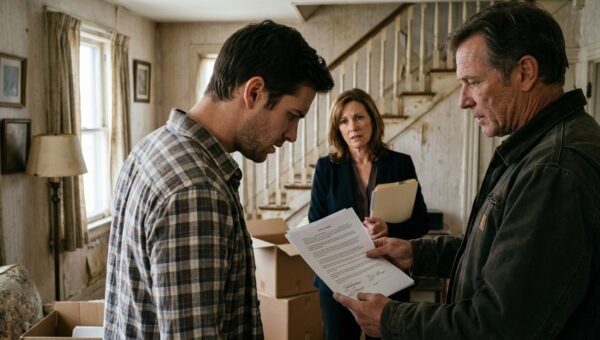
I walked over to the table and looked down at the document. It wasn’t a pawn slip, and it wasn’t a letter.
It was a bank promissory note from the Farmers & Merchants Bank in town, dated October 14, 1968. The borrower’s name was signed in my father’s heavy, sloping handwriting for $4,200. Right beneath it, listed as collateral for the debt, was the deed to the eighty acres our grandfather had left directly to Danny and me.
Daddy had forged Granddaddy’s signature on the title transfer two weeks after Granddaddy died in the autumn of 1967.
“The bank manager called me that morning in November,” Danny said, pointing a calloused finger at the date stamp. “He knew Granddaddy’s hand. He told me Daddy had borrowed against the home place to cover three years of unpaid farm loans, and the note was sixty days past due. If nobody paid it, the sheriff was going to auction the acreage by Christmas. Daddy didn’t have the money. He’d spent it.”
I looked at the number again. Four thousand two hundred dollars in 1968 was more than Daddy made in two years at the grain elevator.
“That night in the kitchen,” Danny went on, “I didn’t call him a thief because of Mama’s ring. I called him a thief because he stole the land out from under us and put the paper in my name as a co-signer without asking. When Daddy hit me, he told me that if I went to the sheriff, he’d go to the state penitentiary, and Mama and you would be out on the street with the mortgage foreclosed before winter ended.”
“So you just left?” I asked, though the truth was already sinking into me like cold iron.
“I didn’t go out west, Martha. That was just what Daddy told people to explain why I wasn’t around to answer questions. I went across the state line to the limestone quarry in Indiana that very night. I worked twelve-hour shifts swinging a sledge and loading gravel trucks. Every two weeks, I took half my wages in cash, put them in a plain cashier’s envelope, and mailed them directly to the bank manager in town under the loan number.”
Danny reached back into the lockbox and pulled out a stack of faded, pink bank receipts, held together with a rotting rubber band.
“It took me seven years,” he said. “Seven years of sleeping in a bunkhouse with six other men and eating canned beans off a hot plate. In November of 1975, I made the last payment of $140. The bank released the lien. The deed went clean into your name and mine, just like Granddaddy wanted.”
I stared at the receipts. Every single one had the same teller initials stamped in blue ink: *F&M Bank, Paid in Full.*
“Why didn’t you write Mama?” I asked, and this time my voice broke. “Even if you couldn’t face Daddy, why did you let her think you were dead? She cried every Sunday night, Danny. Every single Sunday night she sat by that kitchen window.”
“Because Daddy told me what he’d do,” Danny said. His voice stayed level, but I saw his knuckles whiten where he gripped the edge of the wood table. “When I came back in ’76 to bring the clear deed, Daddy met me at the front gate with his shotgun. He told me if I ever set foot in the house or spoke a word to Mama about what he’d done with that loan, he’d tell the whole county I was the one who forged Granddaddy’s name and run off when the money went missing. He said Mama’s heart wouldn’t take the scandal, and he was right about that. Her heart was always weak.”
Danny looked at me, his eyes steady and tired.
“I stayed away to keep him from destroying whatever peace she had left. Then Daddy got sick, and I figured if I came back while he was dying, it would turn into a circus of blaming and shouting in that hospital room. So I bought this five acres here thirty years ago. I kept my head down. I worked the timber yard, and I made furniture.”
“And the cradle?” I asked. “Why give the cradle to our church?”
“I’m seventy-four years old, Martha,” he said softly. “My hands are getting stiff in the mornings. I built that cradle out of a piece of walnut Granddaddy cut back in ’62 that I took from the barn the night I left. I wanted a piece of him back in that church where we grew up. I figured if anyone remembered his mark, it would be you. And if you didn’t, a new baby would have a solid place to sleep.”
ENDING
I sat down in the wooden armchair beside Danny’s table.
For fifty-six years, I had carried the story Daddy built: that Danny was reckless, that he was selfish, that he had thrown his family away for nothing more than a temper tantrum on a cold night. I had spent decades being angry at an empty road, while my brother was sweating in an Indiana gravel pit paying off another man’s theft so the roof wouldn’t be pulled off over my head.
We sat in that room for three hours while the spring rain hit the tin roof of his pole barn. Danny didn’t offer any grand excuses, and I didn’t offer any clean apologies. Some wounds don’t close up neat just because you finally see the scar clearly.
He made a pot of black coffee on his stove, and he showed me the toy trucks he was carving for the county children’s shelter. We talked about Carolyn, and my grandchildren, and how the old hardware store on Main Street had been torn down two summers ago to make room for a car wash. He asked if the apple tree behind our childhood house was still bearing fruit, and I told him it had rotted out in the ice storm of ’94.
Before I left that afternoon, Danny walked me down the porch steps to my car. The rain had stopped, leaving the gravel shiny and the air smelling of wet grass.
He reached into his pocket and handed me a small wooden box, no bigger than a deck of cards, with a sliding lid. Inside was a smoothed piece of walnut, shaped like a leaf, with Granddaddy’s five-pointed star burned square in the center.
“You keep that,” Danny said. “Granddaddy made three of those stamps out of an old iron rail. I still got mine.”
“Danny,” I said, leaning out the car window. “Carolyn and the kids come over for Sunday pot roast at twelve. We have plenty of potatoes.”
Danny looked at the gravel by his boots for a second, then looked back up at me and nodded once.
“Twelve o’clock,” he said. “I’ll be there.”
I backed down the gravel lane and turned south toward home, the little walnut leaf resting safe in the cup holder beside my keys.