PART 1
The self-checkout register at the grocery store on Highway 18 was beeping because the paper roll jammed, and I was too tired to care.
It was a Tuesday evening around five o’clock. I had bought two bags of groceries: skim milk, a tub of margarine, a loaf of sourdough, and the store-brand pork chops on sale for $4.99 a pound. My husband, Martin, had supposedly driven up to Madison that morning for his weekly three-day maintenance consulting contract.
He had been doing that drive every Tuesday through Thursday for nearly twenty months, ever since the machine shop where he worked for thirty-two years cut its pension payout.
I pulled my bags off the carousel and started walking toward the sliding glass doors.
“Excuse me! Ma’am, wait!”
A woman in a cream-colored cardigan hurried toward me from behind the registers. She looked to be in her early forties, with dark hair tied back in a clip and a friendly, apologetic smile. She held a slip of paper between two fingers.
“You dropped this at register four,” she said, catching her breath. “It fell right behind the bag stand.”
“Oh, thank you,” I said, taking it from her. “I would have forgotten it completely.”
“Don’t worry about it,” she said, giving a polite nod before turning back toward the service desk.
I slid the folded paper into my jacket pocket, walked out to my ten-year-old Buick, and drove the four miles back to our small brick ranch on Elm Street.
The house was cold when I stepped inside. Martin always turned the thermostat down to sixty-two before leaving for Madison to save on heating oil.
I set the paper grocery sacks on the laminate counter, put the milk in the fridge, and pulled my receipt out of my pocket to file it in the kitchen drawer with the rest of our household monthly tallies. Martin was meticulous about our budget. Every dollar had to be accounted for, down to the sales tax on laundry soap.
That was when I felt how heavy the paper was.
It was not normal thermal receipt paper. It was folded twice. Inside the store receipt for my $38.42 grocery bill was a ripped piece of blue-lined notebook paper.
Written on it in sharp, hurried black ballpoint pen was a message:
“You are Martin Vance’s wife, aren’t you? Look at the glove box in his truck before you give him another dime. He told me you died in hospice last year.”
Underneath the words was a phone number with a local exchange and a name: “Claire.”
I stood by the kitchen sink with the tap dripping into an empty coffee mug.
My first thought was that it had to be a cruel joke or a mix-up.
Martin Vance was sixty-one years old. He wore gray work shirts with his name stitched in blue thread over the left chest pocket. He took blood pressure pills with his morning orange juice and spent his Saturday afternoons greasing the joints on his lawnmower. We had been married thirty-four years. When our oldest son, Kyle, bought his first starter home three years ago, Martin refused to let us give Kyle five hundred dollars for paint because he insisted our savings were down to under nine thousand dollars.
Yet the woman at the register had known my face. She had looked right at me, smiled, and handed me this note.
Martin had left his personal truck, a ten-year-old silver Dodge Ram, sitting in our driveway. He had taken the commuter bus up to Madison from the park-and-ride lot on the county line, just like he claimed he did every single Tuesday morning to save on mileage.
I set the grocery bag down on the floor, took Martin’s spare keys off the magnetic hook by the back door, and walked out into the driveway.
PART 2
The latch on the Dodge Ram clicked loudly in the cold afternoon air.
Martin kept that truck spotless. The seats were covered in gray canvas, and there was always a pine air freshener hanging from the turn signal. I climbed into the passenger side, pulled the heavy door shut, and reached for the glove compartment.
It was locked.
Martin had never locked the glove box in thirty-four years of owning vehicles. The registration and insurance card were supposed to be easy to reach in case of a traffic stop.
I sat there on the vinyl seat, listening to the wind hit the windshield. The truck key on his spare ring did not turn the glove box lock. But Martin had an old habit: whenever he locked a toolbox or a cabinet in the garage, he kept the small silver key on a safety pin under the floor mat.
I bent over, peeled back the heavy rubber mat on the driver side, and found it taped flat to the carpet with a strip of black electrical tape.
My hands were shaking as I pulled the tape off. The small brass key turned smoothly.
Inside the glove box, there was no vehicle registration. There was a thin manila folder labeled “Oakhaven,” an unopened package of mints, and an unfamiliar gold ring tucked into a tiny velvet pouch.
I opened the manila folder first.
On top was a purchase agreement dated four months earlier, in June. It was for a lake cabin up in Oconto County, four hours north of us. The purchase price was $146,000. The buyer listed on the deed was Martin Vance and Claire Evans, as joint tenants with right of survivorship.
Below the deed was a bank cashier’s check receipt. The down payment had been $42,000, paid in full on June 12th.
The money had been drawn from a joint high-yield savings account at Northern State Bank.
That was our account. It was the account my mother had left me when she passed four years ago, holding $48,000 intended to carry us through our late seventies so we wouldn’t burden our two children. Martin had told me three years ago that he rolled that money into a five-year fixed certificate of deposit to protect it from market drops. He had brought home a certificate on heavy blue paper, which sat in our firebox in the bedroom closet.
It had been a fake. Martin had simply kept the cash in a liquid account where he had single-signature withdrawal authority.
I pulled out my cell phone and dialed the number on the back of the receipt.
The phone rang three times before a woman answered.
“Hello?”
“Claire?” My voice sounded thin, like someone talking through a screen door. “This is Linda. Linda Vance. You handed me a note at the grocery store.”
There was complete silence on the other end of the line for several seconds.
“Oh, God,” she said quietly. Her voice was not angry. It sounded hollow, like all the air had left her chest. “I wasn’t sure if you would call. I wasn’t even sure it was you until I saw the grocery store rewards card screen flash your last name when you scanned it.”
“Who are you?” I asked. “And why do you have my husband’s name on a deed?”
“Martin told me you had breast cancer,” Claire said. Her voice broke slightly, then stabilized. “He said you died fourteen months ago in a nursing facility in Green Bay. He showed me photos of your garden, told me how hard it was to stay in that house alone. We met at the state fair two summers ago. We bought the cabin together so he could have a quiet place to retire.”
“He’s not retired,” I said. “He told me he works in Madison three days a week.”
“He doesn’t go to Madison, Linda,” Claire answered, her tone flat and steady. “He spends Tuesday through Thursday at my apartment in town. He’s sleeping on my sofa right now because he claims he worked a twelve-hour shift last night.”
PART 3
I told Claire not to wake him.
I went back inside my house, walked into the bedroom, and opened the small metal firebox. I pulled out the blue certificate Martin had given me two years earlier. Looking at it closely under the reading lamp, I could see the ink on the bank seal was slightly smudged. It was a color copy he had run on thick cardstock.
He had not just taken my mother’s money. He had erased my existence to build a second life forty miles from where we raised our kids.
I called my son Kyle. I didn’t cry. When something this big breaks wide open, there is no room for hysterics; you just need your feet firmly planted on the floor.
“Mom?” Kyle said, answering on his commute home. “What’s going on?”
“I need you to come over,” I said. “Bring your truck. And bring a padlock.”
Kyle arrived twenty minutes later. I laid the manila folder, the receipt, and the fake certificate out on the kitchen table. He read every line without saying a word. His jaw worked hard, the way his father’s used to when an engine part wouldn’t seat properly.
“He’s in town?” Kyle asked, his voice low and dangerous.
“He’s at her apartment,” I said. “She gave me the address. She told me she wants her name off that cabin title tonight, and she wants him out of her home.”
We drove over in Kyle’s truck. The apartment complex was a modest two-story brick building behind the lumber yard on the east side of town. Claire was waiting by the front steps in her coat. She looked even younger up close, tired around the eyes, with two packed duffel bags sitting on the porch beside her.
“His clothes are in those bags,” Claire said, looking at me directly. “I packed everything he brought into my apartment. He’s inside in the living room. I told him someone was here to see him about the cabin taxes.”
I picked up the manila folder from Kyle’s front seat and walked up the stairs.
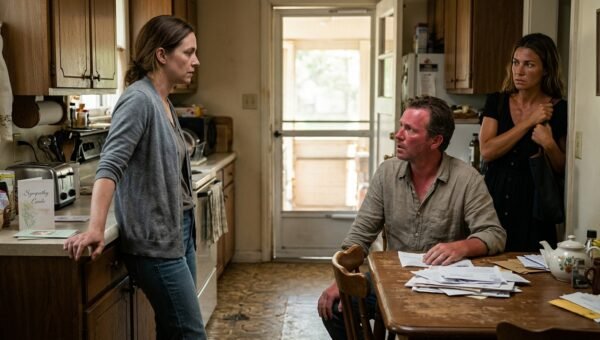
When Martin saw me walk through Claire’s doorway, he didn’t jump up or shout. He was sitting at a small kitchen table with a mug of black coffee, wearing the gray flannel shirt I had ironed for him on Sunday night.
For three seconds, his face was completely blank. He looked at me, then at Claire standing in the hallway behind me, then at Kyle, who filled the doorway with his arms crossed.
“Linda,” Martin said. His voice was quiet, almost conversational. “What are you doing here?”
“I came to return your receipt,” I said. I dropped the grocery receipt on the table between his hands, right next to his coffee. “The woman who picked it up for me was very polite.”
He looked down at the paper. He saw his own handwriting on the back, then Claire’s note underneath.
“Linda, listen,” he began, his hands moving toward the table edge. “You don’t understand the pressure I was under. When the shop cut the pensions, I panicked. I didn’t know how we were going to survive. I met Claire, and she had capital, and I thought if we invested in the lake property—”
“You told her I was dead, Martin,” I said.
The room went dead silent.
Martin opened his mouth, but no sound came out. That was the one lie he could not reframe as a financial plan. He could pretend the stolen savings was an investment. He could pretend he was working overtime to help the family. But telling a woman he had buried me fourteen months ago was pure, cold cowardice.
“The cabin has to be sold,” I said, keeping my voice level. “Kyle and I are going by the bank tomorrow morning. Claire is going to sign her interest over to an escrow agent, and you are going to sign the paperwork to liquidate it. Every single dollar of my mother’s money goes back into an account with only my name on it.”
“Linda, we can talk about this at home,” Martin whispered. “Don’t do this in front of Kyle.”
“You don’t have a home on Elm Street anymore,” Kyle said from the door. He didn’t raise his voice, which made it hit harder. “Your bags are on the porch, Dad. Take your truck and get a motel room.”
ENDING
The cabin in Oconto County sold four months later, in late February. The housing market was slow that winter, so we took a small loss on the closing fees, but $41,200 of my mother’s money was recovered and placed into a separate checking account at a completely different credit union downtown.
Martin moved into a single-bedroom rental near the county line. He tried calling every Sunday for the first two months, leaving messages about how he had lost his head after the pension cut, how he felt like a failure as a provider and took the easiest way out to feel important again. I never answered those calls. I had our lawyer handle every document through the mail.
Our divorce was finalized on an ordinary Tuesday in July.
There was no shouting in the county courthouse. The judge divided Martin’s remaining small pension equally, gave me full ownership of the house on Elm Street, and ordered Martin to finish paying off the balance of the truck out of his share.
After the final hearing, I walked across the parking lot toward my car. Martin was standing near the row of bicycle racks by the exit, holding a paper envelope with his copies of the decree.
“Linda,” he said as I passed. “I’m sorry. I really am.”
I stopped and looked at him. Without his work uniform and the routine of our marriage, he just looked like an aging man in an ill-fitting suit who had traded thirty-four years of decency for a few months of pretending he was somebody else.
“I know you are,” I told him. “Keep your copies safe.”
I drove home, unlocked the front door, and walked into the kitchen. The house was quiet, but it was warm. I had bumped the thermostat up to sixty-eight the week he left and never turned it down again.
On the counter sat a small white magnetic clip holding my grocery list for the week. Behind it was that torn grocery receipt from Highway 18, smoothed out flat against the refrigerator door.
I left it right there. Not to stay angry, but to remind myself that the truth sometimes finds you in the middle of an ordinary grocery aisle, and that a woman doesn’t have to stay quiet just because she spent a lifetime keeping the peace.