PART 1
The banquet tray was heavy, but the weight in my lower back was familiar after five years at the Oakridge Event Center. I was fifty-three, wearing a black apron and black non-slip shoes, carrying a silver coffee pot between round tables dressed in navy linen and silver balloons. It was our thirty-fifth high school reunion, the Class of 1989.
When the booking sheet had come across the banquet office clipboard three weeks earlier, I could have asked my manager to assign me to the wedding in Salon B. But five years ago, my husband David got sick.
Four years of treatments, specialty co-pays, and home hospice wiped out everything we had saved, and after he died, the banquet hall shifts kept the mortgage paid. I needed the weekend overtime rate. Pride does not pay the electric company.
I told myself people would just look past me anyway. In a catering uniform, you are mostly invisible.
Then I reached Table Four.
Vanessa Vance sat in the center seat facing the dance floor, wearing a tailored emerald dress with diamond studs that caught the chandelier light. In 1989, Vanessa decided who sat where in the cafeteria and whose senior year was miserable. Beside her sat two of her old friends, laughing over wine glasses.
I stepped up with the pot. “Decaf or regular?”
Vanessa looked up, her painted brow lifting. The laugh stopped, then turned into a slow, deliberate smirk. She glanced across the table to make sure the others were watching.
“Well, look who’s serving us now,” Vanessa said, raising her voice just enough for the surrounding tables to hear over the soft pop music. “Sarah Miller. Some people actually made something of themselves, and some are still clearing plates thirty-five years later.”
One woman at the table looked down into her lap, embarrassed. Another let out a nervous snicker.
My fingers tightened on the insulated handle of the pot. I could feel the heat rising up my neck, hot and sharp, but I didn’t shake. I looked right at Vanessa, poured two ounces of regular into her white ceramic cup without spilling a drop, and set the creamer beside it.
“Regular for you, Vanessa,” I said. “Enjoy your evening.”
I walked back toward the kitchen swinging doors, my boots squeaking slightly on the polished floor. My face burned, but I held my head straight. I had survived watching the man I loved take his last breath in our living room.
An arrogant comment from a high school bully was not going to break me.
I pushed through into the dish pit, set the pot down on the stainless steel counter, and took two slow breaths. Through the small circular window in the swinging door, I could see our former class president, Mark Henderson, standing near the podium by the DJ booth. He was holding an accordion folder and a microphone.
Mark tapped the mic. The sound echoed through the banquet room, cutting through the chatter.
“Good evening, everyone,” Mark said, adjusting his glasses. “Before we cut the cake, there’s something we need to handle. While organizing this reunion, I had to dig through the school archives to clear old student council records. In those boxes, I found something that was hidden for thirty-five years.”
He stopped, paused, and looked straight across the room, past the tables, directly at me standing by the kitchen door.
“Tonight,” Mark said into the microphone, “everyone deserves to know what really happened back in 1989.”
PART 2
The room grew quiet. Vanessa leaned back in her chair, a slight smile on her lips, probably assuming Mark was about to announce another nostalgic senior prank or run through old homecoming photos.
I stayed frozen behind the door window. In May of 1989, one week before graduation, the senior class treasury had vanished. It was $2,400, collected through bake sales, car washes, and community sponsorships to fund our class gift and provide a small scholarship for a student entering state college. I had been the treasurer.
The morning the money disappeared from the locked office drawer in the journalism room, Vanessa had gone directly to the principal. She claimed she had seen me lingering by the filing cabinets after seventh period. I didn’t have an alibi; I had been in the darkroom developing photos alone. Because my family didn’t have money or influence, the whisper campaign spread like wildfire. The principal couldn’t formally charge me without hard proof, but the school board rescinded my nomination for the community leadership grant, and my classmates treated me like a criminal until graduation day.
David had been one of the few who believed me back then. When we married four years later, he told me that truth has a way of outlasting rumors, even if it takes a lifetime. But after David died, I had stopped caring about old school gossip. Survival took all my energy.
Now, Mark stood at the front of the room, unbuttoning his suit jacket.
“Many of you remember our senior gift,” Mark said clearly into the microphone. “And many of you remember the scandal that ruined a classmate’s reputation right before we walked across the stage. Two thousand four hundred dollars went missing. The finger was pointed at Sarah Miller.”
Several heads turned toward the kitchen doors. Vanessa’s smile vanished. Her hands tightened around the stem of her wine glass.
“For thirty-five years, people believed that lie,” Mark continued, his voice steady and deliberate. “Three months ago, the high school began renovating the old administration wing. Behind a false back panel in the bottom drawer of the student council desk, maintenance workers found an old bank deposit bag. Inside that bag was the full $2,400 in cash, still in the original bank bands from April 1989.”
A collective murmur rolled through the room.
“Along with that cash,” Mark said, lifting a faded sheet of yellow legal paper from his folder, “was a signed confession and a transfer note that never got turned in. It was written by our former vice principal, Mr. Harris, dated two weeks after our graduation.”
Mark looked over the top of his glasses directly at Table Four.
“Mr. Harris documented that he caught the student who hid that money before graduation. That student took the funds to frame Sarah Miller because Sarah had earned the higher GPA and was set to receive the Rotary scholarship. But because that student’s father was the chairman of the school board at the time, Mr. Harris was pressured to bury the report and hide the cash until the dust settled. He kept the money and the confession tucked away, intending to clear the record after the board chair retired, but Mr. Harris passed away that winter, and the desk sat in storage.”
Vanessa’s face went completely stiff. The green dress that had made her look so commanding suddenly seemed absurd under the bright hall lights.
“The student who hid that money,” Mark said, his voice ringing through the sound system, “was Vanessa Vance.”
PART 3
The entire banquet hall went dead silent. You could hear the hum of the ice machine behind me.
Vanessa pushed her chair back, the metal legs scraping loudly against the parquet floor. “This is ridiculous,” she snapped, her voice cracking slightly. “This is an ancient misunderstanding, Mark. You have no right to bring up high school nonsense in front of everyone.”
“It wasn’t nonsense to Sarah,” Mark replied plainly. “That scholarship was worth four thousand dollars. It would have covered her first two years of tuition. When it was pulled, she couldn’t afford to go to Michigan State. She stayed local, worked two jobs, and took care of her family while you went off on your father’s dime.”
People at Vanessa’s table pulled back, visibly distancing themselves. The woman who had snickered earlier looked down at her bread plate, her cheeks bright red.
Mark set the microphone on the stand, picked up the folder, and walked down from the low stage. He walked straight toward the kitchen doors.
I didn’t run. I took off my white cloth service gloves and pushed the swinging door open, stepping out onto the carpeted floor.
Mark stopped in front of me. He looked older, his hair gray at the temples, but his eyes carried the same decency he had shown as an eighteen-year-old kid.
“The school district audited the discovery,” Mark said gently, so only the nearby tables could hear. “The board of education formally released the original funds plus the accumulated interest from the trust account Mr. Harris eventually moved it into before his stroke. They issued a certified bank check to make full restitution for the scholarship you were denied. It’s thirty-six thousand nine hundred dollars, Sarah. It belongs to you.”
He handed me a crisp manila envelope.
I looked down at it. For five years, I had counted every dollar. I had stretched ground turkey with oats, cut my blood pressure pills in half until the clinic warned me not to, and worked double shifts on holidays just to keep the roof David had shingled over my head. Thirty-six thousand nine hundred dollars would pay off the rest of David’s remaining medical debt and clear the small balance left on our mortgage.
Vanessa walked toward the exit, her purse clutched against her ribs, her heels clicking fast and erratic toward the coat check. No one followed her. No one offered to share an Uber. The classmates she had entertained minutes earlier just watched her leave in silence.
I looked at Mark, then looked out at the room. Some people were looking at me with pity, but many looked at me with genuine regret.
“Thank you, Mark,” I said. My voice was quiet, but it didn’t tremble.
ENDING
I didn’t make a speech. I didn’t throw anything in anyone’s face.
I walked back into the banquet office, placed the envelope inside my locked locker, and put my apron back on. My shift ended at eleven o’clock, and I wasn’t going to leave my floor partner, Maria, alone to clear seventy tables. We broke down the linens, stacked the banquet chairs on the rolling dollies, and ran the final racks of silverware through the commercial washer.
When the night manager signed my timecard at 11:15, he asked if I wanted to take Sunday off.
“No,” I told him, putting my coat on. “Put me down for the bridal shower in the morning. I like staying busy.”
Driving home in my old sedan, the heater took ten minutes to warm up against the October chill. The envelope was sitting on the passenger seat under my purse.
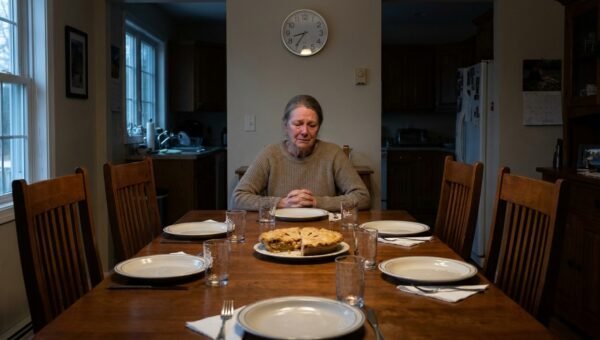
When I unlocked my front door, the house was dark and quiet. I hung my coat on the peg in the hall, walked into the kitchen, and set the bank check on the counter next to David’s framed photograph. In the picture, he was wearing his faded blue work shirt, smiling from the porch steps on the day we finally finished painting the trim.
I made myself a simple cup of tea, sat down at the table, and looked at the numbers on the check.
Justice didn’t change the fact that David was gone, and it didn’t undo thirty-five years of hard work. But as I took a sip of hot tea in the quiet kitchen, the tightness that had lived in my shoulders for half a lifetime finally let go. I was going to keep my house.