PART 1
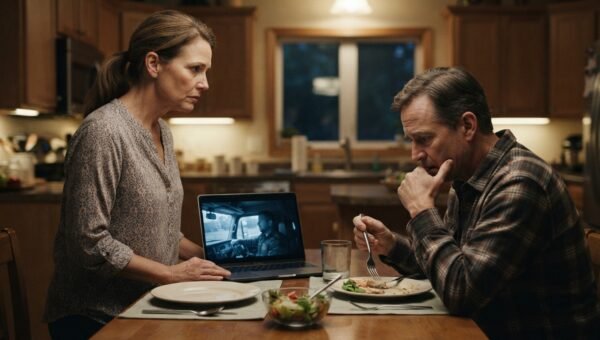
I counted out five fifty-dollar bills onto our scratched kitchen table, laid my car keys over them so they wouldn’t slide, and looked my eighteen-year-old son in the eye.
“If you want to be a man,” I told him, “build your own life.”
Daniel had just looked at me and said his girlfriend, Chloe, took two positive pregnancy tests in the high school bathroom before fifth period. He was terrified.
He was looking for me to tell him what to do, or maybe just to say we would figure out a way through it together. Instead, my own panic had turned hard and cold. I had raised him alone after his father walked out when Daniel was four. I worked thirty-two hours a week at the county billing office and took extra shifts at a dry cleaner’s on Saturdays. I had spent eighteen years terrified of being dragged back down to zero, and in that split second, all I saw was my own hard life repeating itself in him.
He didn’t yell. He didn’t pick up the keys. He just took the $250, folded the bills into a tight little square, and walked down the hall to his bedroom. Ten minutes later, he walked out the front door carrying one blue canvas duffel bag.
He never called. That was 2010.
For fifteen years, whenever someone at church or my sister Clara asked about him, I lied.
I told everyone he was doing fine somewhere across the country. I said he had settled down out west, that he had steady work in construction, that young men just get busy with their own lives. After a while, people stopped asking. I kept the lie going because the truth was humiliating: I had traded my only child for a lecture on independence and two hundred and fifty dollars.
I retired from the billing office in 2022. To keep myself from sitting in an empty three-bedroom house listening to the refrigerator run, I started volunteering two mornings a week at St. Jude’s Grace Pantry on 4th Street. It was quiet, practical work. Mostly I wiped down the stainless steel counters and filled cardboard cartons with ladles of vegetable beef soup.
It was a rainy Tuesday in October. The clock over the double doors read 11:40. The lunch line was moving slowly because the floor near the entrance was wet from umbrellas.
I grabbed a clean dishtag, looked up from the soup counter, and the breath caught in my throat.
A tired man in a faded work jacket was standing at the front of the line. In his left arm, he carried a little girl with curly brown hair who couldn’t have been more than three. Clutched tightly to his right coat pocket was a skinny boy around eight, wearing a pair of sneakers with the toes taped up with electrical tape.
The man looked forty, but he was thirty-three. He had my father’s square jaw and the small white scar right below his left eyebrow from when he fell off his bike on his tenth birthday.
It was Daniel.
He recognized me instantly. His hands tightened on the little girl’s legs, but he didn’t run. He didn’t make a scene. He just waited quietly until the volunteer next to me, Mrs. Gable, handed the little boy two wrapped oatmeal cookies and pointed them toward the corner coloring table.
Once the children were three steps away, Daniel stepped closer to the stainless steel divider. His jacket smelled like damp cotton and sawdust. He looked directly at me, his eyes bloodshot from exhaustion, and whispered, “Mom… I don’t need food. I just need someone.”
PART 2
“Step behind the counter,” I said. My voice was shaking, but I kept my hands flat against the cold metal edge. “Daniel, come through the side door.”
Mrs. Gable glanced over at me, surprised. I had worked beside her for three years and rarely spoke about anything more personal than the weather or the price of butter.
“Take a break, Martha,” she murmured gently, taking the ladle from my fingers. “Go on into the office. I’ll cover the trays.”
I opened the gray metal service door and brought Daniel and the two children into the small volunteer break room. There were three folding chairs, an old coffee pot, and coats hanging on wall pegs. The little boy climbed into a metal chair and put the oatmeal cookies on his lap, not opening them yet, watching me like a stray dog watching an open gate. The little girl rested her chin on Daniel’s collarbone and sucked her thumb.
“Sit down,” I told him.
He sat. He looked down at his boots. They were cracked across the instep, covered in dry gray sheetrock dust.
“Their names are Toby and Maya,” he said quietly. “Toby is seven. Maya is almost three.”
“Where is Chloe?” I asked.
“She stayed until Toby was four,” Daniel said. He didn’t sound angry; he just sounded drained of every ounce of fight. “She tried, Mom. We both did. But we were nineteen living in a basement apartment with no heat on weekends. When her sister got an apartment down in Georgia, Chloe went down there for work and just… didn’t come back. She sends fifty dollars through an app whenever she has it, but it hasn’t come since June.”
“Where have you been living?”
“Over on Miller Street. In the brick duplexes by the lumber yard.”
I stared at him. Miller Street was four miles from my house. It was a twenty-minute drive down Route 9.
“You’ve been in town?” I asked.
“Since last winter,” Daniel said. “I worked framing houses for Miller Contracting down in Ohio for eight years. Then the boss died, the company broke up, and work got thin. I came back because I knew the county. I thought maybe I’d find enough remodel jobs to get us our own place. But I threw my back out two weeks ago carrying a subfloor sheet. I can’t lift twenty pounds right now without my leg giving out. The landlord gave me until five o’clock tonight to pay three hundred dollars in back rent, or he’s changing the padlock on the front door.”
I looked at his hands. His knuckles were raw and swollen.
“You didn’t call me,” I said. It came out harsher than I meant it to, but the sting of fifteen silent years was right there between us. “You were four miles away for ten months, Daniel. You knew where my house was. You knew my number never changed.”
Daniel slowly reached inside his faded jacket. He pulled out a worn, dark leather bifold wallet. It was held together with a thick blue rubber band. He slid the band off with his thumb, opened the interior pocket, and pulled out an old piece of yellowed lined paper folded into a tiny rectangle.
He didn’t throw it. He didn’t slam it down. He just unfolded it with careful, stiff fingers and smoothed it against the plastic break room table.
Inside the paper were five old fifty-dollar bills.
PART 3
I looked from the bills to my son’s face.
The paper was so creased at the folds that the edges were soft as cloth. It was the same two hundred and fifty dollars I had set under my car keys in the summer of 2010.
“You never spent it,” I whispered.
“I promised myself I would never touch it until I could hand it back to you,” Daniel said, his voice cracking for the first time. “I wanted to walk up your driveway in a clean shirt with the keys to my own truck, pay you back your two hundred and fifty dollars, and prove to you that I was a man. That was the only thing that kept me moving for ten years. Every time things got bad, every time an engine blew or a paycheck bounced, I touched that wallet and told myself I wasn’t going to crawl back to you with empty pockets.”
He looked over at his children. Toby had finally peeled the plastic wrap off one oatmeal cookie and was breaking it into halves to share with his little sister.
“I couldn’t do it, Mom,” Daniel whispered, covering his face with one dusty hand. “I broke my back, the rent is due, and they haven’t had hot milk since Sunday. I didn’t come here to ask for your money. I came because I saw your name on the church volunteer bulletin board at the laundromat. I just need someone to watch them for three hours while I go talk to the landlord and beg him not to throw their clothes into the alley.”
I sat in that cold folding chair and felt the sheer weight of what my pride had built. Fifteen years of telling my neighbors he was thriving across the country, all while my boy was breaking his spine four miles down the road, starving himself so he wouldn’t violate the cruel rule I had handed him at eighteen. I had given him money to push him out the door because I was too cowardly to help him carry his fear.
I stood up. My knees made a cracking sound in the quiet room.
I picked up the five fifty-dollar bills from the table. I didn’t put them in my purse. I folded them back up and slipped them into the front pocket of Daniel’s work coat.
“Toby,” I said, turning to the little boy. “Do you like grilled cheese sandwiches?”
The boy looked at his father first. Daniel nodded once, swallowing hard.
“Yes, ma’am,” Toby said in a small, polite voice.
“Good,” I said. “Put your sister’s coat on.”
I went to the door, opened it, and told Mrs. Gable I had an emergency and wouldn’t be back for the afternoon shift. Then I walked Daniel and my two grandchildren out to my Buick in the rainy parking lot.
We drove straight to the brick duplex on Miller Street. The landlord, a sour-faced man named Henderson who smelled of stale tobacco, was already standing on the porch with a cordless drill in his hand, ready to take the doorknob off.
I didn’t yell. I didn’t cause a scene. I got out of the car, pulled three hundred dollars in cash out of my checking envelope in my purse, and handed it to him along with thirty dollars extra for the late fee.
“Give him till the end of the month to pack,” I said, looking Henderson dead in the eye until he dropped his gaze. “He’s moving out today.”
We spent the next two hours loading Daniel’s life into the trunk and back seat of my car. There wasn’t much. Two plastic tubs of children’s clothes, a box of hand tools, a broken toaster, and the same blue canvas duffel bag he had carried down my front steps when he was eighteen years old.
ENDING
We got back to my house at four in the afternoon. The house had been clean and silent for three years, smelling like lemon polish and old radiator heat. Within twenty minutes, Toby had his shoes lined up by the front mat and Maya was sitting on the living room rug, turning the pages of an old Sears catalog I had kept in the magazine basket.
I made a pot of chicken rice soup on the stove and toasted four sandwiches in the heavy cast-iron skillet.
Daniel sat at the kitchen table, in the exact same chair he had occupied fifteen years ago. He moved stiffly, guarding his lower back, his shoulders slumped like a man who had been carrying an anvil up a hill for half his life.
I set a hot bowl in front of him, along with a glass of water and two aspirins.
He didn’t pick up the spoon right away. He just stared at the table, his eyes wet.
“I’m sorry, Mom,” he whispered. “I made a mess of it.”
I pulled out the chair next to him and sat down. I reached out and took his rough, work-calloused hand in both of mine. It felt like my father’s hand, but it was my boy’s.
“You didn’t make a mess of anything, Daniel,” I said, and for the first time in fifteen years, I wasn’t lying to save my own face. “You took care of your children when everybody else walked away. You’re a better man than I gave you credit for. And you’re home.”
He didn’t answer. He just held onto my hand with a grip so tight his knuckles went white, put his head down on the wooden table, and wept.
Toby came into the kitchen a few minutes later, holding an empty plastic cup, and asked if he could have some more water. I stood up, took the cup, and filled it at the sink.
Outside the window, the rain was coming down steady on the driveway, washing the dust off the hood of my car. The house wasn’t quiet anymore. There were small boots in the hallway, laundry running in the basement, and three people sleeping under my roof who needed me. For fifteen years I thought I was protecting my life by keeping it small and safe. Sitting there watching my son finally eat, I knew I had just been waiting for him to come back and show me how to live it.