PART 1
The brass key fell out of the bottom seam of Mark’s canvas gym bag while I was shaking out his dirty sweatpants. It was brand new, without a single scratch or nick on the teeth, cut clean and shiny. We had lived in our brick ranch on Maple Drive for twenty-eight years. I knew every key on our ring by touch alone, even in the dark.
I took that brass key straight to our front door. It slid into the slot, but the cylinder would not turn.
I walked around to the back kitchen entrance, then the utility room, and finally the padlock on the garden shed out near the walnut tree. None of them matched.
On Thursday morning, I drove down to Miller’s Hardware on 4th Street. The locksmith was an older man named Pete who had rekeyed my mother’s storm door ten years ago. He set the brass key on his rubber counter mat, peered at it through his bifocals, and charged me $15.
“This is for a standard Kwikset deadbolt,” he said, handing it back across the counter. “Residential. Cut recently, probably within the last month or two. You won’t find this on a padlock or an office file cabinet.”
I put the key into my coin purse, drove home, and put it right back into the seam of Mark’s duffel bag.
I waited until Saturday. For three years, Mark’s Saturday morning routine had been identical.
He woke up at 5:30 AM, drank one mug of black coffee, kissed the top of my head while I pretended to sleep, and left the driveway in his silver pickup at precisely 6:00 AM for what he called his weekend leg workout at the YMCA.
At 5:58 AM, I was already sitting in my blue sedan parked three houses down the street, hidden behind the Miller family’s tall hedge. When his taillights turned the corner onto the main road, I put the car in gear and followed.
He did not take the highway toward the YMCA. He stayed on the secondary county routes, driving at an easy, unbothered pace through the morning fog. I kept three cars between us the whole time. Fourteen miles south, out past the old rail spur, he pulled into the gravel drive of a beige vinyl duplex on Crane Avenue.
He did not knock. He walked up the concrete front steps, reached into his gym bag, took out the brass key, and unlocked the deadbolt.
Before he could even pull the storm door shut, a woman opened the inside door. She was wearing a faded plum bathrobe. Her brown hair was pinned up loosely with a plastic clip. She handed him a white ceramic mug, stepped onto the porch mat, and leaned into him while he put his arm around her waist.
I parked at the curb four houses down, cut the engine, and picked up my phone. I sat in that car for forty minutes without turning the heat on. My fingers were stiff from the cold steering wheel, but I kept my hands steady against the glass and took eleven clear, focused photos. I caught his truck in the driveway, the house number beside the mailbox, his hand on her lower back, and the key turning in that brass lock.
When he finally went inside and the curtains closed, I started my car and drove home.
He walked through our kitchen door at 8:45 AM smelling like drugstore shampoo and asked if we had any bacon left in the meat drawer. I told him we were out, and he offered to run down to the grocery store later.
First thing Monday morning, I sat in the downtown office of Evelyn Vance, a family attorney my sister had used four years ago. Evelyn did not give me dramatic speeches. She looked at the eleven photos, wrote down the address on Crane Avenue, and opened the county property portal on her desktop monitor.
“The parcel is registered as 214 Crane Avenue,” Evelyn said, turning her screen slightly toward me. “It’s a two-family residential duplex. It was purchased in October of 2023 for $167,000.”
“Whose name is on the deed?” I asked.
“Mark’s,” she said. “Sole ownership. He took title in his name alone as an individual purchaser.”
My mouth felt dry. Mark was a retired county road supervisor. His monthly pension check was $3,100, and our joint checking account rarely held more than $4,500 at any given time. We had paid off our own home five years earlier, burning the note at our anniversary dinner. He did not have $167,000 sitting in a savings account.
“How did he pay for it?” I asked.
Evelyn pulled the secondary county filing for the lien and clicked through to the lender’s registered mortgage instrument.
“He took out a home equity line of credit against your primary house on Maple Drive,” she said quietly. “A full equity draw of $170,000 through First Valley Bank. He used $167,000 of it for the cash purchase at closing.”
“I never went to a bank,” I said. “I never saw a single piece of paper from First Valley.”
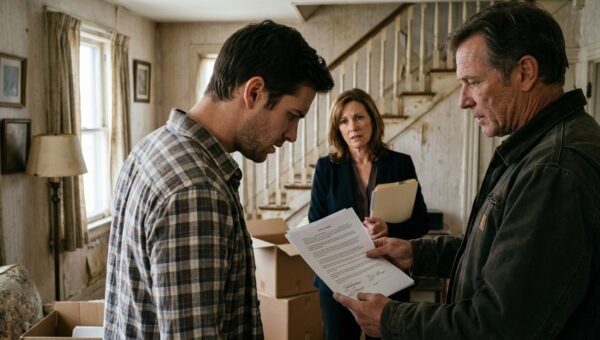
Evelyn downloaded the scanned signature page from the county deed registry, enlarged the file, and printed out the bottom sheet. She pushed the warm paper across the wooden desk.
Near the bottom line sat Mark’s bold, familiar signature. Right beside it, on the line marked Co-Borrower, was my full legal name written in stiff, shaky cursive that slanted to the left instead of the right. My signature on the HELOC application was forged.
PART 2
Evelyn kept her pen flat on the desk and looked directly at me.
“A forged signature on a federally insured home equity loan is not just grounds for divorce,” she said. “It is bank fraud. The state and federal charges alone carry up to thirty years in prison and substantial fines. If you confront him in your kitchen tonight, he might transfer title, move assets, or draw the remaining credit limit.”
“What do I do right now?” I asked.
“You go home and act like nothing happened,” Evelyn replied. “Let me request the original loan packet, the notary log, and the wire transfers directly from First Valley Bank. I will prepare an emergency motion for a financial restraining order to freeze that equity line before he touches another dollar. Do not give him a hint.”
Walking back into our home on Maple Drive that afternoon felt like stepping into an unfamiliar building. Mark’s boots were sitting on the boot tray by the door. His reading glasses were on the end table beside the sofa. For thirty years, I had trusted him with every tax return, every utility bill, and every maintenance check, believing we were building a safe, quiet retirement together. Instead, he had tied a $170,000 rope around our roof to buy another woman a home fourteen miles away.
That evening, Mark came home from his hardware run. He laid a package of thick-cut bacon and two loaves of bread on the counter, then complained about the price of butter.
“Everything is getting ridiculous,” he grumbled, taking off his jacket. “You have to watch every nickel these days or the banks bleed you dry.”
I washed the lettuce for our dinner salad and did not turn around. “You’re right, Mark,” I said. “Every nickel counts.”
Later that night, after he fell asleep and his heavy breathing filled our bedroom, I went downstairs in my socks to the small oak desk in the den. Mark had always kept the household tax folders locked in the lower metal drawer. I found his spare key ring inside his tackle box in the garage, unlocked the drawer, and pulled out the 2023 and 2024 folders.
Tucked behind our old property tax receipts was an account statement from First Valley Bank sent to a post office box in town that I had never heard of. The monthly interest payment on the equity line was $985. He had been paying it out of a private commercial checking account fed by rent checks collected from the other half of the Crane Avenue duplex.
The woman in the plum bathrobe lived on the left side rent-free. The tenant on the right side was paying $1,050 a month, which Mark used to cover the interest on the stolen loan so our main checking account would never show a trace of it.
He had built an entire self-contained ecosystem of deceit, funded entirely by our home.
By Wednesday morning, Evelyn called me back into her office. She had the complete closing package from the title company. The closing had taken place at a drive-through mobile notary service eighteen months prior. The notary had documented a driver’s license number for me that was completely fabricated, missing two digits.
“The emergency freeze on the equity line was granted two hours ago,” Evelyn told me, sliding three sealed manila folders into her briefcase. “The process server is waiting at his favorite diner near the county maintenance yard right now. But we need to serve him with the full petition for legal separation, the asset freeze, and the criminal referral notice.”
“No,” I said, my voice steady. “I want to be the one who hands it to him.”
PART 3
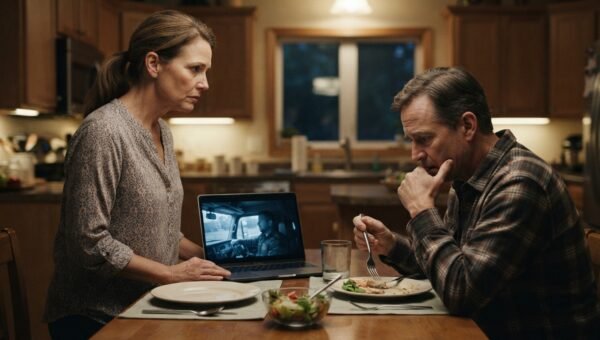
I sat at our round oak kitchen table at 4:30 PM on Thursday. The afternoon sun came through the window, hitting the salt and pepper shakers we had received as a wedding gift twenty-eight years ago.
Mark walked through the door whistling, his keys jingling in his fingers. He dropped his jacket onto the back of a chair and opened the refrigerator door.
“You want chicken or pork chops tonight, Clara?” he asked, grabbing a pitcher of iced tea.
“Sit down, Mark,” I said.
He turned around, holding the glass pitcher, and laughed a little. “What’s going on? You look like someone died.”
I placed the first item in the center of the table: the brass Kwikset key.
Mark stopped mid-step. His eyes dropped to the shiny piece of metal, and the casual smile slid right off his mouth. He set the tea pitcher down on the counter with a soft thud.
“What is that?” he asked.
“Fifteen dollars at Pete Miller’s shop,” I said. “He told me it was for a residential deadbolt. Saturday morning, I followed you to Crane Avenue. Fourteen miles. You used this key to open the door of unit A.”
Mark swallowed hard, his throat bobbing. He pulled out a kitchen chair and sat down heavily, leaning his elbows on the wood.
“Clara, listen to me,” he started, his voice dropping into that soothing, reasonable tone he always used when a contractor made a mistake on a county road job. “It’s not what you think. It’s an investment property. A business deal. I was going to tell you once the cash flow stabilized. The woman you saw is Brenda. She manages the units for me. She was just handing me the utility ledger.”
I did not raise my voice. I took out the manila envelope and laid down the eleven photographs, fanning them across the table like a deck of cards.
There was the photo of his hand rested familiarly on her waist. There was the photo of her kissing his cheek on the front porch mat while he held her coffee mug. There was the photo of him reaching up to adjust the collar of her bathrobe.
Mark looked down at the photos. The blood drained from his face, leaving his skin gray and dull. He opened his mouth, but no sound came out.
“Now let’s talk about the business deal, Mark,” I said.
I laid the county deed on top of the photographs.
“Purchased in October 2023. One hundred and sixty-seven thousand dollars. Paid in full with cash drawn from our home equity line at First Valley Bank.”
“Clara, the equity was just sitting there doing nothing,” he stammered, his hands beginning to tremble on the tabletop. “Our house was completely paid off. The interest rate was low. I bought that duplex below market value. It’s an asset for our retirement. For both of us.”
“Then why isn’t my name on the deed?” I asked.
He looked away, staring toward the dark oven window. “The lender said it was cleaner to run it under one name because of my pension documentation.”
“That’s funny,” I said, placing the final document directly in front of him. “Because my name is on the mortgage note. Right here.”
I tapped the paper with my index finger.
“Look at that signature, Mark. Look at it. You forged my name on a federal loan application for $170,000. You risked the roof over my head, the house my father helped us build, so you could set Brenda up in a duplex fourteen miles from here.”
“I was going to pay it back,” he whispered, his head sinking into his hands. “The rental income from unit B covers the interest. I swear to you, Clara, you were never going to lose this house. I had it under control.”
“You don’t have anything under control,” I said. “The equity line is frozen. Evelyn Vance filed the injunction at noon. And tomorrow morning at nine, this forged loan application goes to the fraud division at First Valley Bank and the county prosecutor’s office.”
Mark lunged forward across the table, his face twisted in genuine panic. “Clara, please! Do you know what they do to bank fraud? I could lose my pension! I could go to prison! We’ve been married twenty-eight years! You can’t put your own husband in jail over a bank loan!”
“You stopped being my husband the day you signed my name to steal our house,” I said.
ENDING
We did not scream that night. Mark spent four hours begging, crying, and offering to transfer the duplex deed entirely into my name if I promised not to send the paperwork to the bank’s fraud investigators.
I did not make any deals at the kitchen table. I let Evelyn handle every single exchange through formal legal channels.
When First Valley Bank received the formal affidavit of forgery backed by the notary’s flawed records, they immediately called the entire $170,000 note due. Under the threat of immediate criminal indictment, Mark agreed to an emergency partition sale of the Crane Avenue property.
The duplex sold six months later for $178,000. Every single penny from the closing went directly to pay off the forged home equity line, the accumulated interest, and the legal fees Mark had incurred. What little remained of his equity was forfeited to me in the property settlement to compensate for the damage done to my credit file.
Brenda had to vacate unit A by court order. It turned out Mark had promised her the duplex would be entirely paid off within five years, telling her he was an independent real estate investor whose previous wife had passed away long ago. She had believed his stories just as easily as I had believed his Saturday gym routines.
Mark moved into a small one-bedroom basement apartment on the north side of town, living on what remained of his pension after our court-ordered division of assets. He avoided criminal prison only because the bank was repaid in full through the forced property sale, though the county prosecutor placed him on three years of supervised administrative probation.
I kept our brick ranch on Maple Drive.
Last Saturday morning, I woke up at 6:00 AM. The house was quiet, filled with the clean smell of fresh coffee brewing on the kitchen counter. I walked out to the front porch with my mug and watched the morning light filter through the leaves of the old walnut tree.
On the small table beside my front door sat my key ring. The extra brass key was gone, locked in Evelyn’s storage vault with the final divorce decree.
I locked the deadbolt behind me when I went out for my morning walk. It was our original lock, the one that had kept me safe for three decades, and every single key that opened it belonged to me alone.