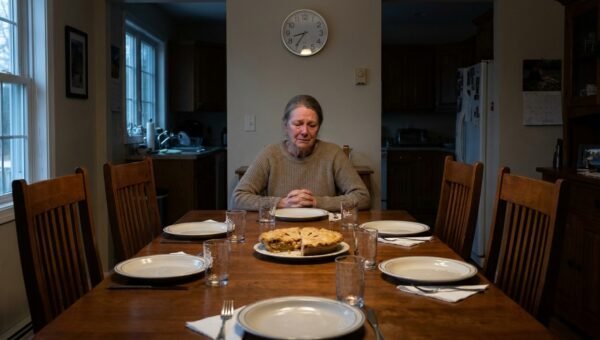
PART 1
My mother moved across the country to live near my brother after Dad died. I supported her decision, though I missed our Sunday lunches. When she came back for a visit, she seemed quieter and kept asking whether I had kept her old sewing machine. I said it was in the basement. She asked me to check the drawer beneath the bobbins. I found a stack of unopened letters addressed to my brother, all dated after she moved away.
She said she had written them but never sent them. I asked why.
She held one and said, “Someone I trusted told me you were the reason I left.” She sent garden photos every Sunday, so I thought she was adjusting better than I. Then she reached for the phone, and I realized she meant to call that person.
I froze with the old steel-hinged sewing box in my lap, dust motes floating in the afternoon shaft of light cutting through my basement window. My mother stood at the bottom of the wooden stairs, her knuckles white against the strap of her leather handbag. She was seventy-four, small-boned and usually unflappable, but her hands were trembling in a way I had never seen.
“Who told you that, Mom?” I asked, keeping my voice low so my husband, Mark, wouldn’t hear from upstairs.
She didn’t answer right away. She walked over to the old workbench, her sensible loafers clicking on the concrete floor, and picked up a faded receipt from a hardware store. “Greg said you were the one who pushed me out.
He said you told the family you couldn’t handle having me nearby after your father passed, that you needed breathing room.”
The words hit me like cold water. Greg is my older brother, the golden child who had inherited our father’s easy charm and none of his work ethic. When Dad died two years ago, Mom had been adrift in the house they shared for forty-eight years. Greg had swept in during the funeral reception, poured himself a glass of iced tea, and announced he had a spare bedroom and a community with active senior programs waiting in North Carolina. I had thought it was generous. I had helped them pack her china barrels and loaded her cedar chest into the back of Greg’s rented van, crying as they drove away because I trusted him to take care of her.
“I never said that,” I told her, my chest tightening. “Mom, you know I wanted you to stay here.
We talked about you moving into the apartment over the garage on my street.”
“Greg said you offered that just to look good in front of Aunt Clara,” she whispered, looking down at the workbench. “He said you told him privately that you didn’t want the daily burden.”
I set the sewing box down and stood up, brushing dust from my jeans. The entire narrative of the past two years began to tilt on its axis. Every Sunday, Mom had texted me pictures of her hydrangeas and the local farmers market. She had sounded cheerful on our monthly phone calls, though she always seemed a little rushed, always cutting the conversation short because Greg was taking her somewhere or because she had a bridge game starting. I had blamed the distance. I had blamed the natural adjustment period of losing a spouse of nearly fifty years.
“Mom, look at me,” I said, stepping closer. “Why did you come back to visit alone?
Greg drove you to the airport, but he didn’t come with you. Why?”
She swallowed hard, her gaze dropping to the floor. “Because he told me I wasn’t allowed to leave North Carolina unless I signed over the deed to the Florida property Dad left us. He said you had already signed your half over to him.”
That stopped me cold. Dad had owned a small, paid-for fishing cottage in Florida, meant to be split evenly between Greg and me. I had never signed anything. I hadn’t even seen paperwork regarding the property, let alone discussed giving up my share.
“I never signed anything, Mom,” I said firmly. “Not a single paper.”
She looked up then, her eyes swimming with a terrifying mix of confusion and realization. “He told me you had electronic signatures. He showed me a paper with your name on it.”
We spent the next two hours sitting on the basement steps, going through the rest of the letters in the sewing box. They weren’t just unsent notes to Greg; they were journal entries, draft after draft of frantic questions. She had been trying to figure out why I stopped visiting, why my text messages had seemingly turned cold and transactional, and why I never answered her phone calls during the winter months.
Except I had answered. Or rather, I thought I had. During that first winter after she moved, my phone had acted up repeatedly, dropping calls and failing to deliver messages. I had chalked it up to poor service in our neighborhood, but looking back, the disruptions had always coincided with the weekends Greg visited her or when she mentioned visiting friends.
“He’s been using my phone, hasn’t he?” Mom whispered, the truth finally settling over her like a heavy shroud.
“I think he has,” I said, my blood running cold as I calculated what else Greg might have intercepted.
PART 2
The revelation in the basement changed the atmosphere of our house for the rest of the weekend. My husband, Mark, sat with us at the kitchen table that evening as Mom laid out everything she had managed to bring back with her. She hadn’t just packed her clothes; she had brought a small metal lockbox she kept hidden in the bottom of her suitcase. Inside were bank statements, copies of her retirement account distributions, and a power of attorney document bearing a signature that looked suspiciously like hers, but stiff and hesitant.
“I didn’t sign this,” Mom said, tapping the corner of the power of attorney form. “My arthritis makes my hand shake when I write my full name like that. I always print my middle initial. Look here—there’s no middle initial.”
Mark, who works as a commercial real estate paralegal and knows his way around fraudulent paperwork, put on his reading glasses and examined the document under the bright kitchen light. He didn’t say anything for a long time, just traced the lines of the signature with the blunt end of a pen.
“This is an amateur job,” Mark said quietly, looking up at me and then at Mom. “The notary seal is stamped over the signature line in a way that suggests it was added digitally or pressed after the fact. Helen, did you ever go to a notary public in North Carolina with Greg?”
“Never,” Mom said, shaking her head. “Greg said he had a friend who was a mobile notary come to the house while I was resting from my hip replacement. He told me it was just permission for him to handle my grocery deliveries and medical appointments if I was laid up.”
“Medical appointments and groceries don’t require a general durable power of attorney with real estate transfer riders,” Mark said grimly. “This gives him total control over your accounts, your house here, and your investments.”
The anger that had been simmering in my chest suddenly flared into something sharp and focused. Greg had always been the golden boy, the one Dad bailed out of two failed landscaping businesses and a messy divorce. When Mom and Dad sold their family home to downsize, Dad had insisted on setting up specific protections for Mom’s widow’s pension and the Florida property, specifically because he knew Greg’s financial habits. Dad had trusted me to be the executor of the estate precisely because he knew I wouldn’t let Greg raid the accounts.
“He locked me out of my own life,” Mom said, her voice cracking as a single tear finally escaped down her cheek. “He took my phone for hours at a time, saying he was updating my security settings. He told me my friends back home didn’t call because they were busy with their own families. I sat in that spare bedroom for fourteen months, looking out at a cul-de-sac I didn’t know, believing everyone had forgotten about me.”
“They didn’t forget, Mom,” I said, taking her soft, trembling hand in mine. “And we are going to fix this right now.”
We started gathering evidence. Mark spent Sunday night pulling public records from the county clerk’s website in Florida and North Carolina. What he found confirmed our worst fears. Two weeks after Mom moved north, a quitclaim deed transferring the Florida property entirely to Greg had been filed in Florida, complete with the forged signature. Furthermore, online banking logs retrieved from Mom’s tablet showed three large transfers totaling forty-five thousand dollars moving from her primary savings account into an LLC registered under Greg’s name in Charlotte.
Greg called while we were still looking over the records. Mom’s phone buzzed on the kitchen island, his name flashing across the screen with a cheerful stock photo of a golden retriever he didn’t even own.
“Put him on speaker,” Mark instructed, leaning in close.
I pressed the green button. “Hello, Greg.”
“Hey, sis,” Greg said, his voice instantly dropping into that smooth, practiced cadence he used whenever he wanted something. “Is Mom there? She left her blood pressure medication on the kitchen counter, and she’s been acting a little spacey today. I need to talk to her.”
“She’s right here, Greg,” I said, keeping my tone unnervingly level. “And she doesn’t need her medication. She needs to know why you forged her signature on the Florida deed.”
There was a sharp silence on the other end of the line. You could almost hear the gears turning in his head as he assessed the damage, shifting from brotherly concern to defensive hostility in three seconds flat.
“What are you talking about, Sarah? Have you been poisoning her mind again? Put Mom on the phone right now. You have no business interfering with her care.”
“I am right here, Gregory,” Mom spoke up, her voice suddenly steady and clear as she leaned toward the speaker. “I saw the letters. I saw the bank statements. And I know you lied about what Sarah said.”
Greg didn’t hesitate. The mask slipped completely. “You’re getting old and confused, Mom. If you listen to her, you’re going to end up in a state home. You need me to manage things.”
“Don’t call here again, Greg,” I said, my voice cold. “We have the bank records, we have the fraudulent deed, and we have the local police department’s elder abuse division on speed dial. If you don’t return every cent to her account by Tuesday morning, I’m walking this file directly to the district attorney’s office.”
The line went dead with a harsh click.
PART 3
The following forty-eight hours were a blur of legal consultations, bank fraud reports, and emotional exhaustion. Mark took Monday off work to help Mom file formal affidavits with her bank and the local police precinct where she had lived before moving. Because Greg had used electronic banking and interstate wire transfers, the scope of the fraud immediately caught the attention of regional investigators.
Mom stayed in our guest room, sleeping in the bed that had been made up for her visit. On Monday afternoon, we sat at the kitchen table with a pot of chamomile tea while she talked about the past two years with a clarity that felt like she was waking up from a heavy sedation.
“I knew something was wrong,” she told us, stirring a spoonful of honey into her cup. “Every time I tried to call your cousins or my old neighbors, Greg would tell me their numbers had changed or they had moved away. He made me feel like my mind was failing. After a while, I stopped trusting my own thoughts.”
That was the most insidious part of what Greg had done. It wasn’t just the money, though forty-five thousand dollars was a massive chunk of her retirement security. It was the deliberate dismantling of her confidence, isolating her from everyone who loved her so she would be entirely dependent on him.
“You’re tougher than you think, Mom,” I said, squeezing her shoulder. “Dad knew it, too. That’s why he made sure you had your own legal protections.”
On Tuesday morning, Greg tried a different tactic. He didn’t call; he showed up at our front door.
Mark looked out the living room window and saw Greg’s silver sedan parked illegally in our driveway. Greg strode up the front steps and pounded on the front door hard enough to rattle the glass pane.
I motioned for Mom to stay in the back sitting room, then walked to the door and unlocked it, opening it just enough to use the security chain. Greg stood on the porch, his face flushed red, his tie loosened around his collar.
“Are you out of your mind?” Greg hissed, gripping the edge of the doorframe. “Calling the bank? Filing police reports? Do you have any idea what this does to the family?”
“The only thing being ruined here is your freedom, Greg,” I said, looking him straight in the eye. “The bank investigator called Mark ten minutes ago. The frozen funds have been routed back to Mom’s primary holding account, but the fraud investigation into the wire transfers and the forged deed is still active unless you sign a full relinquishment of power of attorney today.”
Greg stared at me, his expression shifting from anger to genuine panic. He knew as well as I did that financial crimes against elderly family members carried severe prison sentences in our state, especially with clear paper trails and notarized fraud evidence.
“I was just trying to invest her money,” he muttered, dropping his gaze to the welcome mat. “The landscaping business hit a rough patch. I was going to pay it back.”
“You weren’t going to pay back a dime, Greg,” I said quietly. “Now sign the papers Mark left on your car hood, or the detective handling this case will come pick you up at your office.”
He didn’t argue further. He turned around, grabbed the paperwork from his car hood, signed the termination of power of attorney and the quitclaim deed reconveyance against the fender, and threw the pen into the bushes before speeding out of our driveway.
ENDING
Three weeks later, the legal paperwork was fully processed, and Mom’s accounts were restored. Greg was entirely out of the picture, having packed up and moved further south to avoid the fallout from his former business associates and the lingering threat of criminal charges if he ever tried to contact Mom again.
We didn’t move Mom back into her old house immediately. Instead, we helped her settle into the ground-floor garden apartment just three blocks away from my house—the very same apartment she had wanted to look at two years ago before Greg convinced her otherwise.
On a bright Sunday afternoon in October, the sunlight streamed through her new kitchen windows, catching the polished wood of her old sewing machine sitting in the corner. Mom was sitting at her small kitchen table, rolling out pie dough for apple tarts while Mark helped her set up a video call on her tablet so she could chat with her sister in Ohio.
“My phone hasn’t stopped ringing all week,” Mom said, looking up with a bright, genuine smile that reached her eyes. “Mary called from church, and Helen from the quilting circle came by with a casserole yesterday. It turns out nobody forgot about me at all.”
“They never did, Mom,” I said, setting a basket of fresh apples on the counter.
As the screen flickered to life and my aunt’s face appeared on the tablet, laughing and waving from hundreds of miles away, I watched my mother wave back with both hands steady and firm. The house was quiet in the way that real homes are—filled with the sound of family, familiar voices, and the quiet assurance that the truth had finally found its way home.