PART 1
When I was nineteen, working thirty hours a week at a diner while trying to pull off a full schedule at the local community college, things got so tight I could barely afford my textbook access codes. My car was making a grinding noise every time I took a left turn, and my tuition balance for the spring semester was sitting at eight hundred dollars with the drop deadline looming.
My mother had married Arthur ten years earlier, and while they weren’t rolling in luxury, Arthur always seemed to have cash for his woodworking tools, his hunting gear, and the endless bags of fertilizer he bought for his lawn. He sat at the kitchen table nursing a cup of black coffee while I laid out my bills, my hands shaking slightly from fatigue because I had pulled a double shift the day before.
He didn’t even look up from the newspaper when I asked if I could borrow five hundred dollars to keep from getting dropped from my classes. Instead, he folded the sports section, cleared his throat, and told me that my generation just wanted everything handed to us on a silver platter. He said that working thirty hours a week was nothing compared to what he did at my age, and that if I weren’t so lazy and disorganized with my money, I would have plenty saved up for school.
My mother stood by the sink, staring hard into the soapy water, refusing to catch my eye or say a word in my defense. I walked out of that house with my face burning, my pride shredded, and zero help. I managed to scrape the money together by selling my old keyboard and working an extra weekend shift, but I never asked Arthur for another dime, and I barely spoke to him for the next fifteen years.
When Arthur passed away from a sudden stroke last month, the grief in our family was complicated, to say the least. My mother was beside herself, weeping into black dresses and leaning heavily on me to handle the catering and the paperwork, acting as though we had been a tight-knit, loving family all along. I played my part because that is what you do when someone dies, sitting through the endless rows of folding chairs at the funeral home and nodding politely as neighbors praised what a good man Arthur had been.
Two days after the burial, his attorney, a quiet man named Mr. Henderson who had handled our family’s meager wills for decades, asked me to stay behind in his office after my mother went home to rest.
Mr. Henderson slid a heavy, scratched metal toolbox across his polished mahogany desk. It was an old Craftsman box, green paint chipping around the latches, the kind Arthur used to keep his drill bits and rusted fasteners in. Mr. Henderson told me that Arthur had left specific instructions regarding this box, written into an addendum of his will just two weeks before his stroke. My mother hadn’t been told about this addendum, and Mr. Henderson looked slightly uncomfortable as he slid a small brass key across the desk toward me. He told me I should open it alone, in his office, before taking it home. My fingers trembled as I turned the key in the worn lock, lifting the heavy lid to find a neat stack of old spiral-bound notebooks and a sealed manila envelope with my name written across the front in Arthur’s shaky, deliberate block letters.
PART 2
I broke the seal on the manila envelope first, pulling out a letter written on lined yellow legal paper. The ink was faded in spots, but Arthur’s handwriting was unmistakable. He wrote that he had always been a proud, stubborn man who didn’t know how to express affection without sounding like a drill sergeant. He admitted that calling me lazy all those years ago had been one of the biggest regrets of his life, not because I was lazy, but because he was terrified of looking weak in front of my mother. He said that watching me work myself to exhaustion at the diner had actually scared him, making him realize how hard I was fighting for a future while he sat back and judged.
With shaking hands, I set the letter aside and lifted the top spiral-bound notebook. It was an old ledger, the kind with blue and red lines running across yellowed paper. I flipped it open to the middle pages, and my breath caught in my throat. Every single line was filled with meticulous, date-stamped entries in Arthur’s handwriting. There were columns for every tuition payment I had made during my community college years, down to the exact dollar amount and transaction number. Right beside each of my payments was a matching deposit entry, tracking money he had funneled into a separate savings account under his own name, accumulating interest semester after semester.
I had never seen Arthur write more than a grocery list or a quick note about lawnmower oil, yet here was a decade-long accounting of my education, tracked with obsessive precision. He had recorded every book fee, every lab supply charge, and every emergency parking permit I had ever stressed over. The ledger showed that as I transferred to the state university and took out small student loans, he had been matching those loan amounts in his ledger, setting the cash aside month by month. Attached to the back of the ledger was a bank printout showing a balance of nearly twenty-two thousand dollars in an account I had never known existed, designated entirely in the routing notes for my continued education and startup fund.
I sat there in Mr. Henderson’s quiet office, staring at those columns of numbers while the afternoon sun shifted across the carpet. For fifteen years, I had carried a bitter knot of resentment in my chest, convinced that my stepfather was a cold, unfeeling tyrant who watched me struggle without a shred of empathy. Now, I was looking at undeniable proof that he had cared deeply, yet had chosen to suffer under the mask of a hard-nosed taskmaster rather than risk breaking his own stubborn pride or upsetting my mother, who believed in strict, old-fashioned discipline. Mr. Henderson watched me quietly, clearing his throat softly before telling me there was one more item at the bottom of the toolbox.
PART 3
I reached back into the metal box, expecting to find another bank statement or perhaps a copy of the title to the old car I used to drive. Instead, my fingers brushed against a torn edge of paper. I pulled out a loose, ragged sheet from the same yellow legal pad, but it was clear something was wrong. The bottom half of the page had been ripped straight across, leaving jagged fibers and an abruptly cut-off sentence about how the funds were to be formally transferred over to my name upon his passing. The final page, the one that presumably contained the legal instructions or account numbers needed to claim the money, was completely missing from the box.
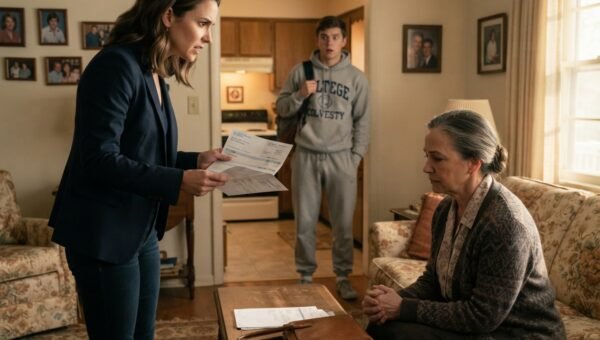
I looked up at Mr. Henderson, holding the torn paper out across the desk. I asked him if there were any other pages or if it had fallen out somewhere in his office. Mr. Henderson took the paper, examined the ragged edge, and his expression hardened into a look of deep concern. He adjusted his glasses and told me that the document was entirely complete when he received the box from Arthur two weeks prior. He explained that my mother had stopped by his office yesterday afternoon, asking to look over Arthur’s final legal files to help settle the estate before the official probate process began. She had spent twenty minutes alone in the conference room with the file folder while Mr. Henderson was out briefly on a client call.
The pieces clicked together with a sickening clarity. My mother, who had spent my entire youth enforcing Arthur’s tough-love rules and nodding along when he called me lazy, had apparently gone through the box before I ever saw it. She must have discovered the ledger, the bank balance, and Arthur’s secret provision leaving twenty-two thousand dollars to me. To her, that money represented her inheritance, her security, and her rightful property as his surviving wife. She had torn out the final page to destroy the transfer instructions, believing she could either keep the account hidden or fold it into the general estate assets where she would control every penny.
Anger flared hot and sharp in my chest, replacing the bittersweet shock I had felt just moments before. I asked Mr. Henderson what legal standing we had, pointing out that the ledger and the matching bank routing numbers were right there in black and white. Mr. Henderson sighed, leaning back in his chair and folding his hands over his stomach. He explained that while the ledger and the letter were powerful moral evidence of Arthur’s intent, the missing signature page and transfer directive complicated things significantly under state probate law. Without that final authorization, my mother—as the primary beneficiary of the general estate—could legally claim that the separate account was marital property, leaving me with a stack of nostalgic notebooks and a bitter fight in probate court.
ENDING
I drove home from the attorney’s office with the heavy metal toolbox rattling on the passenger seat, my mind racing through options I never thought I would have to consider. When I walked into the house, the smell of furniture polish and stale coffee hung in the air, and my mother was sitting at the kitchen table sorting through a stack of condolence cards. She looked up, her eyes still carrying that practiced, fragile sorrow, and asked me how the meeting with Mr. Henderson went. She kept her hands resting casually over a manila folder sitting right in front of her on the table, the exact folder I knew contained the missing piece of my future.
I didn’t yell, and I didn’t let her see the rage burning underneath my skin. Instead, I pulled out the ledger, laid it open right on top of the condolence cards, and asked her if she recognized Arthur’s handwriting. The color drained from her face instantly, her hands trembling as she tried to stammer out an excuse about protecting the estate and making sure things were divided fairly between us. She looked small and cornered, suddenly stripped of the righteous authority she had wielded when Arthur was alive. I told her quietly that she could either sign the transfer papers at Mr. Henderson’s office first thing tomorrow morning, or I would hand the complete ledger, the letter, and my lawyer’s business card to the probate judge by noon. She swallowed hard, stared at the ledger for a long moment, and finally whispered that she would meet me at the office at nine.