PART 1
My brother, Mark, stopped visiting Grandma Evelyn the third week after we moved her into Shady Pines Memory Care. It was the spring of 2021, right when the facility began letting families schedule thirty-minute window visits through the courtyard.
“She doesn’t know who I am anyway, Sarah,” he told me over the phone while he was driving back from his firm. He sounded tired, but mostly he sounded inconvenienced. “It just upsets her, and it ruins my whole Saturday. What is the point of torturing both of us?”
I did not argue with him. Mark was four years older, a junior partner at an estate planning firm in Columbus, and he had always lived his life by balance sheets and convenience. I worked as an intake coordinator at a physical therapy clinic twenty minutes away. Every single Sunday morning for three straight years, I drove out to Shady Pines with a container of fresh lemon cookies from the bakery she used to love. Most days, Grandma Evelyn drifted. She would stare at the courtyard birdfeeder, call me by her sister Clara’s name, or talk about canning green beans in the middle of winter.
Then came last Tuesday morning.
The nursing desk phoned me at work around nine. The head nurse, Donna, said Evelyn was having an unusually lucid window, but she was deeply agitated and refused to take her morning blood pressure medication until she spoke to Sarah.
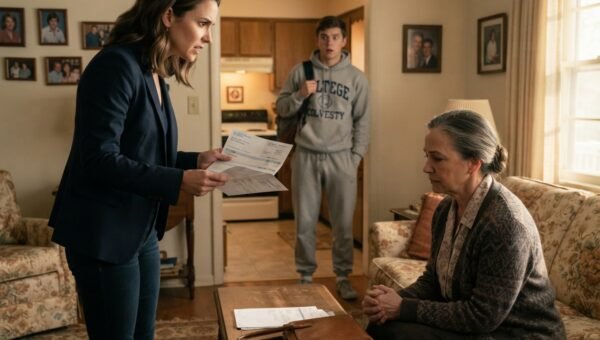
I clocked out early, walked into room 114, and found Grandma sitting upright on the edge of her mattress, her knuckles gripping her floral purse in her lap.
When she looked up, her eyes were completely clear. There was none of that foggy, wandering gaze that had broken my heart for three years. She recognized me instantly.
“Sarah,” she whispered, her voice rough and dry. She reached out and grabbed my wrist with surprising strength. “Listen to me before the cloud rolls back in. The blue coat. The heavy wool one in the hall closet back at the house. Go get it. Before he sells off the rest of the furniture.”
Our parents passed away in a highway accident back in 1996, when I was sixteen and Mark was twenty. Grandma took us in. Now, her small two-story brick home on Elm Street sat mostly empty, listed for sale by Mark, who held her financial power of attorney.
He had already auctioned off the dining set and cleared out the garage to stage the house for buyers.
“Grandma, what’s in the coat?” I asked, sitting beside her on the bed.
She blinked hard, her eyes watering. “Get the blue coat. Do not ask Mark. Go today.”
Ten minutes later, the fog was already drifting back in. She patted my hand, asked if I had finished my high school algebra homework, and laid back against her pillows.
I drove straight from the care home to Elm Street. Mark had given me a spare key months ago so I could water the porch ferns while the house sat on the market. The house felt hollow, smelling like stale dust and lemon-scented cleaning spray. I walked into the dark foyer, stepped around the staged decorative rug, and opened the narrow hall closet under the staircase.
Hanging behind three plastic-wrapped church dresses was Grandma’s heavy navy-blue winter coat.
She had worn that coat to Sunday service every winter for thirty years.
I carried it out into the bright daylight of the kitchen table. I checked the deep front pockets first. Nothing except two crumpled peppermint wrappers and an old pair of brown knit gloves. I checked the inside breast pocket. Empty.
I was about to hang it back up, wondering if Grandma had simply had a vivid hallucination, when my thumb grazed the lower interior hem on the right side. The fabric there felt unusually stiff. There was a hard, rectangular lump trapped between the thick wool exterior and the smooth satin lining.
Someone had hand-stitched the hem shut with crude, uneven black thread that did not match the original factory tailoring.
I ran to the kitchen drawer, found a pair of blunt poultry shears, and carefully snipped four stitches loose. I slid two fingers deep inside the lining.
My fingertips hit metal, then brittle paper.
I pulled it out. It was a tiny brass safe-deposit box key, taped securely to a yellowed grocery receipt from Kroger, dated October 14, 1998. The tape had yellowed and dried, peeling away at the corners.
I flipped the receipt over. In Grandma Evelyn’s distinctive, sharp cursive, written in dark blue ballpoint pen, was my brother’s name and one short sentence:
“He thinks I forgot what he did with your college money.”
My hands started shaking so violently I had to press both palms flat against the kitchen counter.
In the fall of 1998, I had been an eighteen-year-old freshman at Ohio State University. Two months into my first semester, Grandma sat me down at this very kitchen table in tears. She told me that our parents’ modest life insurance policy had run out faster than expected, and the private education fund our father had set aside for my tuition had suffered catastrophic losses in an offshore municipal fund failure. I had dropped out of the dorms, taken a night job filing records at the local hospital, and spent the next seven years scraping together night classes to get my associate degree.
Mark, meanwhile, had finished law school without a single dollar of student debt. He always claimed he won an unpublicized merit grant.
I stared down at the small brass key. Stamped into the metal head was a single four-digit number: 412. And below it, the initials FNB. First National Bank, the old branch three blocks down from the town square, which had merged into Huntington Bank fifteen years ago.
I did not call Mark. I walked back out to my car, sat in the front seat with the key clutched in my fist, and drove straight toward downtown.
PART 2
The downtown branch still occupied the original limestone building on Broad Street. When I walked through the heavy glass doors, the smell of polished mahogany and old security carpets brought back childhood memories of holding Grandma’s hand while she cashed her pension checks.
I sat across from an assistant manager named Mrs. Miller. I explained that my grandmother, Evelyn Vance, was in memory care, and showed her my driver’s license along with the small brass key stamped 412.
“I’m sorry, Ms. Vance,” Mrs. Miller said gently after checking her system. “The safe-deposit box lease was officially transferred to your brother, Mark Vance, three years ago when he took over power of attorney. Only authorized signers can access the vault. You aren’t on the signature card.”
My stomach dropped into my shoes. “Did he close the box?”
“No,” she replied, glancing at her screen. “The annual fee of seventy-five dollars is automatically debited from her remaining trust account every January. But box 412 hasn’t had an entry logged since November 2004.”
Mark hadn’t opened it in twenty years. He probably didn’t even know the physical key existed. When he took over Grandma’s paperwork, he must have simply assumed the bank would bill the account for an old safety box he hadn’t bothered to drill open.
I walked out of the bank with my heart pounding against my ribs. Grandma had given me the key, but legally, I was locked out. The only person with the legal authority to sign me into that vault was Mark, or Grandma herself during a rare moment of certified competency.
I went back to Shady Pines that evening. The head nurse, Donna, met me outside room 114 with a sympathetic frown. “She’s sleeping heavily, Sarah. Her blood pressure dipped this afternoon, and she’s been confused since lunch. She thought the television was a window.”
I stood in the doorway, watching Grandma’s chest rise and fall under the thin floral blanket. If I waited for another lucid day, it might take weeks, or it might never happen again. Meanwhile, Mark was closing on the sale of her house at the end of the month. If the buyers took possession, anything left in the house or attached to her estate would be scattered.
I had to confront Mark. But I couldn’t just throw an old grocery receipt in his face; he was a lawyer. He would shrug, tell me Grandma had been losing her mind even back in 1998, and immediately go down to the bank to empty box 412 himself.
I needed to know what happened in the fall of 1998 before I showed my hand.
I spent the next three hours in the public basement archives of the county recorder’s office. If my parents’ estate had been closed or amended, or if my father’s education trust had been dissolved, there would be a public probate filing.
The clerk brought up the microfiche roll for the estate of David and Mary Vance, 1996 through 1999.
I sat in front of the illuminated screen, cranking the plastic dial until the docket numbers lined up. There it was. My father had established a testamentary trust upon his death: forty-eight thousand dollars designated specifically for my undergraduate education, held in custodial care until my eighteenth birthday in August 1998.
On September 3, 1998, three weeks after I turned eighteen, a petition had been filed in Franklin County Probate Court to liquidate the trust due to “unforeseen insolvency and emergency maintenance of primary family assets.”
Attached to the petition was a signature page.
My name was at the bottom, waiving all rights to the trust funds and authorizing their transfer directly into an account controlled by the co-executor.
Beside my name was a notary stamp from a local car dealership where Mark had worked part-time during his senior year of college.
I stared at the black-and-white scan of my own signature. It was an unmistakable forgery. The loops of the ‘S’ were stiff and deliberate, completely unlike the loose, rounded handwriting I had used at eighteen.
The money hadn’t been lost in a bad municipal investment. It had been drained by someone who forged my name on a court waiver three weeks after I became an adult. And according to the distribution receipt, the entire forty-eight thousand dollars had been transferred directly into a private commercial checking account under the name Vance & Associates Logistics.
Vance & Associates wasn’t an investment fund. It was the failed freight brokerage Mark had tried to launch with his college fraternity brother in the summer of 1998, the one that collapsed within six months.
My brother hadn’t won a merit scholarship for law school. He had gambled my entire future on an ill-fated startup, lost the capital, and allowed Grandma to carry the guilt of telling me the money was simply gone.
I sat in the dark records room, staring at the screen until my eyes burned. The date on the back of the receipt, October 14, 1998, was exactly six weeks after the forged waiver had been filed. Grandma had figured out the truth back then. But instead of tearing the family apart, she had hidden the key in her coat lining.
I took out my phone and took clear, high-resolution photos of every single probate document, the fake signature, and the account transfer numbers.
Then I drove to Mark’s suburban house in Upper Arlington.
PART 3
Mark’s silver Lexus was parked in the circular driveway. When he opened the heavy front door, he was holding a glass of bourbon, wearing sweatpants and an expensive fleece pullover.
“Sarah? What’s going on? It’s nine o’clock,” he said, stepping aside with a puzzled look.
I didn’t step past the foyer. I reached into my coat pocket, pulled out the brass key and the brittle 1998 Kroger receipt, and laid them flat on his glass entryway table.
“I found Grandma’s coat,” I said evenly.
Mark glanced down at the yellow paper. His expression didn’t change at first, but then his eyes caught the faded ballpoint cursive. A small, tight muscle in his jaw twitched.
“Sarah, she has vascular dementia,” he said, his voice dropping into his practiced, calm courtroom tone. “She’s been writing nonsensical notes on scrap paper for a decade. You know that. Why are you dragging this up?”
“Box 412 at Huntington Bank downtown,” I said. “You haven’t checked on it in twenty years, Mark, but you’ve been letting her trust pay the box rental fee every January. What’s in it?”
“I don’t have the slightest idea,” he snapped, taking a sip of his bourbon. “Probably costume jewelry or expired war bonds. What is this really about? Are you upset about the house sale? We agreed the proceeds go straight into her care fund. Memory care is seven thousand dollars a month. Every dime from the house is earmarked for her monthly burn rate.”
“I went to the county recorder’s office an hour ago,” I said.
The glass in his hand stopped halfway to his mouth.
“I pulled the 1998 probate records, Mark. The waiver on Dad’s trust fund. The forged signature notarized at the car lot where you worked. The forty-eight thousand dollars wired to Vance & Associates Logistics.”
The silence in his foyer was suffocating. The only sound was the low hum of his refrigerator from the kitchen.
For ten long seconds, Mark didn’t blink. The polished, unbothered posture slowly cracked. He set his glass down on the table, right next to Grandma’s note.
“You don’t know what it was like,” he said, his voice dropping into a harsh whisper. “Mom and Dad were dead. We had no safety net. I tried to build a business so we would have real money. The freight market crashed in August. If I didn’t cover the margin calls, the partners were going to sue our estate into oblivion. We would have lost the house on Elm Street before you even finished high school.”
“You forged my name, Mark! You stole my tuition and told me Dad made bad investments!”
“I paid my own way through law school with night shifts and private bank loans!” he shouted, stepping closer. “Grandma found out when the bank sent the transfer notice to the house. She was furious. She threatened to go to the police. I begged her not to. I told her it would ruin my legal career before I even took the bar exam. She agreed to keep it between us to protect the family name, but she made me sign a promissory note for every single penny.”
I froze. “A promissory note?”
“Yes,” Mark breathed, rubbing his forehead with both hands. “She made me write out an unconditional repayment agreement, witnessed by her church pastor, promising to pay back the forty-eight thousand dollars plus six percent annual interest directly to you upon her death or whenever you demanded it. She told me she was locking it in her safe-deposit box. She said if I ever mistreated you or failed to take care of her, she would hand you the key.”
He looked at the tiny brass key on the table, his skin pale under the foyer chandelier.
“That’s why you stopped visiting her,” I realized out loud, the truth hitting me like ice water. “It wasn’t because she forgot who you were. It was because you were terrified she would remember.”
He didn’t deny it. He just stood there, looking down at his socks. “I thought when she got sick… I thought she’d forgotten where she hid the key. I searched the Elm Street house twice after we moved her out. I couldn’t find it.”
“Tomorrow morning at nine o’clock,” I said, my voice shaking with cold fury, “you are meeting me at the bank. You are signing me into that vault. If that promissory note is in box 412, we are settling this. And if you refuse, I am walking straight from the bank to the Franklin County Bar Association with the probate records and your forged notary stamp.”
Mark looked at me for a long moment, then slowly nodded his head. “I’ll be there at nine.”
ENDING
At nine-fifteen Wednesday morning, the bank vault attendant unlocked the heavy steel gate and used her master key alongside Mark’s authorization to slide metal box 412 from the wall. She carried it into a private consultation room, placed it on the oak table, and shut the door behind her.
Mark sat with his arms crossed, staring out the narrow frosted window. He looked as if he hadn’t slept a minute.
I lifted the lid of the long metal container.
Inside was a thin stack of papers, held together by a rusty binder clip. On top was the document Mark had described: a handwritten, notarized promissory note dated October 20, 1998, signed by Mark and co-signed by Pastor James Miller of First Baptist Church. It acknowledged an unauthorized withdrawal of forty-eight thousand dollars from my father’s testamentary trust, pledging full restitution to Sarah Vance with accrued interest.
Over twenty-six years, at six percent simple interest, that debt had grown to over one hundred and twenty thousand dollars.
I reached for the note, but as I lifted it, my fingers brushed against a thicker manila envelope resting underneath it. Across the front, in Grandma’s clear, older handwriting from the late 2000s, was my name: *For Sarah, when you need it.*
I opened the clasp and pulled out the contents.
It was not a debt record. It was an active, paid-up whole life insurance policy purchased through Northwestern Mutual in March 2001. Attached to the policy schedule was a typed summary of account statements, dated just four months before Grandma moved into memory care.
Grandma had never relied on Mark’s promise.
She knew my brother better than either of us realized. In the spring of 2001, after Mark graduated law school and immediately bought himself a brand-new sports car without offering a single dime to help pay my student loans, Grandma had taken a part-time job bookkeeping for a local lumberyard. For twelve years, working three afternoons a week on bad knees, she had funneled every single paycheck into a single-premium variable life contract, naming me as the sole, irrevocable beneficiary.
Tucked inside the policy folder was a short note on a piece of church stationery:
*Sarah, my sweet girl. Mark thinks a piece of paper makes a man honorable. It does not. I knew he would never pay you back unless a judge held a gavel over his head, and I refused to leave this world leaving your life in his hands. What he took from you, I have restored with my own two hands. Do not carry bitterness against him. Bitterness is an unpaid rent that ruins the house it lives in. Live your life, finish what you started, and remember how fiercely you were loved.*
The guaranteed cash death benefit of the policy was one hundred and seventy-five thousand dollars, completely protected from Medicaid clawbacks, separate from her estate, and untouched by Mark’s power of attorney.
I looked up across the table. Mark was staring at the paper in my hands, his eyes wide and uncertain.
“Is the note in there?” he asked quietly.
I laid the promissory note on the table between us. Then I slid it across the wood, right in front of his hands.
“Grandma protected me from you twenty-five years ago, Mark,” I told him, keeping my voice perfectly calm. “She didn’t need your money. She worked until she was seventy-four so she could replace what you stole herself.”
He reached out, his fingers trembling as he picked up the yellowing sheet of paper he had signed when he was twenty-two. “Sarah, I… I can get a second mortgage on the house. I can pay you the principal.”
“I don’t want a dime of your money,” I said, standing up and sliding Grandma’s insurance policy into my leather bag. “The house on Elm Street closes next week. You are going to sign over the power of attorney for her medical and daily care to me. You will continue to manage the sale proceeds to ensure every single penny goes directly into the Shady Pines trust account for her nursing staff and her medications. If you skip a single payment, or if you ever try to shortchange her care to preserve an inheritance for yourself, I will take that forged probate document straight to the disciplinary board.”
Mark swallowed hard, his face pale, and slowly bowed his head. “I will sign the transfer today.”
I left him sitting in the private bank room with his old promissory note.
An hour later, I was back in room 114 at Shady Pines.
Grandma Evelyn was awake, sitting in her armchair by the window, watching a pair of cardinals splash in the stone birdbath outside. When I sat down in the visitor’s chair beside her, she turned her head. Her eyes were clouded again, soft and distant.
“Hello, Clara,” she said softly, reaching out to pat my knee. “Did you bring the lemon cookies?”
“I did, Grandma,” I said, opening the bakery box and handing her a cookie.
I took her frail, wrinkled hand in mine and held it tight. She didn’t know who I was anymore, but for the first time in twenty-six years, I knew exactly who she had always been.