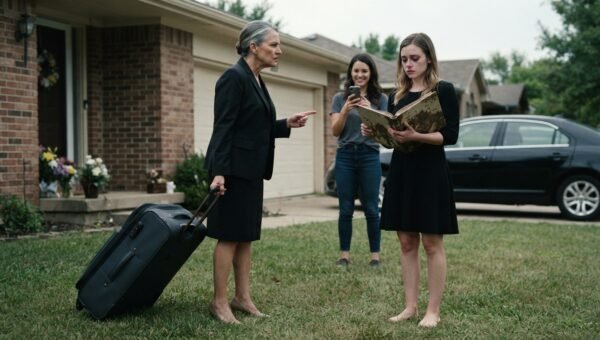
PART 1
I never thought I would look at my husband across the kitchen table and feel like I was sharing space with a total stranger. Mark and I had been married for fourteen years. We built a life in a quiet suburb of Ohio, raised our daughter Lily, and settled into a rhythm that felt steady and predictable. At least, I thought it was steady.
Everything shifted on a Tuesday evening in late September. Lily was sitting at the kitchen island doing her third-grade spelling homework while I chopped vegetables for dinner.
Mark was still at his office downtown, finishing up an audit report.
Lily dropped her pencil, letting out a heavy sigh that made me smile.
“Mom,” she said, her voice dropping into that small, serious tone she used when she was trying to puzzle something out. “Can I ask you a weird question?”
“Of course, sweetie,” I said, keeping my eyes on the cutting board. “What’s on your mind?”
“Who is Aunt Lena?”
I paused, the knife hovering over a carrot. I turned to look at her, wiping my hands on a dish towel. “Aunt Lena? Honey, we don’t have an Aunt Lena. My sister is Sarah, and your dad’s only sibling is his brother Dave. Why do you ask?”
Lily frowned, swinging her legs against the stool. “Well, Daddy calls her every night. After you go to sleep.”
A cold prickle of unease started at the base of my neck.
I forced a light laugh, trying to keep my voice steady. “You must have heard him talking to Grandma or one of his clients on a late conference call, Lily. Or maybe he was talking to Uncle Dave and you misheard the name.”
“No,” she insisted, shaking her head firmly. “It’s not Uncle Dave. And it’s not Grandma. He whispers so you won’t wake up, but I leave my door cracked because I don’t like the dark. I hear him in the hallway by the stairs. He always calls her Lena.”
My chest tightened. I walked over to the island and pulled out the stool next to hers, sitting down so I was at eye level with her. “What does he say when he talks to her, Lily? Do you remember any of the words?”
She bit her lower lip, thinking hard. “He sounds stressed, Mom. One night last week, I heard him say, ‘The papers are ready.
She still thinks the accident was random.’ Then he told her not to worry, that nobody would ever look back that far.”
The kitchen seemed to tilt. The words hit me like physical blows, knocking the air straight out of my lungs.
The accident.
Fifteen years ago, before I met Mark, my parents died in a horrific car crash on a dark country road outside of Canton. The police report said black ice caused my father to lose control, sending their sedan plunging into a freezing creek. They were gone instantly. I inherited their modest home, the insurance payout, and a grief that took a decade to soften into a dull ache. I had never questioned it. It was a tragic, senseless act of weather and bad luck.
Why would Mark be talking about that accident? Why would he be telling a mysterious woman named Lena that I still thought it was random?
My hands were shaking as I stood up. I managed to finish making dinner on autopilot, my mind racing through impossible scenarios. When Mark came home at seven-thirty, smelling of cold autumn air and coffee, I felt physically sick looking at him. He kissed the top of Lily’s head, asked her how spelling went, and then leaned down to give me a kiss on the cheek.
“Rough day at the office, honey,” he murmured, unbuttoning his suit jacket. “The state audit is a nightmare.”
I watched his face, searching for a twitch, a flicker of guilt, anything. His expression was completely open, tired, and entirely normal.
Later that night, after Lily was fast asleep in her room, Mark sat on the edge of the bed scrolling through his laptop. I lay awake staring at the ceiling, my heart hammering against my ribs. Finally, I turned to him.
“Mark,” I said, my voice barely above a whisper. “Lily told me something strange today.”
He didn’t look up from his screen right away. “Yeah? What did she say?”
“She said she heard you on the phone late at night. Whispering in the hallway.”
Mark paused, his thumb freezing on the trackpad. He slowly turned his head to look at me, a slight, weary smile touching his lips. “In the hallway? Must have been a late call with the regional director on the East Coast. You know how these corporate transitions go. Did she say what I was talking about?”
“She said you were talking to someone named Lena,” I said, watching his eyes very carefully. “She said you told her the papers were ready, and that ‘she still thinks the accident was random.'”
The color drained from Mark’s face so fast it was alarming. The relaxed, tired husband vanished in a fraction of a second, replaced by a wall of absolute, guarded tension. But just as quickly as the panic flashed in his eyes, he reined it in. He closed his laptop with a soft snap and set it on the nightstand.
“Lena?” He let out a dry, disbelieving laugh. “Honey, Lily has an incredible imagination. She watches those mystery shows over at her friend’s house. I don’t know any Lena. Look, do you think I’m hiding something?”
Before I could answer, he reached over, picked up his smartphone from the nightstand, and unlocked it with his thumb. He held it out directly toward me, screen facing up.
“Here,” he said firmly. “Look through it. Check my call logs, my text messages, my emails, my deleted folder. Go ahead. Search for ‘Lena’ or anything else. If you find a single thing, I’ll pack my bags tonight.”
I took the phone with trembling fingers. I spent the next twenty minutes scrolling through every menu, every log, and every application. I checked recent calls, blocked numbers, WhatsApp, Signal, and even his email archive.
It was completely clean.
There was no record of any late-night calls to anyone named Lena. No suspicious text threads. Nothing. Just standard work correspondence, text chains with his brother Dave, and grocery lists we had shared.
Mark sat quietly, watching me with a sad, patient expression that made me feel like I was losing my mind. “See?” he said softly when I handed the phone back. “I love you, and I would never lie to you. Lily probably woke up from a dream, or overheard me talking to a client about an estate audit document. You know how kids piece things together out of context.”
I wanted to believe him. God, I wanted to believe him so badly. I was tired, grieving parents from a lifetime ago, and raising a child. Maybe I was cracking under stress. Maybe Lily *did* misunderstand a work call.
We went to sleep, but I didn’t rest. The next morning, Mark left for work at seven as usual. After dropping Lily off at school, I came back to our quiet house to get ready for my part-time job at the local library. Before leaving, I walked into our home office to drop off some mail.
That was when I noticed the landline phone sitting on the wooden desk.
We hardly ever used the landline. Most of our friends and family called our cells. But we kept a basic copper-line package bundled with our home internet because the cellular reception in our rural subdivision was notoriously spotty during storms.
I walked over, picked up the receiver, and pressed the review button to check the caller ID history and recent outgoing calls.
My blood ran instantly cold.
The screen didn’t show cellular numbers. It showed a log of outgoing local calls made between 11:30 PM and 2:00 AM over the past two weeks. Every single night, without fail, a call had been placed to the exact same local number.
I pulled out my own cell phone and snapped a clear photo of the screen. Then, using my search app, I punched the ten-digit number into a public records lookup.
The address attached to the number wasn’t a business in downtown Columbus. It wasn’t a corporate office or a coworker’s apartment.
It was registered to a small, isolated farm property located about twenty miles outside of town, sitting on the edge of the county line. A farm owned by a woman named Clara Vance.
Clara Vance. The name echoed in the dark chambers of my memory. She was my childhood neighbor from the old rural road where I grew up, living just two properties down from the winding creek where my parents’ car went off the edge.
PART 2
The drive out to the county line took thirty-four minutes. The morning sky was a heavy, bruised gray, threatening an autumn storm that matched the churning chaos in my stomach. With every mile marker I passed, the modern suburban landscape fell away, replaced by flat cornfields that had long since been harvested and lonely stretches of asphalt cutting through dying timber.
My hands gripped the steering wheel so tightly my knuckles were stark white. I kept replaying Mark’s clean phone screen in my head. He had handed me his smartphone, completely confident, because he knew I would only check the device he carried in his pocket. He had never used his cell phone to make those calls. He had used the landline, tucked away in the quiet office at the end of our hallway, assuming I would never think to check an analog billing record from a service we barely touched.
When I turned onto Old Mill Road, the memories hit me with physical force. This was the exact road where my parents had died fifteen years ago. The municipal authorities had closed the case within a week. A patch of black ice on a sharp curve, no skid marks, no witnesses, a tragic accident. I had inherited their modest farmhouse further down the road, sold it to pay off medical debts, and moved into the city where Mark and I eventually met.
I slowed my car down as I approached the property matching the phone record.
It was an old, weathered farmhouse with peeling white paint and a sagging front porch wrapped in overgrown wild ivy. A rusted chain-link fence surrounded a patchy front yard where a dead oak tree stood like a skeletal sentinel. A battered blue pickup truck sat in the gravel driveway.
I pulled my sedan off to the side of the road, killing the engine. For a long moment, I just sat there staring at the house. My heart was pounding so hard I could hear it in my ears. Every instinct screamed at me to turn around, go back to the city, pretend I had never seen the phone bill, and live in the comfortable ignorance I had enjoyed twenty-four hours ago.
Instead, I opened the car door and stepped out into the crisp, biting wind.
The gravel crunched loudly under my boots as I walked up the long path toward the front porch. Each step felt heavy, as if I were wading through deep water. I climbed the three wooden steps, which groaned in protest under my weight, and walked up to the heavy oak front door.
I didn’t knock. Before I could even raise my fist to strike the wood, the door clicked and slowly swung open on its own hinges.
The hallway inside was dim, smelling faintly of old cedar, damp earth, and woodsmoke.
“Hello?” I called out, my voice sounding thin and fragile in the cavernous space. “Is anyone here?”
Silence answered me. A cold draft swept through the open door, making me shiver. I stepped across the threshold, closing the door softly behind me. As my eyes adjusted to the dim light filtering through dirty windows, I noticed something hanging from a brass coat hook near the entrance.
It was a bright yellow raincoat.
Not just any yellow raincoat. It was a vintage, heavy-duty vinyl slicker with a distinct brass toggle on the hood—the exact coat I had worn every single day of my senior year in high school. I had left it in the front closet of my parents’ house the night of the accident. After they died, when I packed up what little was left, that coat had vanished from the hall tree. I had assumed it was lost or thrown away in the chaos of the estate clearing.
My breath caught in my throat. I reached out and touched the sleeve. The fabric was cold, but it was real.
“You always did have a bad habit of snooping where you didn’t belong, Clara.”
The voice came from the shadowy doorway leading into the kitchen at the end of the hall.
I spun around so fast I nearly lost my balance. Standing in the doorway was an elderly woman leaning heavily on a wooden cane. Her silver hair was pulled back into a tight bun, and her face was lined with deep wrinkles. But it was her eyes—pale, sharp, and unsettlingly familiar—that made my breath lock in my chest.
It was Clara Vance. But she wasn’t alone.
Stepping out from the shadows right behind her was another woman. She was younger, perhaps in her late forties, wearing a simple gray cardigan and dark trousers. As she stepped into the weak light of the hallway, the blood completely drained from my face.
She looked identical to the framed photograph of my mother that sat on my bedside table back home. Same high cheekbones, same sharp jawline, same exact piercing green eyes.
The woman stepped closer, tilting her head as she looked at me with an expression of cold, detached curiosity.
“Lena isn’t a person,” the woman said, her voice carrying the exact cadence, the exact melodic lilt that I had mourned at a cemetery for fifteen years. “It’s the name your husband gave the evidence he hid for me.”
PART 3
The room seemed to spin violently. I stumbled backward, my spine hitting the wallpapered wall of the hallway for support.
“No,” I whispered, shaking my head violently. “No. That’s impossible. My mother died in that crash. I went to the funeral. I buried her!”
The woman who looked so much like my mother let out a dry, humorless chuckle. She walked closer, stopping a few feet away from me. Up close, the resemblance was terrifying, though her face showed the subtle signs of aging that my mother had been denied.
“You buried a sealed casket, sweetheart,” she said softly. “The authorities never recovered bodies that could be visually identified. The car burned after it hit the embankment. Dental records were matched to teeth pulled from a local clinic and planted in the wreckage. It was very thorough.”
Clara Vance moved forward, leaning on her cane, and gestured toward the kitchen. “Come inside out of the draft. You might as well hear how the sausage was made since your precious husband wasn’t smart enough to cover his tracks properly.”
Stunned, moving like an automaton, I followed them into the old, cluttered kitchen. A kettle was steaming on a cast-iron stove, filling the room with the scent of chamomile. I sat down at a round wooden table because my legs simply refused to hold me up any longer.
The woman who claimed to be my mother sat across from me. Her name wasn’t Clara—Clara was her mother, my grandmother’s old neighbor who had helped orchestrate the whole nightmare. My mother’s real name, the one she had abandoned when she walked away from her family decades ago, was Elena.
“Why?” I choked out, the word tearing through my throat. “Why would you fake your death? Why would you do that to me?”
Elena looked at me without a shred of maternal warmth, her green eyes as cold as winter glass. “Because your father was a suffocating tyrant, and the life we built in this county was a prison. I wanted out. I wanted a clean break, a new identity, and a fresh start in the Pacific Northwest where nobody knew my name. But I couldn’t just walk away—your father would have hunted me to the ends of the earth, and he controlled every penny of our finances.”
She took a slow sip from a ceramic mug. “So, we engineered an exit. Clara helped me stage the crash using a junk car rolled down the embankment into the creek. We needed someone on the inside to verify the dental records and ensure the local sheriff’s department closed the file quickly without asking uncomfortable questions.”
My mind raced back through the years, connecting terrifying dots. “Mark,” I whispered.
“Mark was a bright, ambitious law clerk working for the county prosecutor’s office back then,” Elena continued, a faint smirk touching her lips. “He helped us secure the forged death certificates and bury the municipal reports. That’s how we met him. When he and I reconnected years later through professional circles, he recognized me immediately. We fell in love, and he became my husband. He gave me a comfortable life in the city, and in exchange, I kept him tied to my secrets.”
“And the calls?” I asked, my voice trembling with a rage so hot it burned away my shock. “Why was he calling you every night?”
Elena’s expression hardened. “Because the state auditor’s office is poking around old property deeds from fifteen years ago. Mark used some of the hidden trust funds we set up back then to buy our stake in his current firm. An independent forensic auditor found irregularities in the paper trail. Someone is digging into the estate settlement from your parents’ ‘death.’ Mark was calling me to figure out how to destroy the remaining bank ledgers stored in Clara’s attic before the federal investigators subpoena them.”
The entire foundation of my life crumbled into dust in a matter of minutes. The man I had slept next to for fourteen years wasn’t just a partner; he was an accomplice to a calculated fraud that had stolen my childhood grief, manipulated my memories, and built a fraudulent empire on a foundation of lies.
“You destroyed my life,” I whispered, tears finally spilling hot down my cheeks. “You let me mourn you for half my life. You let me cry myself to sleep wondering what I did wrong.”
Elena didn’t blink. “Life requires sacrifices, darling. You turned out fine. You got an education, you got married, you have a wonderful daughter.”
“And you think I’m going to keep quiet about this?” I stood up so fast my chair scraped loudly against the linoleum floor. “I have the phone records. I have the address. I am going straight to the federal authorities the second I walk out that door.”
Clara Vance, sitting quietly in the corner, let out a raspy, wheezing laugh. “Go ahead, child. But remember who signed off on those municipal filings fifteen years ago. Mark goes down for conspiracy and fraud. Your family loses everything—our home, our savings, your husband’s career. And Lily loses her father.”
She wasn’t threatening me with violence; she was threatening me with collateral damage. She knew that exposing them would blow up my own daughter’s world just as thoroughly as it destroyed theirs.
ENDING
I didn’t answer Clara. I turned on my heel, walked out of the dim farmhouse, and got back into my car. My hands were shaking so violently I stalled the engine twice before I finally got it started and tore down the gravel driveway.
The drive back to the city was a blur of gray highway and tear-blurred windshield. By the time I pulled into our driveway, the autumn wind was whipping dead leaves across the lawn, and Mark’s car was already parked in the spot. He must have left work early when he realized I wasn’t answering his frantic text messages.
When I unlocked the front door and stepped inside, Mark was waiting in the hallway. His face was pale, his eyes wide with a mixture of terror and desperate calculation.
“Where have you been?” he demanded, stepping toward me. “I called your cell a dozen times. Did you… did you go out to the county line?”
I didn’t scream. I didn’t throw anything. I simply looked at him—really looked at him—taking in the expensive suit, the handsome face, and the hollow, rotten core underneath.
“I went to see Lena,” I said quietly.
Mark stopped dead in his tracks. All the color drained from his face, leaving him looking gray and shrunken. He opened his mouth, but no words came out. He knew the game was over. He knew the house of cards had finally collapsed.
“Pack your bags, Mark,” I said, my voice steady, cold, and absolute. “You have until Lily gets off the school bus to get your things out of this house. If you aren’t gone, I won’t just call the state police about the financial audit. I’ll tell them everything about the woman living on Old Mill Road.”
He stared at me, realizing there was no negotiation left, no comforting lie that could patch this fracture. Without a single word of defense, he turned around and walked up the stairs toward our bedroom.
I walked into the kitchen, sat down at the island where Lily had asked me about Aunt Lena just twenty-four hours earlier, and picked up my phone. I didn’t call the local police. I dialed a direct number for a federal investigator whose card was tucked inside the audit notice Mark had carelessly left on his desk two days ago.
When the agent answered, I didn’t cry.
“My name is Sarah Miller,” I said, my voice ringing clear and strong in the quiet kitchen. “I need to report a massive financial fraud involving my husband, Mark Miller, and a woman who has been legally dead for fifteen years.”