PART 1
My daughter Clara made me promise on a stack of worn photograph albums that her father would never drive the grandchildren anywhere after he had been drinking. She stood in my kitchen with her car keys clutched in her hand, her eyes red-rimmed from crying, begging me to be the safety net she desperately needed. She told me that Arthur had promised to cut back, that he swore he was only having a beer or two with lunch, but she could no longer trust him alone with ten-year-old Toby and eight-year-old Lily.
I agreed instantly, because Arthur has always been slippery with his habits, hiding his whiskey bottles behind the winter coats in the hall closet and laughing off my warnings as nagging. I thought I was helping protect my grandchildren by keeping a close eye on things when they visited our small suburban home on weekends. For two months, I watched him carefully, checking his breath whenever he volunteered to take the kids to the park or pick up ice cream from the local dairy bar. I thought we were managing the danger, that my presence as a sober witness was enough to keep the family steady. Then came a Tuesday afternoon in late August that shattered every fragile boundary we had built. Toby called me from a public pay phone near a roadside gas station on Route 9, his small voice shaking so badly I could barely understand the words.
He told me Grandpa pulled the sedan off the highway, turned off the engine, slumped over the steering wheel, and would not wake up no matter how many times they shook his shoulder. My heart stopped beating for a second. I told Toby to stay inside the air-conditioned convenience store, locked my front door in a panic, and drove my old hatchback down Route 9 faster than I had driven in twenty years. When I pulled up behind Arthur’s car at the pump island, a county sheriff’s deputy was already standing by the driver’s side window. Arthur was conscious by then, blinking stupidly into the glaring afternoon sun, smelling like stale bourbon and cheap peppermint. The deputy was polite but firm, asking Arthur to step out of the vehicle for a standard sobriety check while another officer helped calm the terrified children in the back seat. While the deputy was speaking with Arthur near the patrol car, I climbed into the back to gather Toby and Lily’s backpacks.
As I reached under the passenger seat to retrieve a dropped juice box, my fingers brushed against a thick, stiff Manila envelope wedged deep beneath the springs. I pulled it out, thinking it might be some paperwork Arthur had forgotten for his masonry business, and tucked it into my canvas tote bag without opening it in front of the officers. Arthur managed to talk his way out of an immediate arrest because the deputy decided to let me drive them all home after a roadside breath test showed he was just under the legal threshold for an operating-while-intoxicated charge, though his license was immediately suspended for reckless endangerment. We drove home in a dead, suffocating silence, the children sobbing quietly in the back, terrified of their grandfather and bewildered by the afternoon’s violence. It was only after I put the kids down for naps in the guest room and locked myself in the quiet safety of my bedroom that I finally pulled the Manila envelope from my tote bag to see what Arthur had managed to misplace this time.
PART 2
The envelope was unsealed, its flap tucked crudely inside. When I tipped it over onto my quilt, the contents spilled out across the floral pattern with a dry, heavy rustle. There was a thick stack of crisp hundred-dollar bills held together by a rubber band, easily two thousand dollars in cash. Beside the money lay three plastic hotel key cards from the Riverside Motor Inn, a faded motel fifty miles north near the state line known mostly for weekly rates and cash-only transactions. But what made the room spin around me was the folded piece of lined notebook paper covered in neat, hurried handwriting. It was a schedule of dates and times stretching back four months, annotated with initials, license plate numbers, and specific meeting locations across three different counties. My daughter Clara’s name was written at the top margin of the paper in Arthur’s blocky handwriting, followed by a tally of expenses and gas mileage.
I stared at the ink until the lines blurred into dark smudges. What hurt me most in that terrible quiet was not simply the shock of being left out of whatever family crisis or secret life was unfolding around me. It was the cold, clinical realization that Clara and Arthur had deliberately counted on my age, my blind loyalty, and my traditional sense of domestic embarrassment to keep me from asking hard questions. They knew I hated confrontation, that I would cover for my husband to keep the neighbors from gossiping, and that I would swallow my own suspicions rather than blow up the family peace. I sat on the edge of the bed for hours as the late afternoon sunlight faded from the wallpaper, listening to the muffled breathing of my grandchildren sleeping down the hall. I did not call Clara to scream at her, and I did not shake Arthur awake to demand an explanation.
Instead, I opened the bottom drawer of my oak writing desk, pulled out a fresh spiral notebook and a black ballpoint pen, and began to write down every single date, time, and detail from the schedule. I knew I needed physical proof on paper because my memory tends to falter when I am frightened, and I refuse to let anyone gaslight me into believing I misunderstood what was right in front of my eyes. The schedule showed that Arthur had been taking the children somewhere on his regular Tuesday and Thursday errand runs, places Clara supposedly knew nothing about, using the kids as innocent shields to make his travels look like ordinary grandfatherly outings. The next date on that handwritten list was scheduled for the following morning at nine o’clock sharp.
PART 3
Morning came with an oppressive, humid heaviness that made it hard to draw a full breath. Arthur woke up looking older, his face puffy and gray from the hangover and the lingering humiliation of the day before, shuffling around the kitchen in his stocking feet while avoiding my eyes. He muttered something about needing to take Toby and Lily to the dentist across town for a routine checkup, speaking in that greasy, conciliatory tone he always used when he knew he had crossed a line. I kept my face smooth and completely blank, pouring him a cup of black coffee and telling him in a quiet, steady voice that I had already rescheduled the children’s appointments for next week. He blinked at me, suspicion flaring briefly in his bloodshot eyes before he masked it with a forced, thin smile, assuming he had dodged the worst of the fallout. I let him leave the house alone around eight-thirty to buy cigarettes at the corner store, watching him back out of the driveway in his battered truck without his license, breaking the law yet again without a second thought.
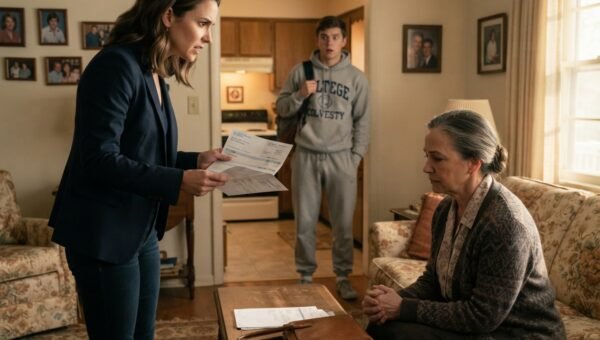
As soon as his tail-lights disappeared down the maple-lined street, I called Clara directly from my landline, telling her in a voice that left no room for argument that she needed to drive to my house immediately if she wanted to see her children before I called the county welfare office. She arrived twenty minutes later, her hair unbrushed and her designer handbag clutched like a shield against her chest, ready to deliver one of her practiced, tearful defenses about how hard her life had become. I did not let her get past the foyer. I walked into the living room, placed the Manila envelope, the cash, the hotel keys, and my copied notes on the coffee table right in front of her, and sat down in my wingback chair. Clara’s face drained of every drop of color until she looked like a ghost standing on my rug, her mouth opening and closing without sound as she looked from the money to the hotel keys.
She tried to stammer out something about misunderstandings and how Arthur was just helping her with a delicate family situation, but I cut her off with a single raised hand. I told her I already knew about the Riverside Motor Inn, the cash handoffs, and the way she had been using her own children as camouflage for whatever illegal business or secret arrangement she and her father were running behind my back. She broke down completely then, collapsing onto the sofa and sobbing into the throw pillows, finally admitting that Arthur had been helping her hide money and property from her abusive ex-husband during the bitter custody appeals. But the relief I expected to feel never arrived, because even if her intentions were rooted in protecting the kids from a dangerous man, she had lied to my face, manipulated my love for my grandchildren, and let an alcoholic drive them down the highway with total disregard for their lives.
ENDING
We sat in that tense, suffocating living room for nearly an hour while Clara poured out a messy, complicated confession involving secret bank accounts, forged affidavits, and Arthur playing the tough guy for a daughter who had lost her way. I listened without interrupting, letting her empty the whole rotten basket onto the floor, but my heart remained as cold and heavy as a stone. When she finally finished and looked up at me with red, pleading eyes, expecting her mother to instantly fold and take up arms beside her, I stood up and walked over to the front door. I told her that she was going to pack the children’s bags, take her cash, and leave my house before Arthur returned from his errand, because I would no longer be a silent accomplice to their reckless lies. I made it crystal clear that if she ever brought the kids back while Arthur was drinking, or if she ever used my home as a staging ground for her secret schemes again, I would hand the entire envelope directly to the family court judge and the state police myself.
Clara stared at me with pure shock, realizing for the first time in her adult life that her mother was no longer a soft cushion she could lean on whenever her choices caught up with her. She packed the children in silence, her hands shaking as she strapped Toby and Lily into the back seat, neither of them looking back as the car pulled out of the gravel driveway for good. Arthur came back ten minutes later, holding a pack of menthols and looking around the empty house with a confused, pathetic expression, asking where everyone had gone. I pointed to the Manila envelope sitting squarely in the middle of the kitchen table and told him to pack his own bags by nightfall, because our forty-two years of marriage ended the moment he put our grandchildren’s lives at risk for a secret that wasn’t even his to keep. He started to yell, trying to pull his usual blustering routine, but I picked up the telephone receiver and dialed the local sheriff’s non-emergency line before he could finish his first sentence.
He stopped dead, stared at me with a look of genuine terror, and walked out the back door toward the shed without another word. Now the house is unnaturally quiet, filled only with the ticking of the grandfather clock in the hall and the sharp, clean smell of bleach as I clean up the rooms. I still worry about my grandchildren every single day, wondering what other messes their parents have dragged them into, but for the first time in my life, I am standing entirely on my own two feet, and nobody will ever use my silence against me again.