The cedar chest in the hallway still smelled faintly of eucalyptus and stale tobacco twelve days after we buried David. I sat on the edge of our mattress in the master bedroom, staring at a folded yellow laundry basket that had been sitting there since Tuesday morning. The house was too quiet. When a man has lived inside the same walls for thirty-four years, his absence does not just feel like silence.
It feels like the air has turned thin and hard to pull into your chest. I kept expecting to hear the heavy thud of his work boots hitting the linoleum in the mudroom at five-fifteen sharp. Instead, there was only the hum of the old refrigerator and the distant barking of a dog down the road.
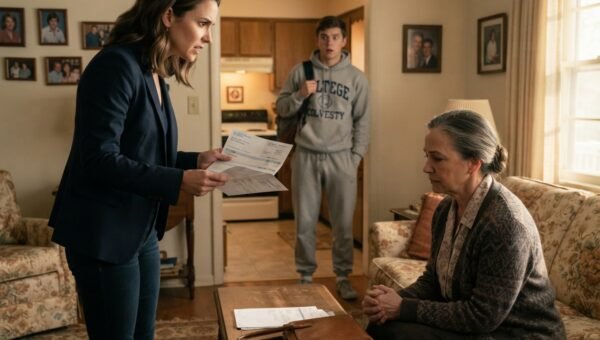
Paul arrived at ten in the morning on a Thursday. He did not call first, which was not like him, or at least not like the son I thought I had raised before he took that job up in Des Moines and started wearing those shiny gray suits with the narrow lapels. He brought a man with him. A man with slicked-back hair and a leather briefcase that looked brand new, smelling faintly of leather conditioner and peppermint oil. I remember wiping my hands on my apron because I was in the middle of cleaning out the pantry shelves when the front door latch clicked.
Paul did not look me in the eye when he stepped past the threshold. He walked straight into the kitchen, his heels clicking hard against the wood floor, and laid a thick manila envelope right on top of the laminate table where David and I had paid our property taxes every November.
“Mom,” Paul said, his voice dropping into that smooth, practiced register he used whenever he was trying to convince a client to sign a bad contract. “We need to talk about the property.”
My youngest daughter, Chloe, was sitting at the end of the counter with a mug of black coffee she had poured twenty minutes ago and barely touched. She looked up from her cup, her eyes red-rimmed from two weeks of crying, and shifted her weight so the wooden stool groaned. “What are you talking about, Paul? Mom is staying right here. This is her house.”
The stranger with the leather briefcase stepped forward, tapping a silver fountain pen against his thigh. He introduced himself as Arthur Vance, an attorney representing Paul’s newly registered interests. He spoke with that crisp, flat confidence that people only have when they think nobody in the room knows enough to question them.
“Actually, Mrs. Miller,” Vance said, sliding a stapled set of heavy bond papers out of the envelope. “Your late husband executed a revised testament just fourteen days prior to his passing. As the primary executor and beneficiary named in this instrument, Paul is taking formal possession of the deed effective immediately.”
The words hit the back of my teeth like cold gravel. I did not drop to my knees. I did not scream. I just stood there with my dishtowel bunched up in my fist, looking at the neat stack of papers. My other son, Tyler, had walked in from the garage by then, wiping grease off his knuckles with a blue shop rag.
He stopped dead in the doorway, his broad shoulders tensing under his flannel shirt.
“A revised will?” Tyler asked, his voice low and dangerous. “Dad couldn’t even hold a spoon fourteen days ago. He was shaking so bad from the morphine he spilled his water half the time.”
“The document is fully witnessed, notarized, and legally binding,” Vance replied, his smile staying fixed in place like something glued to his face. “Mr. Miller was of sound mind. The signature is right here on page four.”
Paul finally looked up at me then. His eyes looked small, darting away toward the hallway clock before settling on my chin. “Dad wanted to make sure things were tidy, Mom. He knew I was the one handling the local accounts. It just makes sense.”
I reached out and touched the paper. The top sheet felt heavy, expensive. My eyes drifted down to the bottom of the fourth page where the signature sat. It was neat. The loops were round and firm, the cross on the T was sharp, and the upward slant of the letters was steady and familiar. It looked exactly like the way David had signed our wedding certificate back in nineteen-eighty-nine. It looked like the way he signed every mortgage check we ever wrote.
“I can help you pack your winter clothes this weekend,” Paul added, his voice dropping an octave as if he were doing me some enormous favor. “We have a moving truck coming Saturday morning.”
My chest felt hollow, like someone had scooped out my ribs with a melon baller. I looked at Chloe, whose mouth was half-open in absolute horror, and at Tyler, who was already taking a slow step toward the table with his fists clenched at his sides. For three long seconds, I genuinely thought about going upstairs and pulling my old suitcases down from the attic. I thought about giving up before I even started. David was gone, the house felt haunted by his absence, and maybe Paul was right. Maybe men change their minds at the end. Maybe grief makes them do strange things.
Then my thumb brushed against the bottom edge of the paper, and something in my head clicked into place with a sharp, ugly snap.
I stopped breathing. The kitchen wall seemed to tilt two inches to the left.
“No,” I whispered.
Paul frowned, shifting his weight. “Mom, don’t make this harder than it has to be. Vance has all the paperwork filed down at the county courthouse already.”
“No,” I said louder this time, my voice flat and cold enough to freeze water. “He didn’t sign this.”
Vance chuckled, a dry, dismissive sound that made Tyler take another half-step forward. “Mrs. Miller, we have a licensed notary who will testify, “
“I don’t give a damn about your notary,” I said, my hands starting to shake, not from sadness, but from a sudden, white-hot fury that surged up from my stomach like acid. “David didn’t sign anything in April. David couldn’t even pick up a coffee mug with his right hand until May.”
The room went entirely dead. Even the refrigerator hum seemed to drop away.
“What are you talking about?” Paul asked, his smooth confidence finally cracking around the edges as a thin line of sweat appeared right above his upper lip.
“The ice storm,” I said, staring straight into his eyes. “The first week of February, when you were up in Minneapolis ignoring our calls. Your father slipped on the black ice by the tractor shed. He shattered his right wrist so bad the bone came right against the skin. He was in a hard plaster cast all the way up to his elbow for eleven weeks. He had to learn how to write his name with his left hand like a first-grader, and even then he couldn’t do it without crying from the nerve pain.”
I reached across the table, picked up page four of the fraudulent will, and held it right under Paul’s nose.
“This is a right-handed signature,” I said. “Every single letter loops to the right with full pressure on the downstroke. My husband spent three months signing his name crooked and left-handed, and two weeks before he died, when he could barely lift his head off the pillow, he miraculously sat down and wrote a perfect, copperplate right-handed signature leaving everything he owned to his most ungrateful child.”
Paul swallowed hard. His Adam’s apple bobbed once, twice. “People recover dexterity, Mom. It happens all the time.”
“Not when the tendons are torn to ribbons,” Tyler growled, stepping right into Paul’s personal space so the lawyer had to take a defensive step backward. “You didn’t even remember the cast, did you, Paul? You were too busy looking at bank statements to remember what Dad went through last winter.”
I didn’t wait for them to argue. I grabbed my car keys off the little magnetic hook by the back door, slipping my canvas jacket over my shoulders without zipping it up.
“Where are you going?” Paul called out, his voice rising in panic as I reached for the handle.
“To see Eleanor Vance,” I said, watching his face drain of color. “And no, Mr. Lawyer, she’s no relation to you.”
Eleanor Vance had been practicing estate law in our county seat for thirty-two years. Her office smelled like old paper, floor wax, and peppermint lozenges, exactly the same as it had when David and I walked in there back in nineteen-ninety-two to draft our original mutual wills. When I pushed open her frosted glass door with the gold-leaf lettering, she looked up from her desk over the top of her half-moon reading glasses, her white hair pulled back into a neat, severe knot.
“Martha?” she said, setting her fountain pen down. “I was so sorry to hear about David. We lost a good one.”
I didn’t sit down. I laid the stapled document flat on her blotter right over her paperwork.
“Eleanor,” I said, my breath coming short. “Paul came to the house this morning with a new will. He says David signed it fourteen days before he passed away. Look at the date on page four. March twelfth.”
Eleanor adjusted her glasses, leaning down so her nose was almost touching the paper. She traced the signature with the tip of her fingernail, her expression growing darker by the second. Then she pulled open her heavy oak desk drawer, hauled out a massive leather-bound appointment ledger from the spring term, and flipped back through the pages with dry, crackling sounds.
She stopped on a page near the middle of March, her finger sliding down a column of handwritten names written in neat, precise ink. She looked up at me, her eyes sharp and clear behind her lenses.
“Your husband was sitting in this office that exact morning,” Eleanor said.
My heart gave a heavy thump against my ribs. “He was here?”
“Evelyn,” Eleanor corrected herself, tapping the ledger. “David came in at ten-fifteen on March twelfth to discuss a minor change to the orchard boundary deed with his brother. He sat right in that green chair across from me for forty-five minutes. And do you know what he spent half that time doing, Martha?”
I shook my head, my throat too tight to speak.
“He was complaining about his hand,” Eleanor said, her voice dropping into a dry, severe tone. “He was trying to sign the boundary release with his left hand because his right arm was still pinned up in that heavy fiberglass cast from his fall on the ice. He dropped my best glass paperweight right on the floor because he couldn’t grip anything properly. It took him three tries just to write his initials.”
She stood up from her chair, walked over to her filing cabinet, and pulled out a manila folder marked with David’s full name. She dropped the actual, genuine boundary release form right on top of Paul’s fake will.
The contrast was like looking at two different species of animal. On Eleanor’s document, the signature was a sprawling, spidery, left-handed scrawl that looked like a spider crawling across ink. On Paul’s document, the signature was crisp, confident, and unmistakably right-handed.
“This is a forgery,” Eleanor said simply, reaching for her telephone. “Shall I call the sheriff, or would you like to handle this in my conference room with your other children present?”
By three that afternoon, the sun had burned through the morning haze, casting long, sharp shadows across our gravel driveway.
Paul was sitting at the kitchen table again, but this time he wasn’t leaning back with that slick smile. He had both elbows planted on the laminate, his face buried in his palms. Arthur Vance, the fancy lawyer from Des Moines, had already packed his briefcase and left twenty minutes earlier, his face the color of sour milk after Eleanor walked into the room with David’s medical discharge papers from the orthopedic clinic and the left-handed boundary release.
“I’ll disbar myself before I touch a fraudulent filing of this magnitude,” Vance had snapped at Paul in the hallway before slamming the front door so hard the kitchen windows rattled in their frames.
Chloe was sitting on the opposite counter, her arms crossed tight over her chest, staring at her older brother like he was a stranger she had found sleeping on the porch. Tyler stood near the back door, his arms folded, chewing slowly on the inside of his cheek.
“How could you do it, Paul?” I asked. I wasn’t shouting. My voice sounded hollow, like wind blowing across an empty silo. “Your father trusted you with the grain accounts. He thought you were the smart one.”
Paul didn’t look up. His shoulders shook once, a small, pathetic shudder. “You don’t know what I owe, Mom. The bank in Ames… they were going to foreclose on the shop by Friday. I needed the equity. I just needed something to hold them off until the harvest loans cleared.”
“So you stole your dead father’s name,” Tyler said, his voice shaking with a cold, controlled rage. “You sat there and wrote a fake piece of paper while his body wasn’t even cold in the ground yet, trying to throw Mom out on the street.”
“I was going to pay it back,” Paul whispered into his hands. “I swear to God, I was going to refinance and put the deed back in her name once things settled down.”
“Liar,” Chloe said quietly.
I didn’t yell at him. Yelling implies there is still some bridge left worth crossing, and right then, looking at the way his expensive jacket was creased at the elbow, I knew the bridge was gone. There are some things you can fix with a hammer and some wood, and there are some things that break so clean they never go back together.
“You’re going to pack your things and go back to Des Moines tonight, Paul,” I said, my voice steady and hard as iron. “You are going to call that bank yourself and tell them the truth, or Eleanor will do it for you with the sheriff sitting beside her. But you are never coming back to this house pretending to be something you’re not.”
He didn’t argue. He didn’t have anything left to say. He stood up slowly, his head down, and walked out the back door without looking back once, his car keys jingling softly in his trembling hand.
When the sound of his tires crunching down the gravel driveway finally faded away into the afternoon silence, the house seemed to settle back into its old bones.
I walked over to the kitchen table, picked up the original estate papers that Eleanor had handed back to me, and carried them toward the window. The sun was dipping low behind the ridge, throwing a long, golden light across the vegetable garden David had spent forty summers tending with his own two hands.
I sat down in his old wooden chair at the head of the table, running my fingers over the worn, familiar grain of the wood where his elbows had rested every evening of our married life. The papers in my hand listed all three children equally, just the way he had wanted it, just the way we had agreed on a rainy Tuesday afternoon back when the world made sense.
I looked out at the garden until the light turned purple and the first evening stars came out over the ridge, and for the first time in three weeks, the silence in the house didn’t feel heavy at all.