The envelope from the credit union came on a Tuesday, right between the electric bill and a circular for discount roofing. I remember pulling it out of the metal box because the corner was dog-eared, the kind of fold you get when a mail carrier jams something too fast into a narrow slot. Arthur was still out at the garage, scraping old paint off the cedar shutters he had taken down the weekend before.
I walked inside, dropped my keys on the counter by the toaster, and tore the top off with my thumb.
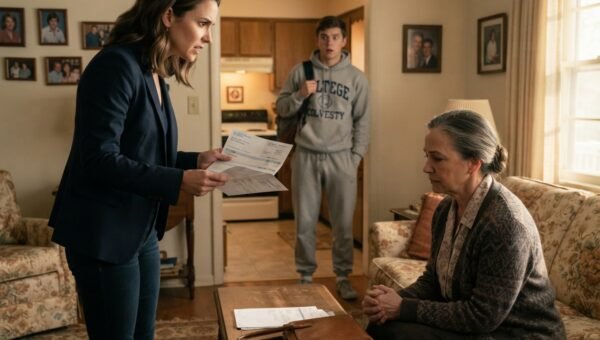
We had been married twenty-eight years last Tuesday. You don’t look at joint statements like a detective when you have lived with someone that long. You scan the big numbers, you check the grocery total to make sure nobody ran up forty dollars on lottery tickets at the Texaco, and you toss the paper into the recycling bin under the sink. But our anniversary was coming up, and Arthur had been acting stiff around the kitchen table ever since the first frost. He kept clearing his throat when I walked in, folding the newspaper into neat quarters, hiding his phone screen under a napkin whenever the little chime went off.
I saw the line item halfway down page two.
It was an online charge from the jeweler down on Elm Street.
Four hundred and twelve dollars, even. I remember staring at the numbers until the black ink seemed to float off the white paper like little ants. Four hundred and twelve dollars was more than we spent on groceries in two weeks. It was more than the deductible on my car insurance.
I set the paper down on the laminate counter and walked over to the sink to run the cold tap, just to hear something besides the blood rushing in my ears. Three weeks before our anniversary. He had looked me right in the eye on Sunday morning over a plate of scrambled eggs and said we needed to watch every penny until the property tax cleared in November.
“Money is just too tight right now, Rae,” he had said, wiping his mouth with a paper napkin. “We will do dinner at home. A nice roast. Just the two of us.”
And then I remembered the Thursdays.
For nearly three months, Arthur had been coming home forty minutes late every Thursday evening. Not every night, just Thursdays. He would walk through the back door with his coat collar turned up against the wind, smelling faintly of nothing at all, which somehow felt worse than smelling like grease or sawdust. When I asked him how the parts run went, he would just nod, hang his jacket on the peg by the door, and ask what was for supper.
I told myself I was being foolish. I told myself that men don’t suddenly start having affairs at fifty-four years old after twenty-eight years of growing winter squash in the backyard and grumbling about the knee-wall in the basement. But I checked the location-sharing app on my phone anyway. I hated myself for doing it. My thumb hovered over the little blue dot for three whole minutes before I pressed it down, my hand shaking so hard I dropped the phone against the edge of the kitchen table with a dull crack.
The blue dot wasn’t at the parts warehouse on Route 9. It was sitting still in a gravel parking lot four miles past the county line, right next to a brick building with a sign that said Cedar Creek Community Services.
I didn’t say a word to him that night. I didn’t say anything on Wednesday either. I just watched him move around the house like a ghost, his shoulders slightly rounded, his old flannel shirt hanging loose on his ribs. He looked tired. Not the tired of a man working twelve hours on a tractor, but the tired of someone carrying a wet sack of cement up a long hill. Every time he caught me looking at him, he would look away toward the window, pretending to watch the crows scatter across the frost-heaved corn stubble.
On our anniversary, the sun came up white and cold, the kind of morning where the frozen weeds look like broken glass in the ditches. Arthur made coffee. He set my mug down on the table with both hands, the way he always did when he was trying to be gentle.
“Happy anniversary, Rae,” he said softly.
I looked right at him, my coffee growing a skin on top while I waited for him to say something else. He didn’t. He just stood there with his hands in his pockets, waiting for me to take a sip.
“Where is the bracelet, Arthur?” I asked.
My voice didn’t shake. That surprised me. It came out flat and dry, like someone dropping a shingle onto a pile of scrap wood.
Arthur didn’t jump. He didn’t drop his mug. He just closed his eyes for a second, a very long second, and let out a breath that smelled faintly of peppermint and cheap tobacco.
“You saw the statement,” he said. It wasn’t a question.
“I saw four hundred and twelve dollars to Miller’s Jewelry,” I said, standing up so fast my chair legs scraped a loud groan across the linoleum. “And you told me we couldn’t afford new tires for the truck. You told me we had to pinch every nickel until winter. Who got the bracelet, Arthur? Is there someone else? After twenty-eight years, are you really doing this?”
He didn’t yell back. He just walked to the entryway, picked up my heavy winter coat off the hook, and held it out toward me.
“Get in the car, Rae,” he said. His voice was too quiet, steady in a way that made my stomach turn over. “I am not going to explain it across the kitchen table. Just get in the car.”
“I am not going anywhere until you tell me who she is,” I said, my hands clenched into fists in the pockets of my apron.
“Nobody is who you think,” he said, and for the first time I saw something raw and terrified in the corners of his eyes. “Get your coat. We have to go right now, or visiting hours are going to close before we get through the gate.”
I didn’t move for a long time. Every instinct I had told me to stay right there in the kitchen, lock the back door, and pretend none of this was happening. But the look on his face wasn’t the look of a guilty man caught in a lie. It was the look of a man who had been dreading a reckoning for ninety days.
“If this is a joke,” I muttered, grabbing the coat from his hands, “I swear to God, Arthur.”
The drive took twenty-four minutes. Neither of us said a word. I stared out the passenger window, watching the bare oak trees blur past in the pale morning light, my fingers digging into the hem of my sweater until the wool felt like wire. We turned off the paved highway onto a narrow asphalt lane that wound down behind the old county fairgrounds, past a row of skeletal maples and a weathered sign that had fallen half-sideways into a patch of dead briars.
Cedar Creek Rehabilitation Center.
The building was yellow brick, built back in the seventies during the state hospital expansion, with small tinted windows that looked like they hadn’t been washed since the Reagan administration. A few people in gray sweatsuits were shuffling across the frozen lawn near a metal picnic table, their hands stuffed deep into their pockets against the wind.
Arthur killed the engine. The heater fan gave a dry little tick-tick-tick before it died down.
“Why are we here?” I asked, my voice barely louder than the wind against the windshield.
“Because I couldn’t fix it by myself,” Arthur said. He kept both hands on the steering wheel, staring straight ahead at the brick wall by the entrance. “And because you deserved to know three months ago, but I didn’t have the stomach to break you in half until I had something to show for it.”
“Arthur, what are you talking about?”
“Come on,” he said, opening his door.
The lobby smelled like floor wax and instant coffee that had been sitting on a hot plate since six o’clock. A receptionist behind a high glass partition didn’t even look up when the buzzer let us through the inner door. We walked down a narrow hallway with green-painted cinderblock walls until we reached the common room at the end of the wing.
There were six or seven plastic chairs, a scarred laminate table with a puzzle missing half its border, and a small television bolted to the ceiling playing a morning talk show with the sound turned off. A woman was sitting by the radiator, her legs pulled up onto the seat of her chair, staring down at her wrists.
She was wearing a thick gray cardigan that was too big for her shoulders, her hair cut short in a ragged, uneven bob that looked like it had been done with kitchen shears. But it wasn’t the hair. It was the way her left earlobe turned up at the corner, exactly like our father’s, a little notch of flesh that none of the rest of us ever inherited.
My breath caught in my throat. I took one step backward until my shoulder hit the green cinderblock wall.
“No,” I whispered. “No, that’s not, “
She looked up when our shoes squeaked on the tile.
Her eyes were sunken, dark shadows pooled beneath them like bruised fruit, but the blue of them was unmistakable. It was the same blue that had looked back at me from the bathroom mirror every morning of my childhood until the day the house on Mulberry Street was sold off for back taxes.
On her left wrist, catching the harsh fluorescent light from the overhead tube, was a thin band of braided silver.
Four hundred and twelve dollars.
“Rae?” she said.
Her voice was rough, like gravel being dragged across a shovel, but the name came out clear enough to knock the wind right out of my lungs.
Thirty years. Ten thousand nine hundred and fifty days since the night she packed a red canvas gym bag, slammed the screen door until the glass rattled in its frame, and walked down the gravel driveway into the dark without leaving a forwarding address. My little sister. The one Mother had wept over into her apron until the day the old woman stopped speaking entirely.
“Clara?” I choked out, my hands flying up to cover my mouth.
She didn’t get up. She just sat there in that oversized gray cardigan, her hands trembling as she reached into the deep pocket of her sweater and pulled out a folded piece of lined yellow paper.
“He found me,” Clara said, nodding her head once toward Arthur. “Back in August. I was in the county lockup over in Jefferson on a possession charge, and he showed up on a Tuesday morning with a lawyer and a box of clean socks. I didn’t even know he knew my name.”
Arthur stood beside me, his hands jammed into his jacket pockets, staring down at the scuffed linoleum between his boots.
“She was living in a lean-to behind the old lumberyard down by the river,” Arthur said, his voice rough and low. “A guy from the feed store mentioned seeing someone who looked like you back in July. I went down there to check it out. Took me three Thursdays just to find her hiding out in the brush. She wouldn’t come near the house. She said you wouldn’t want her track marks tracked across your clean floors.”
I couldn’t look at him. I couldn’t look away from Clara either.
“The bracelet,” I managed to say, the words tasting like dry ash. “The charge on the card…”
Clara looked down at her wrist, her thumb tracing the silver links with a slow, mechanical motion. “I told him I didn’t want any charity. I told him I wasn’t worth the gas he was burning to come see me. But he came every Thursday anyway. And when I hit ninety days clean last week, he showed up with this. He said it was an anniversary gift from both of us, to remind me I wasn’t a ghost anymore.”
She held out the yellow paper. It was folded into a tight square, the edges soft and worn from being carried in a pocket for a very long time.
“Mom left this before she died,” Clara whispered. “She kept it in the Bible on the nightstand. She knew where I was, even if you guys didn’t. She told me to give it to you when the time was right.”
I took the paper from her hand. My fingers brushed against hers; her skin felt thin and dry like parchment paper left out in the sun. I unfolded it under the harsh yellow light of the hallway.
Mother’s handwriting was spidery and shaky, the ink bleeding slightly into the cheap pulp of the pad where her hand had rested too long.
*If you ever find her, don’t let her go the way we did. We were too proud to ask for help, and now the house is empty.*
I stood there in the middle of that linoleum hallway for a long time, the paper shaking between my fingers, while the television on the ceiling flickered through a commercial for laundry detergent with no sound at all.
Arthur didn’t say anything. He didn’t ask me to forgive him for the secret, or for the money, or for the Thursdays he spent driving forty miles south while I sat at home wondering if my marriage was rotting from the inside out. He just reached out and took my cold hand in his, his palm rough and warm against my knuckles.
“Happy anniversary, Rae,” he said softly.
We didn’t go back to the kitchen table for hours. We sat on a wooden bench outside in the thin midday sun, the three of us together on the edge of the gravel parking lot while the wind whipped the dry brown grass around our ankles, holding an old letter that had waited thirty years to find its way home.